
Research Symposium
26th annual Undergraduate Research Symposium, April 1, 2026
Nivaya Montoya Poster Session 3: 1:45 pm - 2:45 pm / Poster #141

BIO
Nivaya Montoya is an undergraduate student at Florida State University pursuing a Bachelor of Science in Behavioral Neuroscience with a minor in Chemistry on the pre-medical track. Her academic interests center on the intersection of neuroscience, communication, and developmental disorders, with a particular focus on autism spectrum disorder and language development.
Through the Florida State University Undergraduate Research Opportunity Program (UROP), Nivaya has worked under the mentorship of Ashley Sellers, MS, CCC-SLP, contributing to a systematic review and meta-analysis examining caregiver-mediated interventions and verbal speech outcomes in autistic children. Her work has involved screening studies for inclusion, evaluating inter-rater reliability, and assisting in the early stages of data synthesis for the project.
In addition to her research involvement, Nivaya is actively engaged in student leadership and campus community initiatives at Florida State University. She is passionate about expanding access to evidence-based interventions that support communication development and improve quality of life for individuals with developmental disabilities.
Following graduation, Nivaya plans to pursue medical training with the goal of becoming a physician and contributing to research and clinical care that advances understanding of neurological and developmental conditions.
Verbal Speech Outcomes of Caregiver-Mediated Interventions for Autistic Children: A Meta-Analysis
Authors: Nivaya Montoya, Ashley SellersStudent Major: Behavioral Neuroscience
Mentor: Ashley Sellers
Mentor's Department: Communication Disorders Mentor's College: College of Communication and Information Co-Presenters:
Abstract
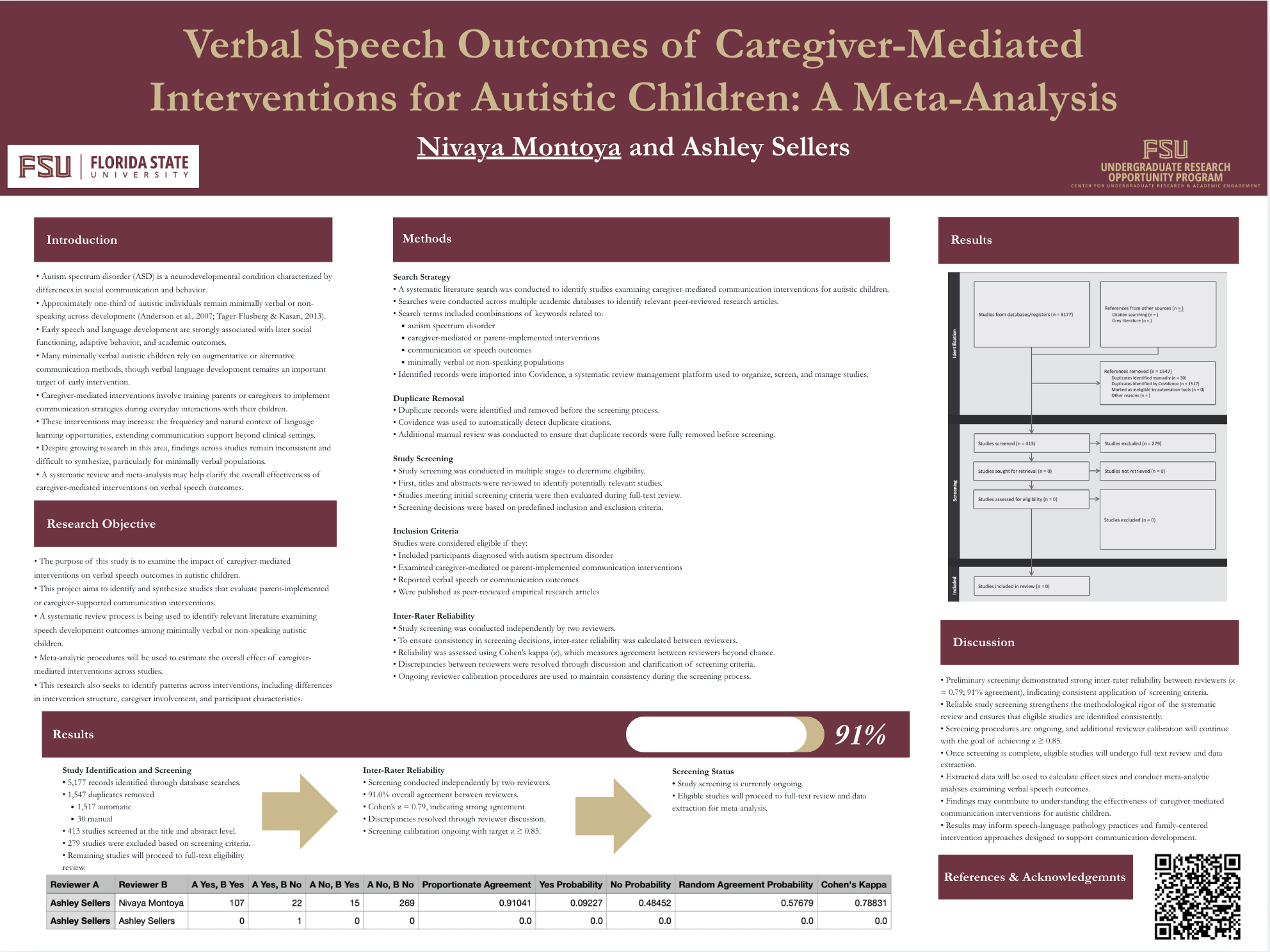
Many autistic children remain minimally verbal, and early speech abilities strongly predict later communication and adaptive outcomes. This project examines whether caregiver-mediated interventions support verbal speech development, including both pre-linguistic vocalizations and spoken language, through a meta-analysis of peer-reviewed and grey literature in which caregivers serve as intervention agents. Study characteristics and effect sizes are extracted and analyzed using random-effects models to evaluate overall intervention effects and moderators such as caregiver involvement methods, intervention framework, and participant characteristics. Expected findings suggest caregiver-mediated interventions positively influence verbal speech outcomes, though effects may vary across intervention and study characteristics. These results will inform clinical practice and future research by identifying effective caregiver-mediated strategies and supporting developmentally sensitive approaches for minimally verbal and non-speaking autistic children.
Keywords: autism, meta-analysis, caregiver-mediated, speech