
Research Symposium
26th annual Undergraduate Research Symposium, April 1, 2026
Jo Fernandez-Jenkins Poster Session 3: 1:45 pm - 2:45 pm / Poster #35

BIO
Jo Fernandez-Jenkins is a freshman Biological Sciences major with minors in Chemistry and Psychology at Florida State. She's part of FSU's Honors Program, Tri-Beta Biological Honor Society, and Spoonbill Society. She loves birds and behavior, and she focused her research on better understanding the complexities of Lance-tailed Manakin courtship through machine learning with the guidance of Dr. Emily DuVal and the DuVal Lab DeepLabCut team. After graduation, she hopes to gain a PhD in Wildlife Biology and continue to contribute to our understanding of why birds do what they do.
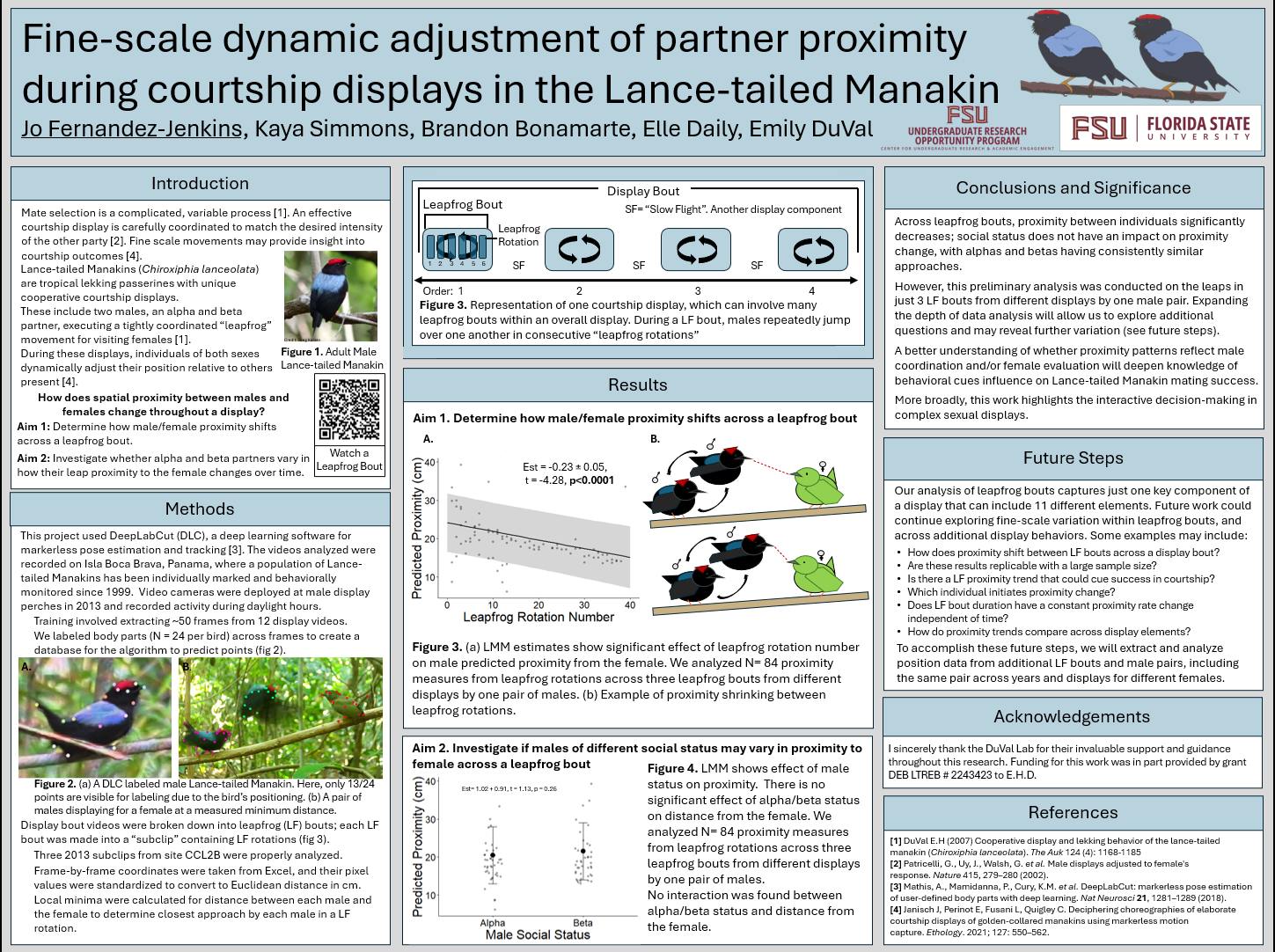
Fine-scale dynamic adjustment of partner proximity during courtship displays in the Lance-tailed Manakin
Authors: Jo Fernandez-Jenkins, Emily DuValStudent Major: Biological Science
Mentor: Emily DuVal
Mentor's Department: Biological Sciences Mentor's College: Arts and Sciences Co-Presenters:
Abstract
Mate selection is a complicated, variable process. Lance-tailed Manakins (Chiroxiphia lanceolata) are small, tropical passerines that perform unique cooperative courtship displays. These consist of two males, an alpha and beta partner, executing a tightly coordinated “leapfrog” movement in front of visiting females. During these displays, both sexes dynamically adjust their position relative to each other’s fluctuations. Here I investigate how spatial proximity between males and females changes throughout the display, and whether these distance patterns are correlated with the likelihood of copulation. Because manakin displays depend on coordination, spatial proximity may provide further insight into what can lead to successful courtship. Using DeepLabCut, an AI pose-estimation and tracking software, I will analyze at least ten recorded display bouts. For each bout, I will extract frame-by-frame coordinates for all individuals, identify all local minimum distances during each leapfrog sequence, and quantify how proximity changes across time using regression models. I will test whether distance consistently decreases within a single leapfrog bout or consistent in a leapfrog bout but “steps down” with each successive leapfrog across an overall display, and what may characterize successful displays. I will also evaluate whether male or female movements dictate these inter-individual distances using a logistic regression to assess whether closer displays are more likely to end in copulation. A better understanding of whether proximity patterns reflect male coordination and/or female evaluation will deepen knowledge of behavioral cues influence on Lance-tailed Manakin mating success. More broadly, this work highlights the interactive decision-making in complex sexual displays.
Keywords: Biology, ComputerScience, Birds, MachineLearning