
Research Symposium
26th annual Undergraduate Research Symposium, April 1, 2026
Kristen Cavanagh Poster Session 2: 10:45 am - 11:45 am / Poster #260

BIO
Kristen Cavanagh is a first-year student at Florida State University. She is pursuing a degree in English, with a minor in religious studies. As a member of UROP, Kristen is studying representations of Christian evangelization through postcards, an under-represented cultural artifact, alongside her mentor Dr. Michael Neal. In her academic life, she is passionate about the interaction between religion and literature, with a specific focus on the influence of Catholicism. As a recipient of the Tyler Grant Fellowship, Kristen plans to study the resurgence of Catholicism among English youth in Oxford. She hopes to integrate this research into her Honors-in-the-Major project, which will examine Catholic novels as a literature of protest during the modernist period. Ultimately, Kristen aspires to attain a graduate degree in religious studies, where she can combine her love for religion and literature.
Postcard Representations of Proselytization
Authors: Kristen Cavanagh, Dr. Michael NealStudent Major: English: Literature, Media, and Culture
Mentor: Dr. Michael Neal
Mentor's Department: English Mentor's College: College arts and sciences Co-Presenters:
Abstract
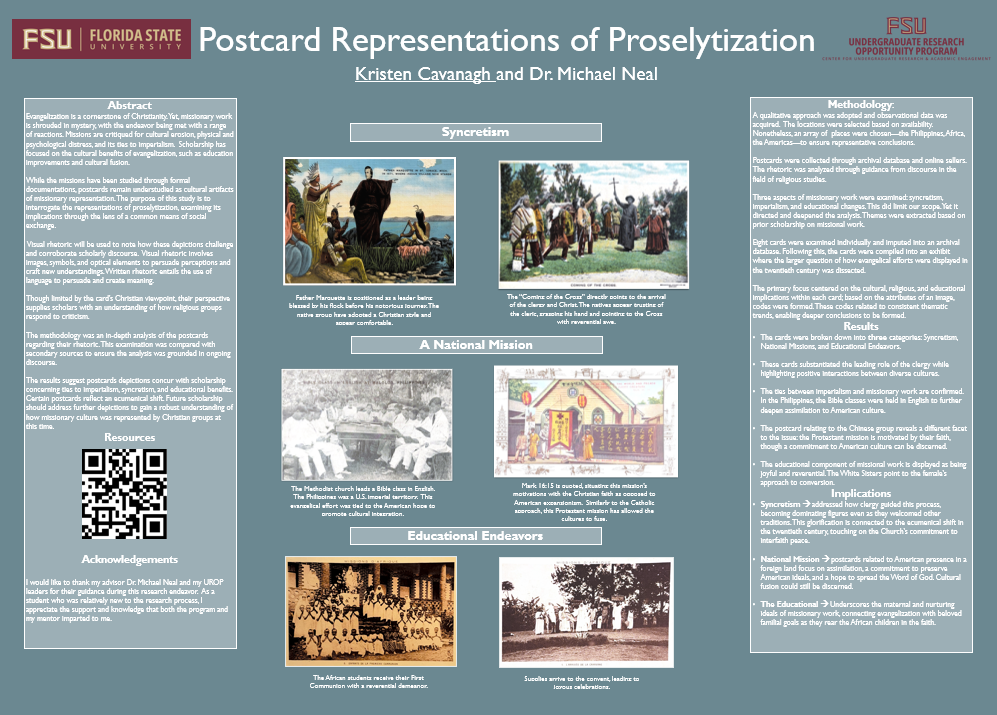
This study aims to understand how twentieth century postcards depict Christian missions. Through establishing the relationship between postcards and missionary work, one can grasp a unique facet of religious missions. With the twentieth century social movements, proselytization was critiqued for various reasons: cultural erosion, physical and psychological distress, and their ties to imperialism. However, scholarship has focused on the cultural benefits of evangelization, such as education improvements, health advancement, and cultural fusion. The purpose of this study is to interrogate representations of proselytization, examining its implications through the lens of a form of social exchange—postcards. Thus, this addresses a gap in scholarship. While these cards reflect the viewpoint of the Christians producing the cards, their perspective supplies scholars with an understanding of how religious groups respond to the waves of criticism while enabling researchers to grasp the nature of these missions through a distinct perspective. My methodology was an in-depth analysis of the postcards regarding their visual and written rhetoric. This examination was compared with secondary sources to ensure the analysis was grounded in ongoing discourse and well-established scholarship. The results suggest that postcards depictions appear to concur with scholarship concerning ties to imperialism, syncretism, and educational benefits. It was concluded that despite the biases within the cards, a nuanced perspective could be extracted. Finally, certain postcards reflect the ecumenical shift in the twentieth century. Future scholarship should address further depictions to gain a robust understanding of how missionary culture was represented by Christian groups at this time.
Keywords: Religion, Missionary, Postcard, and Representation