
Research Symposium
26th annual Undergraduate Research Symposium, April 1, 2026
Domenica Jaramillo Poster Session 1: 9:30 am - 10:30 am / Poster #263

BIO
Domenica Jaramillo is a first-year biochemistry student at Florida State University with a strong interest in chemistry and biomedical science. She is proud to represent the FSU Honors Program and the professional chemistry fraternity Alpha Chi Sigma. Through her current research experience, she has begun developing hands-on wet-lab skills while investigating biochemical processes related to human health and disease. Her work focuses on understanding how molecular interactions influence physiological processes, particularly in systems related to blood coagulation and cellular responses. Domenica enjoys the problem-solving and discovery involved in laboratory research and values the opportunity to contribute to projects that explore unanswered questions in biomedical science.
Looking ahead, Domenica hopes to continue expanding her research experience throughout her undergraduate career while deepening her understanding of the connections between fundamental biochemistry and clinical medicine. She is especially interested in research that merges laboratory science with real-world medical applications. Ultimately, she plans to pursue a career in both scientific research and medicine, where she can contribute to advancing healthcare through innovation, discovery, and the development of more effective treatments for patients.
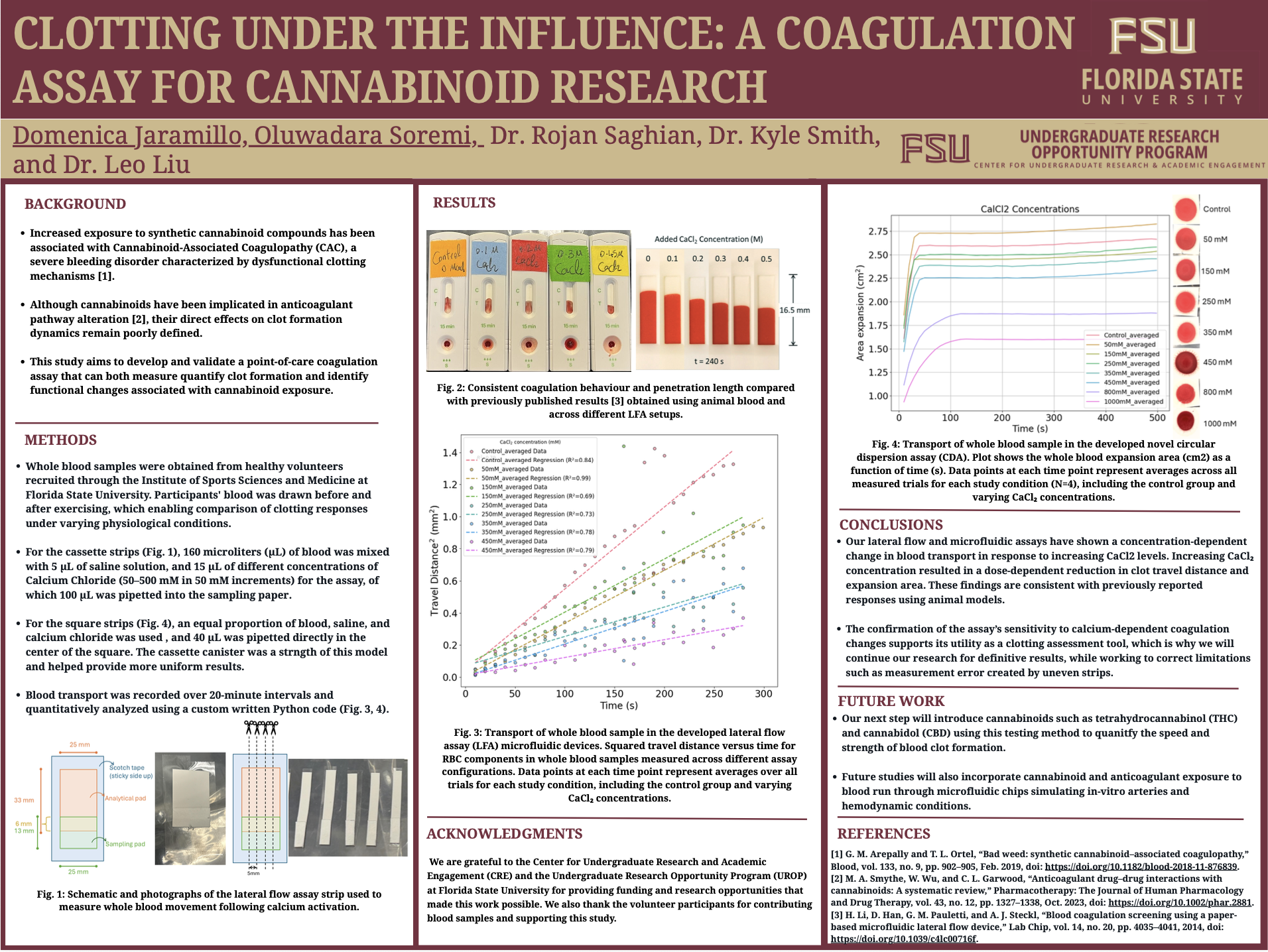
Clotting Under the Influence: A Coagulation Assay for Cannabinoid Research
Authors: Domenica Jaramillo, Dr. Rojan SaghianStudent Major: Biochemistry
Mentor: Dr. Rojan Saghian
Mentor's Department: Chemical and Biomedical Engineering Mentor's College: FAMU-FSU College of Engineering Co-Presenters: Oluwadara Soremi
Abstract
Cannabinoid-Associated Coagulopathy (CAC), a bleeding disorder linked to the use of synthetic cannabis, has seen a recent surge in cases that indicates an urgent need for rapid and personalized tools to assess coagulation risks. This research aims to investigate the clinical implications of CAC and help develop a point-of-care coagulation assay that can measure a patient’s clotting capacity and detect changes in anticoagulant therapy efficacy brought about by cannabinoid exposure.
A lateral-flow-based microfluidic technique, designed to simulate blood flow conditions that favor clotting, was used. Different concentrations of calcium chloride and protamine are the established methods utilized in controlling coagulation in citrate and heparinized blood samples. Samples of the blood were transferred onto the lateral flow assays to be analyzed by the length taken up on each strip and their area expansion over a certain time interval.
Consistent coagulation behavior throughout the trial’s results showed the length that the blood traveled and their circular area expansion decreased as the coagulant concentration increased over a set time span. Considering the viscosity of blood changes with its coagulation ability, the distance area blood travels is directly related to clotting rate. The clear CBD-dependent anticoagulation was seen in both heparinized and citrated blood neutralized with their respective counterparts.
This study’s findings aim to investigate the interaction between cannabinoids such as cannabidiol (CBD) and tetrahydrocannabinol (THC) and blood coagulation behavior.
Keywords: Coagulation, Cannabinoid, Blood, Assay, Anticoagulant