
Research Symposium
26th annual Undergraduate Research Symposium, April 1, 2026
Justin Bolt Poster Session 2: 10:45 am - 11:45 am / Poster #76
BIO
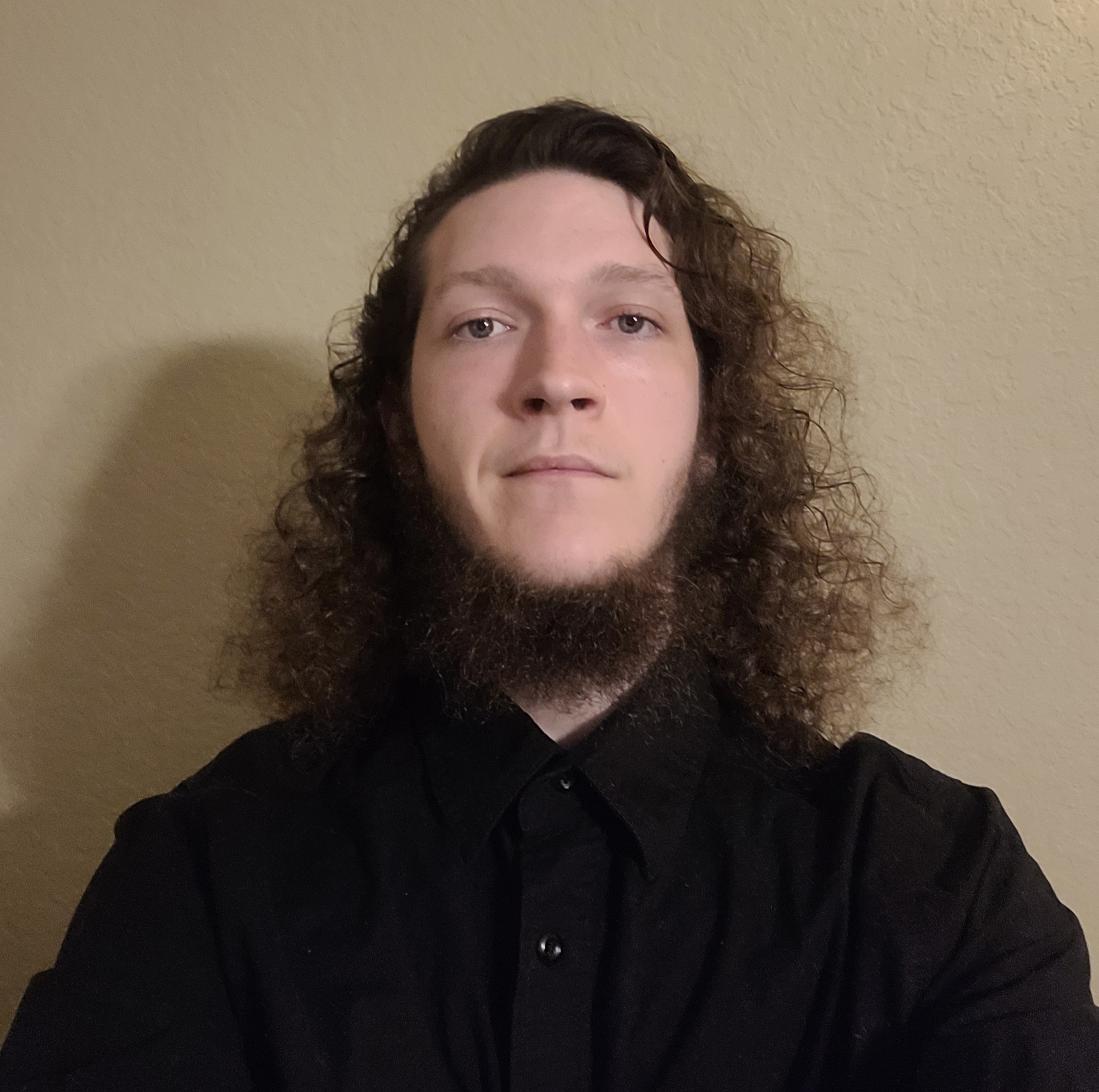
Justin Bolt is a senior striving towards a Bachelor of Science in Biochemistry. Justin transferred to Florida State from Tallahassee State College with an Associate in Arts Degree presented with honors. During his time at TSC, Justin participated in the TSC Undergraduate Research Symposium twice working under Dr. Renee Gordon (2024) and Dr. Joseph McNeil (2025). During the Summer of 2024, Justin was presented with the HBCU-RISE scholarship, granting a summer REU under the guidance of Dr. Natalie Arnett at the FAMU-FSU College of Engineering. In his spare time, Justin plays the tuba for the Capital City Band of TSC as well as the First Baptist Church Chamber Players Orchestra, where he continues to grow in his 13 years of performance experience. Justin Bolt wishes to dive into a Doctoral Program following his graduation to study the industrial commercialization of organic polymers as a replacement material to plastic for consumer goods.
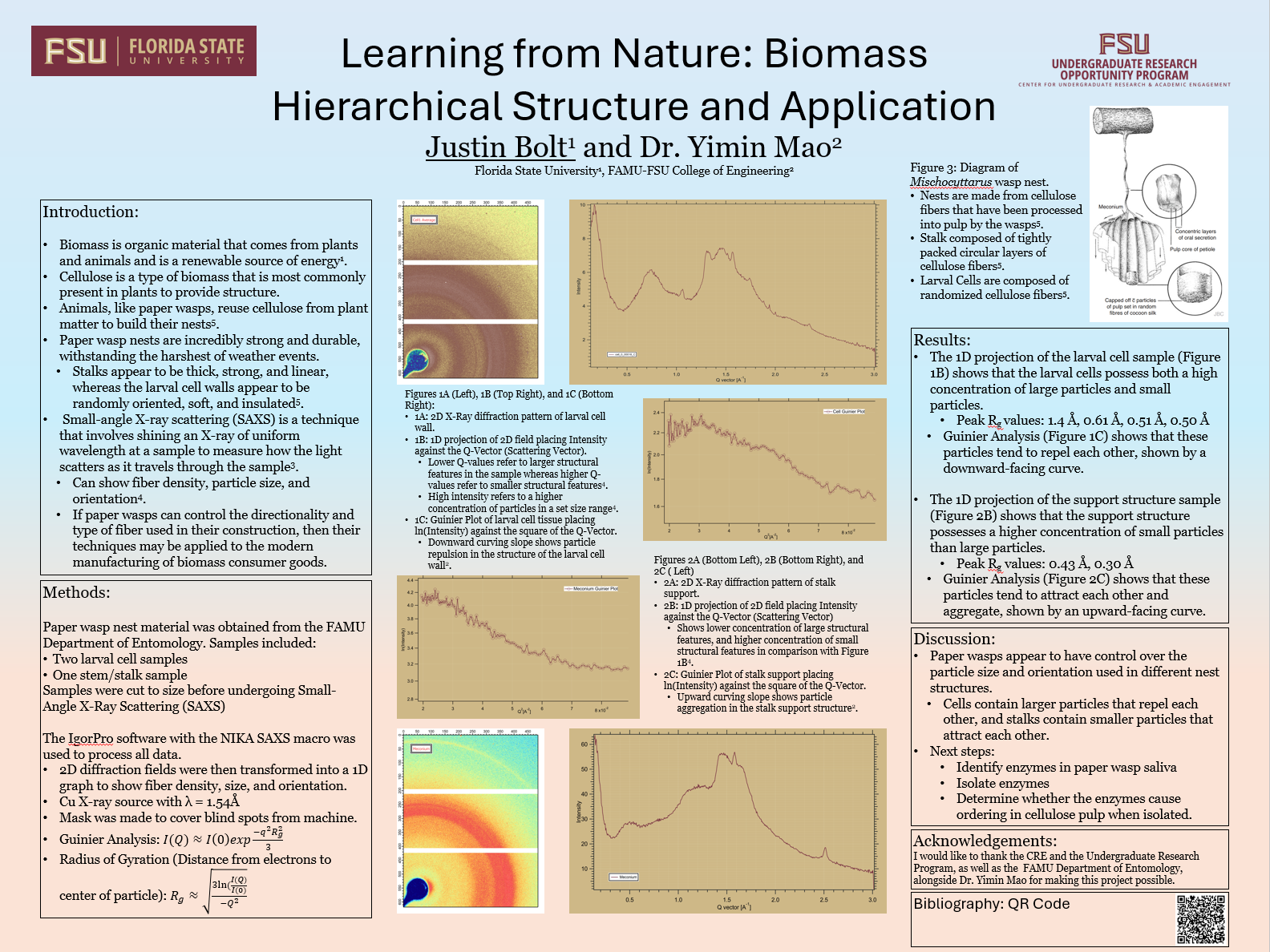
Learning From Nature: Biomass Hierarchical Structure and Application
Authors: Justin Bolt, Dr. Yimin MaoStudent Major: Biochemistry
Mentor: Dr. Yimin Mao
Mentor's Department: Chemical & Biomedical Engineering Mentor's College: FAMU-FSU College of Engineering Co-Presenters:
Abstract
The natural world has always been a point of interest for researchers and engineers alike, bringing innovation in unexpected forms. But what about paper wasps? Paper wasps are social creatures that tend to make large nests out of cellulose from specific plants that live near them. These nests are strong, durable, weather-resistant, and incredibly light. Understanding how wasps make these nests could yield innovative ideas that improve our daily lives, from cheaper, more durable housing to alternative materials for consumer goods. Unfortunately, biopolymers such as cellulose can be difficult to utilize once they have been deconstructed to their monomers due to the crystal structures forming with random orientations. Wasps seem to have control over this event, begging the question. How do wasps control the structure of cellulose during the creation of their nests? To better understand the structure of paper wasp nests, samples were taken from both the larval cells and the stalk of a paper wasp nest. Wide-angle X-ray scattering was then performed on the samples to examine the crystal orientation and to determine whether the cells share the same structure as the stalk. It was found that, while the fibers in the cells were mostly randomly oriented, the fibers in the stalk were more ordered. This means that the wasps specifically designed the stalk to be stronger than their cells by aligning the fibers into unidirectional polymer strands. Understanding this phenomenon is the key to utilizing biopolymers as a sustainable replacement for unsustainable goods.
Keywords: Biopolymer, Renewable, Biomaterial, X-Ray, Scattering