
Research Symposium
26th annual Undergraduate Research Symposium, April 1, 2026
Evan Peterson Poster Session 4: 3:00 pm - 4:00 pm / Poster #260

BIO
Evan Peterson is a first-year Honors student at Florida State University pursuing a Bachelor of Science in Biology with a minor in Chemistry. Specialized in the Ecology, Evolutionary Biology, and Environmental Science track, Evan’s research background began with analyzing food insecurity trends and impacts for a nonprofit in his hometown near Cleveland, Ohio. Driven by this early meaningful experience, he sought to apply his research interests to the fields of biology and environmental science. Currently, he works under the mentorship of Dr. Shahin Alam to investigate the spatial distribution of per- and polyfluoroalkyl substances (PFAS) in Florida’s aquatic environments. His work utilizes predictive modeling to identify public water systems potentially vulnerable to contamination and inform environmental management. Following graduation, Evan intends to continue environmental research and pursue a career in conservation biology. Moving forward, his long-term career objective is to continue bridging the gap between scientific study and impactful environmental protection.
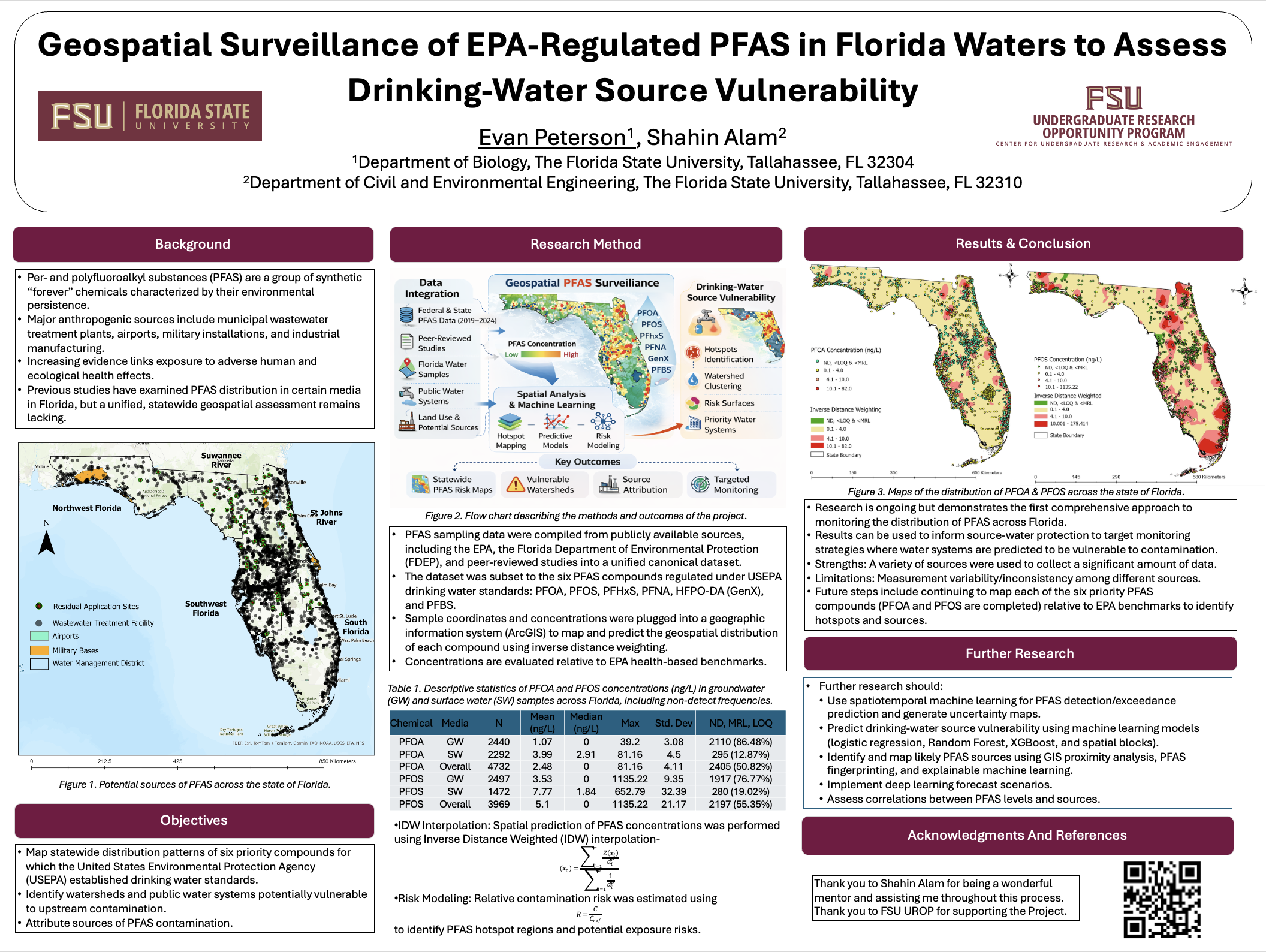
Geospatial Surveillance of EPA-Regulated PFAS in Florida Waters to Assess Drinking-Water Source Vulnerability
Authors: Evan Peterson, Shahin AlamStudent Major: Biological Science
Mentor: Shahin Alam
Mentor's Department: Department of Earth, Ocean and Atmospheric Science Mentor's College: Florida State University Co-Presenters:
Abstract
Per- and polyfluoroalkyl substances (PFAS) are persistent synthetic chemicals widely detected in aquatic environments. In 2024, the U.S. Environmental Protection Agency (EPA) established national drinking water standards for six PFAS compounds: PFOA, PFOS, PFHxS, PFNA, HFPO-DA (GenX), and PFBS, underscoring the need to evaluate upstream contamination threatening drinking-water supplies. Although PFAS have been reported in Florida water bodies, a unified statewide geospatial assessment linking multiple datasets with predictive modeling is lacking. This study integrates PFAS concentration data collected since 2019 from federal, state, and peer-reviewed sources to construct a statewide database of EPA-regulated PFAS in Florida waters. Geographic attributes were standardized and enriched using GIS to assign watershed boundaries (HUC) and proximity to contamination sources and public water system intakes. Concentrations were evaluated relative to EPA drinking-water health benchmarks to assess source-water vulnerability rather than regulatory compliance. Spatial analyses identified contamination hotspots and watershed-level clustering patterns. Machine learning models (logistic regression, XGBoost, and random forests) were developed to estimate the probability of PFAS detection and benchmark exceedance as functions of land use, hydrological context, and proximity to anthropogenic sources, with validation using spatial cross-validation. Results reveal heterogeneous spatial distributions of EPA-regulated PFAS across Florida, with higher detection frequencies and exceedance probabilities near urban areas, airports, and wastewater infrastructure. Predictive risk surfaces highlight watersheds and public water systems potentially vulnerable to upstream contamination. This study provides an integrated, geospatially explicit framework for statewide PFAS surveillance in Florida and demonstrates how drinking-water health benchmarks can inform source-water protection and targeted monitoring.
Keywords: Florida PFAS Geospatial Modeling, Watershed Contamination