
Research Symposium
26th annual Undergraduate Research Symposium, April 1, 2026
John Gardner Poster Session 4: 3:00 pm - 4:00 pm / Poster #88

BIO
John Gardner is a first-year student pursuing a Bachelor of Science in Finance. He is a Presidential Scholar and member of the Honors Program, where he focuses on developing strong analytical and research skills related to economics, data analysis, and financial systems.
Gardner is currently conducting undergraduate research analyzing public transit efficiency in Tallahassee, Florida. His project examines whether bus stop service frequency aligns with observed ridership demand by integrating GTFS transit schedule data with stop-level ridership counts. Using tools such as QGIS and Excel, he maps patterns of service supply and passenger demand across the transit network and classifies stops into efficiency categories to identify potential mismatches in resource allocation. Through this work, he has developed skills in spatial analysis, data organization, and quantitative evaluation of infrastructure systems.
His research is conducted under the mentorship of Dr. Jelly Li, who has guided the development of the project’s research design and analysis. Kelly Grove also assisted Gardner by helping organize the project’s datasets and introducing him to the basics of using QGIS for spatial analysis.
Looking ahead, Gardner plans to pursue opportunities in finance and economic analysis, with particular interests in data-driven investment strategies and the evaluation of infrastructure and public systems.
Evaluating Bus Stop Efficiency in Tallahassee
Authors: John Gardner, Ziyue (Jelly) LiStudent Major: Finance
Mentor: Ziyue (Jelly) Li
Mentor's Department: FSU-FAMU College of Engineering Mentor's College: Florida State University Co-Presenters:
Abstract
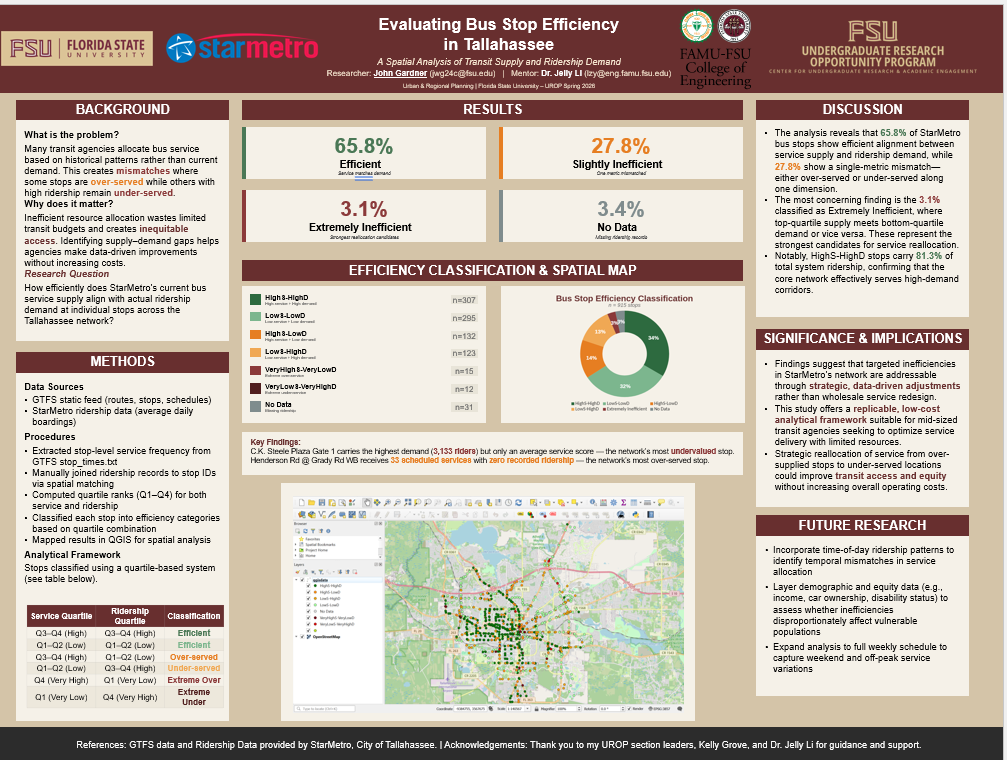
This study investigates whether bus stop service frequency in Tallahassee, Florida is aligned with observed ridership demand across the transit network. Identifying mismatches between scheduled service and actual usage is important because over-served stops represent inefficient resource allocation, while under-served stops limit rider access. For a mid-sized city reliant on public transit, understanding this relationship has direct implications for both equity and operational efficiency.
Stop-level service frequency was calculated from the Fall 2025 GTFS timetable by counting scheduled stop occurrences per stop. Ridership demand was measured by combining average weekday boardings and alightings per stop from October 2025. After manually standardizing stop identifiers across both datasets to ensure a reliable join, the data was mapped spatially in QGIS and stops were classified into six efficiency categories using a quartile-based bivariate model comparing scheduled service supply to observed ridership demand.
Of the 915 stops analyzed, 65.8% were classified as efficient, 27.8% as slightly inefficient, and 3.1% as extremely inefficient, representing the strongest candidates for service reallocation. The remaining 3.4% could not be classified due to missing ridership data. Future research incorporating time-of-day ridership patterns and demographic variables could further refine these classifications.
These findings suggest that Tallahassee's transit network contains targeted inefficiencies that could be addressed through strategic service adjustments rather than system-wide restructuring, potentially improving rider access without increasing overall operating costs.
Keywords: Transportation Transit Infrastructure Data Planning