
Research Symposium
26th annual Undergraduate Research Symposium, April 1, 2026
Allison Hoge Poster Session 4: 3:00 pm - 4:00 pm / Poster #144

BIO
Allison Hoge is a sophomore at Florida State University. Originally from Santa Rosa Beach, Florida. Allison is a first-generation student, currently working towards receiving her Bachelor’s in Science in Criminology, with a minor in Psychology. She has made the President’s List every semester she has been eligible. Beyond her studies, Allison currently serves as the Director of Tournament Logistics for the Undergraduate Mock Trial Team. Allison is also on the Pre-Law track and plans to go to law school following her undergraduate studies. Outside of pre-law, Allison is also interested in writing, and this past fall semester was a Staff Writer for FSU’s HerCampus chapter! Following her work with UROP, in the fall semester of 2026, Allison will serve as an Engage 100, First Year Connections and Success leader. Throughout her research with UROP this year, Allison has been able to balance furthering her academic opportunities while still fostering her interest in unique legal questions. UROP has been an amazing learning experience for Allison, and just a part of what makes the decision of FSU so rewarding. She would like to thank her friends for their support!
Psychedelic Law: Balancing International Treaty Obligations and Clinical Innovation in Canada
Authors: Allison Hoge , Dr. Mason MarksStudent Major: Criminology
Mentor: Dr. Mason Marks
Mentor's Department: College of Law Mentor's College: College of Law Co-Presenters:
Abstract
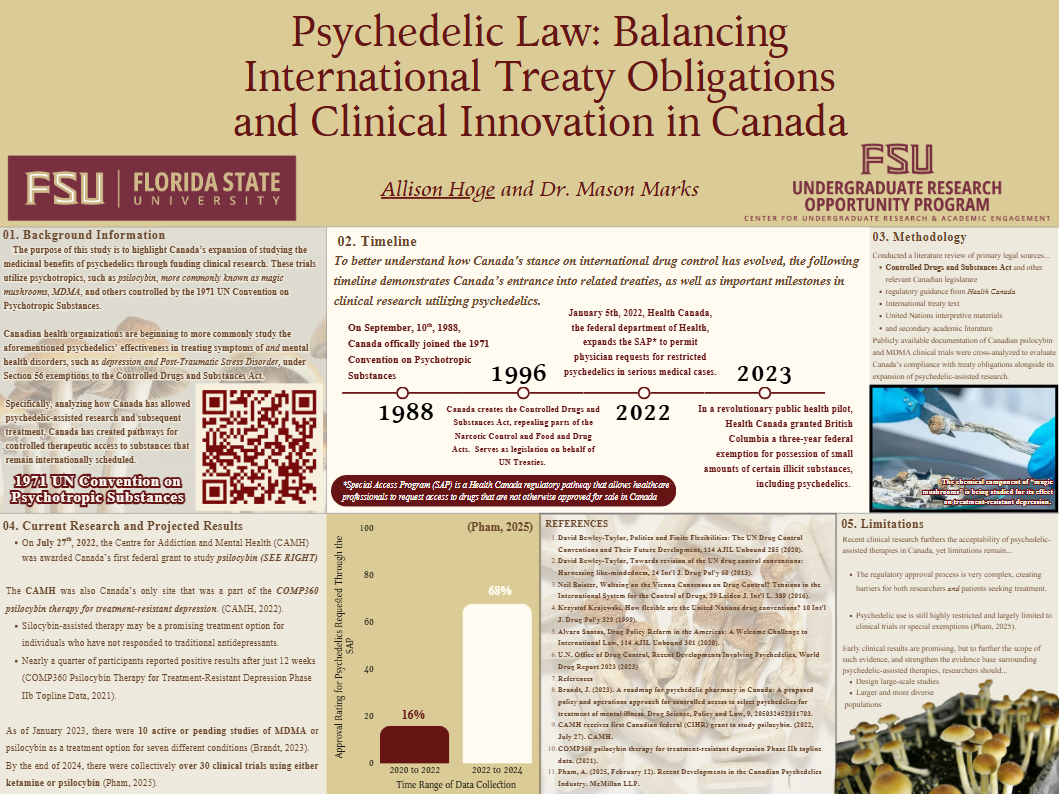
For over 50 years, Canada, along with 180 other state parties have been bound by the 1971 Convention on Psychotropic Substances. Treaties, such as this one, developed by the United Nations, came about in this era in an effort to better control the rapid expansion of psychedelics, which include psychotropics, such as psilocybin, more commonly known as magic mushrooms, MDMA, and others. However, recent scientific research has renewed interest in their therapeutic potential. The purpose of this study is to highlight Canada’s recent advancements in psychedelic-assisted clinical research, while remaining compliant with international treaty obligations.
Analysis of legislation such as the Controlled Drugs and Substances Act, regulatory guidance from Health Canada, and relevant publicly available documentation of Canadian psilocybin and MDMA clinical trials demonstrates that Canada follows narrow statutory outlines while applying executive discretion to find exemptions. Furthermore, dissecting United Nations Standards, other psychotropic-controlling treaties, and National Advisory Councils showcase how Canada maintains formal compliance while expanding authorized medical use.
Canada has recently expanded psychedelic-assisted research; studies use the aforementioned psychedelics to attempt to treat mental health disorders, such as depression, Post-Traumatic Stress Disorder, and related symptoms. Further research must be conducted to understand the full scope of how these substances can be implemented in more widespread or long-term treatment.
Analyzing how Canada continues to invest in mental health research that recognizes the potential medicinal or therapeutic applications of psychotropics illustrates how treaty-bound states can adapt domestic drug policy – and may inform future international approaches to psychedelic regulation.
Keywords: Medicinal, Therapy, International, Psychedelics, Treaty