
Research Symposium
26th annual Undergraduate Research Symposium, April 1, 2026
Kelan Dennis Poster Session 2: 10:45 am - 11:45 am / Poster #282

BIO
Kelan Dennis is a First-Year Presidential Scholar pursuing a Bachelor of Science in Mechanical Engineering with a minor in Mathematics. He is originally from Margate, located in Broward County, Florida.
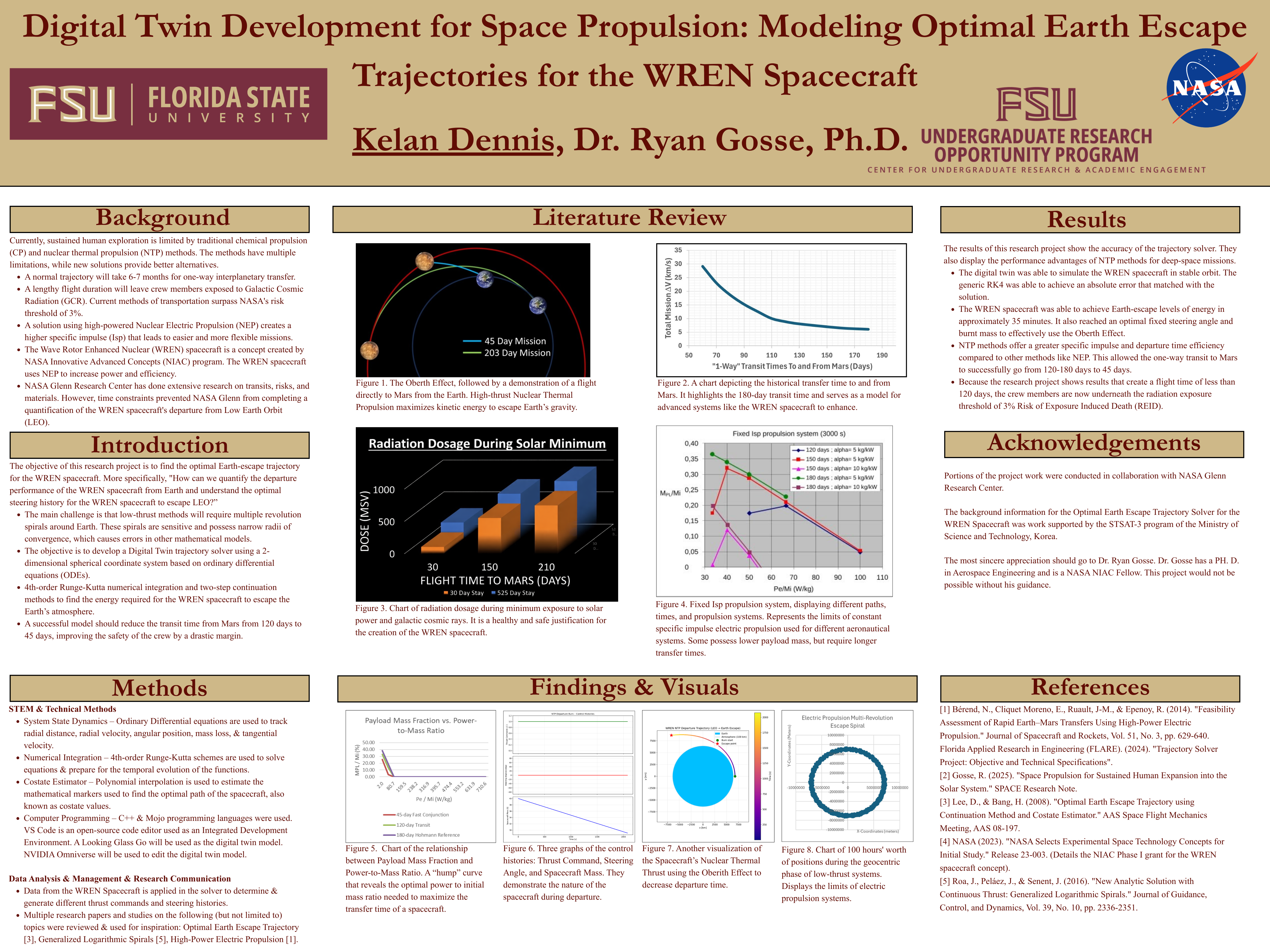
Kelan's research experiences include working with Dr. Gosse on advanced spacecraft propulsion. The research project, “Digital Twin Development for Space Propulsion: Modeling Optimal Earth Escape Trajectories for the WREN Spacecraft”, deals with solving one of NASA's biggest obstacles: sending humans to Mars in an efficient and sustainable manner. This was accomplished using the Wave Rotor Enhanced Nuclear (WREN) spacecraft concept that will support future missions to Mars and other forms of Deep-space exploration.
Kelan Dennis intends to obtain a Master's Degree in Mechanical Engineering, concentrating in Nanotechnology and/or Aerospace. His other research interests include (but aren't limited to) Artificial Intelligence, Machine Learning, Materials Science, Quantum, and Nanomaterials. Kelan intends to utilize engineering, nanotechnology, and other innovations in STEM to develop technology that aids developing countries, such as Jamaica, with their infrastructure and/or environmental needs.
Digital Twin Development for Space Propulsion: Modeling Optimal Earth Escape Trajectories for the WREN Spacecraft
Authors: Kelan Dennis, Dr. Ryan GosseStudent Major: Mechanical Engineering
Mentor: Dr. Ryan Gosse
Mentor's Department: Mechanical and Aerospace Engineering Mentor's College: Engineering Co-Presenters:
Abstract
NASA is advancing sustained human exploration of Mars by using digital twin models for its advanced propulsion systems. The study develops a digital twin trajectory solver for the Wave Rotor Enhanced Nuclear (WREN) spacecraft while targeting the Earth-departure phase for Low Earth Orbit (LEO). A 2-dimensional spherical coordinate system created with ordinary differential equations was used to model and simulate mass dynamics and radial portions. The generic 4th-order Runge Kutta (RK4) numerical integration scheme calculated the temporal evolution.
The primary challenge encountered was multi-revolution spirals, which are sensitive and possess narrow convergence radii. To improve these issues, a second-order polynomial interpolation acted as a costate estimator to adjust the model towards the starting point. The preliminary simulations showed that the WREN spacecraft can successfully achieve an Earth escape velocity. Results suggest that the spacecraft can achieve sufficient thrust to reach Mars faster than the original propulsion methods.
The developed trajectory solver enhances spacecraft performance analysis of the WREN, which refines and enhances mission efficiency. The results suggest that the WREN spacecraft possesses the propulsion efficiency for interplanetary departure. The digital twin trajectory solver serves as a vital tool for future Mars missions and other advances in deep-space exploration.
Keywords: Digital Twin, NASA, Aerospace, Engineering