
Research Symposium
26th annual Undergraduate Research Symposium, April 1, 2026
Aiden Marin Poster Session 4: 3:00 pm - 4:00 pm / Poster #174

BIO
Aiden Marin is a first-generation freshman pursuing a Bachelor of Science in Finance. He is very active on campus, being a part of the Undergraduate Research Program, Entrepreneurship LLC, Quantitative Finance Club, and Investment Trading Club; and was honored as a Quest Scholar, HSF Scholar, and was placed on the Dean's list. Aiden Marin is currently researching machine learning applications in pricing options under Dr. Rafiq Islam.
He is actively seeking internships, research opportunities, and mentorship in order to break into the quantitative finance/ futures trading industry.
Comparing Machine Learning Methods with the Black–Scholes–Merton Model for Option Pricing
Authors: Aiden Marin, Rafiq IslamStudent Major: Bachelor of Science in Finance
Mentor: Rafiq Islam
Mentor's Department: Mathematics Mentor's College: Florida State University Co-Presenters:
Abstract
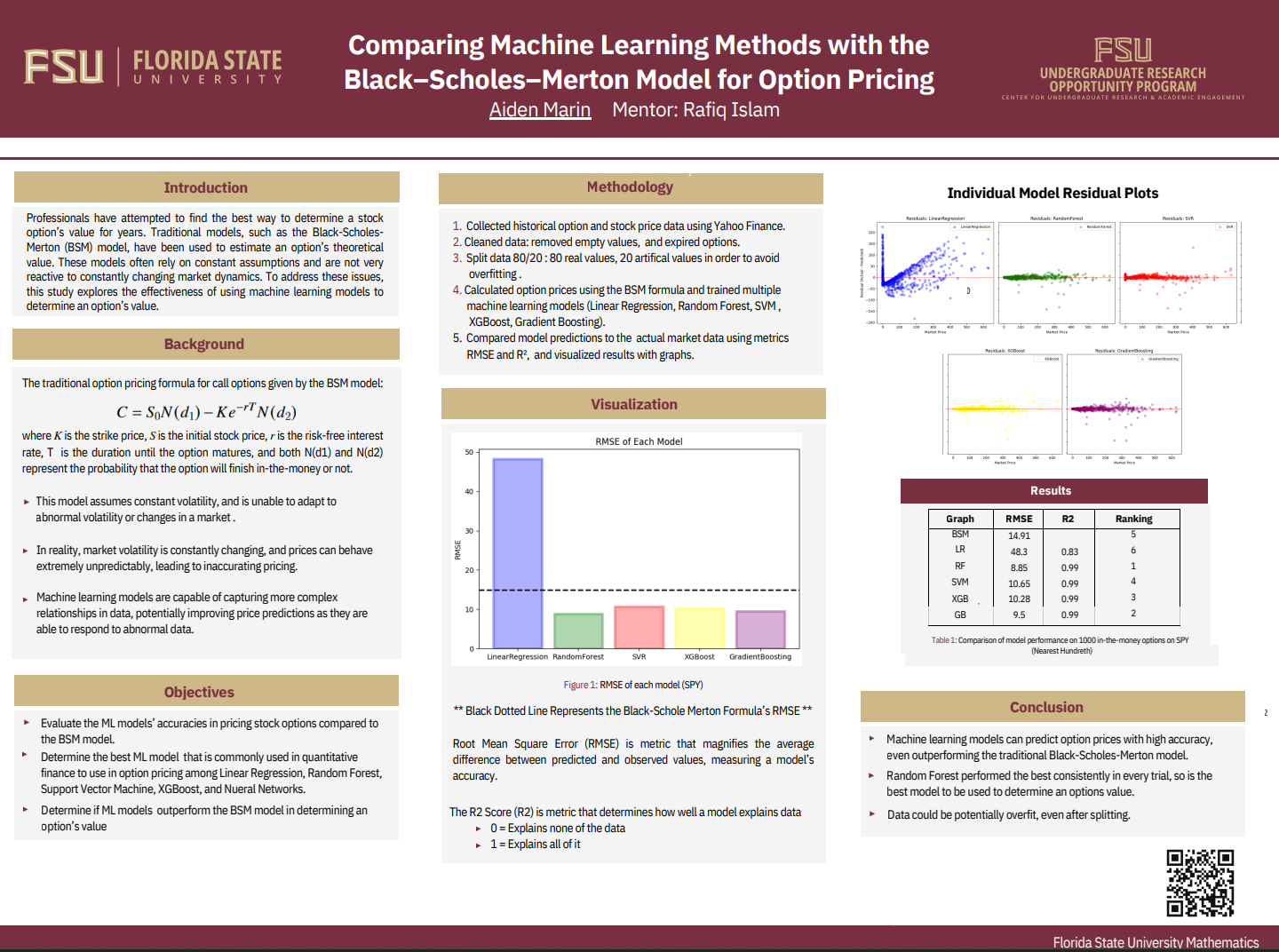
In this study, we investigate whether the machine learning models are comparable to the traditional Black-Scholes-Merton model for pricing European-type call options. The Black-Scholes-Merton model is the most prominent model to compute option prices. We develop an algorithm that prices options using the Black-Scholes formula on cleaned data from options that are in-the-money, along with $20\%$ manufactured data that replicated the stock’s volatility to avoid overfitting. We then train multiple machine learning models, \emph{e.g.,} Linear Regression, Support Vector Machine, Random Forest, XGBoost, and Gradient Boosting on a stock option’s current price, strike, expiration, and implied volatility to predict an option’s value. We use the root mean squared error (RMSE) and R2 score to evaluate how effective the model was, comparing these results to the Black-Scholes-Merton formula’s results. On over 1000 options of the S&P500, most models outperformed the Black-Scholes model in terms of the RMSE and R2 scores. The best performer was Random Forest with an 11.2 RMSE. This study has shown that machine learning can be used more effectively to price options. This can help both retail and institutional traders manage risk, make better investment decisions, and perform portfolio optimizations.
Keywords: Machine Learning, Quantitative Finance, Options