
Research Symposium
26th annual Undergraduate Research Symposium, April 1, 2026
Avarie Bergen Poster Session 1: 9:30 am - 10:30 am / Poster #117
BIO
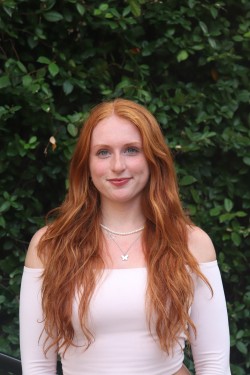
Avarie Bergen is a sophomore majoring in Meteorology and minoring in Mathematics under the Department of Earth, Ocean & Atmospheric Science at Florida State University. The university’s Undergraduate Research Opportunities Program offered Avarie her first official research opportunity within related fields of work: Environmental and Civil Engineering. Faculty mentor Dr. Roshan Panahi acted with a hands-on approach in assisting Avarie throughout her literature reviews, research, and coding. Faculty mentor Dr. Juyeong Choi is the head of the research project, while still finding time to check in on the progress of the UROP students. She expects to continue research in meteorological and climate-related fields throughout her time at FSU while earning a Bachelor's of Science in Environmental Meteorology, accompanied by a minor in Mathematics and a Certificate in Leadership Studies. Post graduation, she plans to work with the National Oceanic and Atmospheric Administration. She hopes to one day return to her schooling to fulfill her dream of earning her Ph.D..
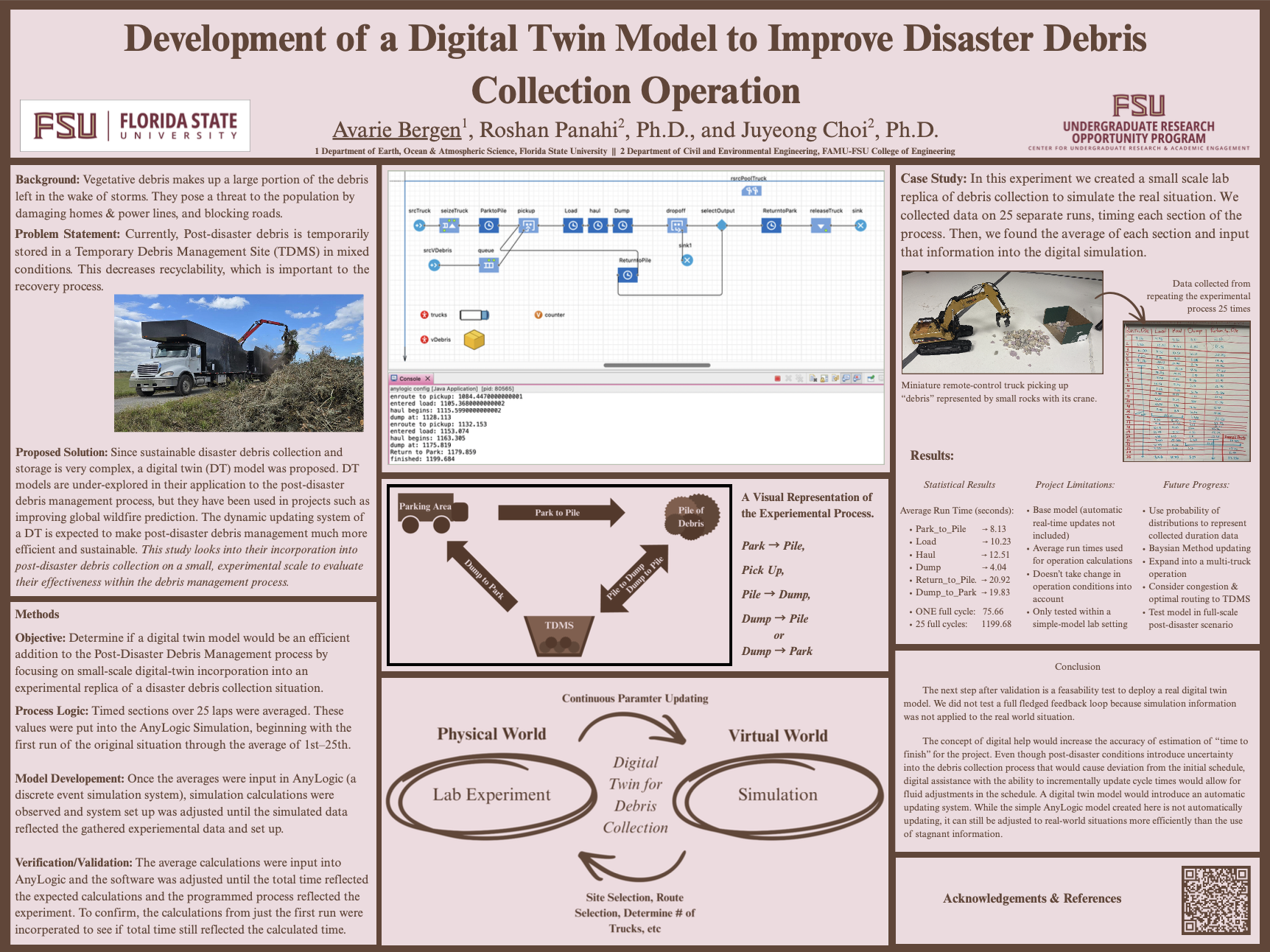
Development of a Digital Twin Model to Improve Disaster Debris Collection Operation
Authors: Avarie Bergen, Dr. Juyeong ChoiStudent Major: Meteorology
Mentor: Dr. Juyeong Choi
Mentor's Department: CEE - Civil & Environmental Engineering Mentor's College: The College of Engineering Co-Presenters:
Abstract
Natural disasters leave millions of tons of vegetative debris in their wake. Post-disaster debris management (PDDM) involves collecting and temporarily storing debris in mixed conditions, reducing recyclability of natural debris. Currently, sustainable collection and storage of natural debris is operationally complex. The process requires detailed and dynamic scheduling since post-disaster conditions evolve so quickly, making static operational plans obsolete.
Understanding digital twins (DTs): Digital twin models (DTMs) are expected to make the debris management process more efficient and sustainable by creating a continuous feedback loop. The initial design is updated alongside the active process throughout the project’s duration to ensure accurate estimations.
Since the concept of incorporating DTs in PDDM is underexplored, this study proposes a DT framework for post-disaster debris collection. In this study, a DTM was created using the AnyLogic software. This simulated a simple debris collection and redistribution experiment (ran 25 times), recording each part of the process and averaging them. Framework feasibility and effectiveness was evaluated by comparing lab results with the AnyLogic software results along the same input information. The simulation was updated if there were inconsistencies. Preliminary results indicate that a DTM in PDDM would prove to be an efficient addition to the process due to its dynamic system. DT models can update alongside the actual process for the most efficient results, instead of relying on static precursory information. This would help improve the sustainable PDDM process by adapting alongside the project to determine the most efficient and sustainable actions and outcomes.
Keywords: debris, management, sustainable, digital-twin, improvement