
Research Symposium
26th annual Undergraduate Research Symposium, April 1, 2026
Shohan Ghatak Poster Session 1: 9:30 am - 10:30 am / Poster #269

BIO
Shohan Ghatak is a Sophomore at Florida State University pursuing a Bachelor of Science in Statistics and Economics. Ghatak’s professional background includes an internship with ImmunoProfile LLC, where he developed an interactive map to visualize antibody protection levels based on client data. He also served as an intern at Increase Alpha, conducting research on Artificial Intelligence systems, specifically LSTMs and Large Language Models, as well as utilizing Python and SHAP to analyze over 2,500 financial data files to enhance the interpretability and identify key drivers of stock market prediction models.
Currently, Ghatak serves as a research mentee under Professor Bryce Morsky in the FSU Department of Mathematics. His work focuses on SIR-type compartmental models and disease prediction based on derivations of basic reproduction numbers. Building on this foundation, he is currently transitioning into an independent research project with Professor Morsky to author a paper on an SAIQR compartmental model for measles. This research specifically investigates the four-day asymptomatic period of transmission and how social dynamics, concretely how premature quarantine exit or delayed entry, impact the containment of measles under varying conditions and levels of adherence.
Upon graduating in May 2028, Ghatak intends to pursue a career as a Data Analyst while furthering his studies in graduate school.
Mathematical Epidemiology: Compartmental Models and Equilibrium Stability Analysis
Authors: Shohan Ghatak, Bryce MorskyStudent Major: Statistics and Economics
Mentor: Bryce Morsky
Mentor's Department: Mathematics Mentor's College: Florida State University Co-Presenters:
Abstract
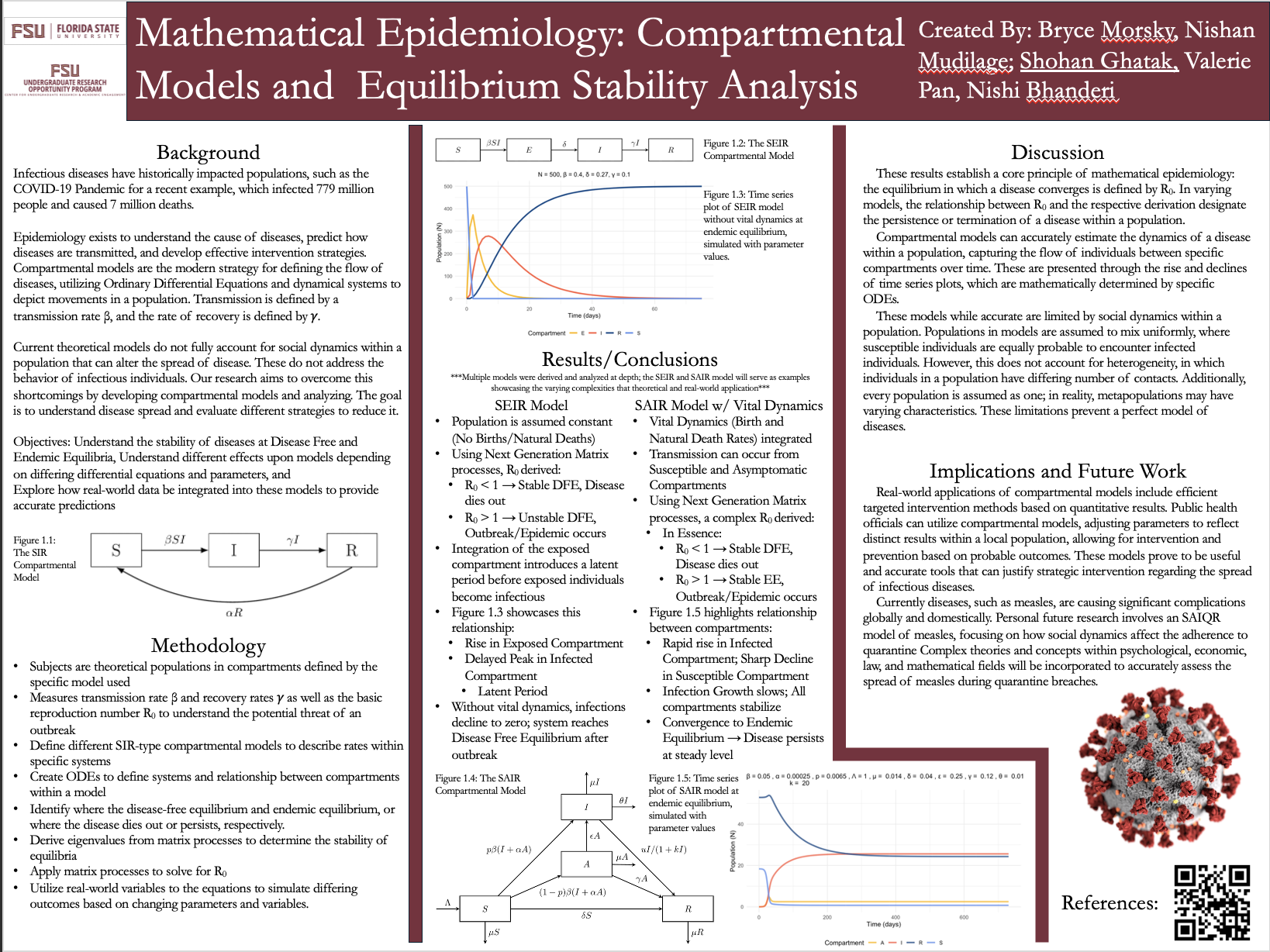
Throughout human history, infectious diseases have spread across varying populations. Most recently, COVID-19 caused a worldwide lockdown from 2020 to 2021, infecting 779 million and killing 7 million. The purpose of epidemiology is to understand the causes of a disease, predict its course, and develop effective interventions. Utilizing compartmental models, the relationship between each of these compartments is defined by differential equations, specifically ODEs and dynamical systems. These equations depict the movement between compartments. These will show the flow of susceptible individuals to the infected compartment as the disease is transmitted at transmission rate (β), as well as the flow of infected individuals either back to the susceptible or recovered compartment at the recovery rate (γ). SIR-type models, varying in complexity, utilize these equations to illustrate these relationships across a multitude of schemes. Using Jacobian and Next Generation Matrix processes, we can determine the stability of the Disease-Free and Endemic equilibria and find R0. Simulating the system can also provide insights into transient dynamics. Together, these results can guide officials in creating effective intervention methods. Further studies can extend this framework to incorporate more realistic features. In particular, models can include social behaviors of populations, such as adherence to quarantine and usage of both vaccines and non-pharmaceutical interventions.
Keywords: Epidemiology, Compartmental Model, Equilibria