
Research Symposium
26th annual Undergraduate Research Symposium, April 1, 2026
Emma Grimes Poster Session 2: 10:45 am - 11:45 am / Poster #40

BIO
Emma is a first-generation first-year honors student pursuing a Bachelor of Arts in International Affairs. She is a recipient of Florida State University's Vires Scholarship and was named a Seminole Scholar by University Housing this past semester for maintaining a grade point average above 3.5. She plans to earn a Juris Doctor and Master of Laws to become an international lawyer working in trade, human rights, and immigration.
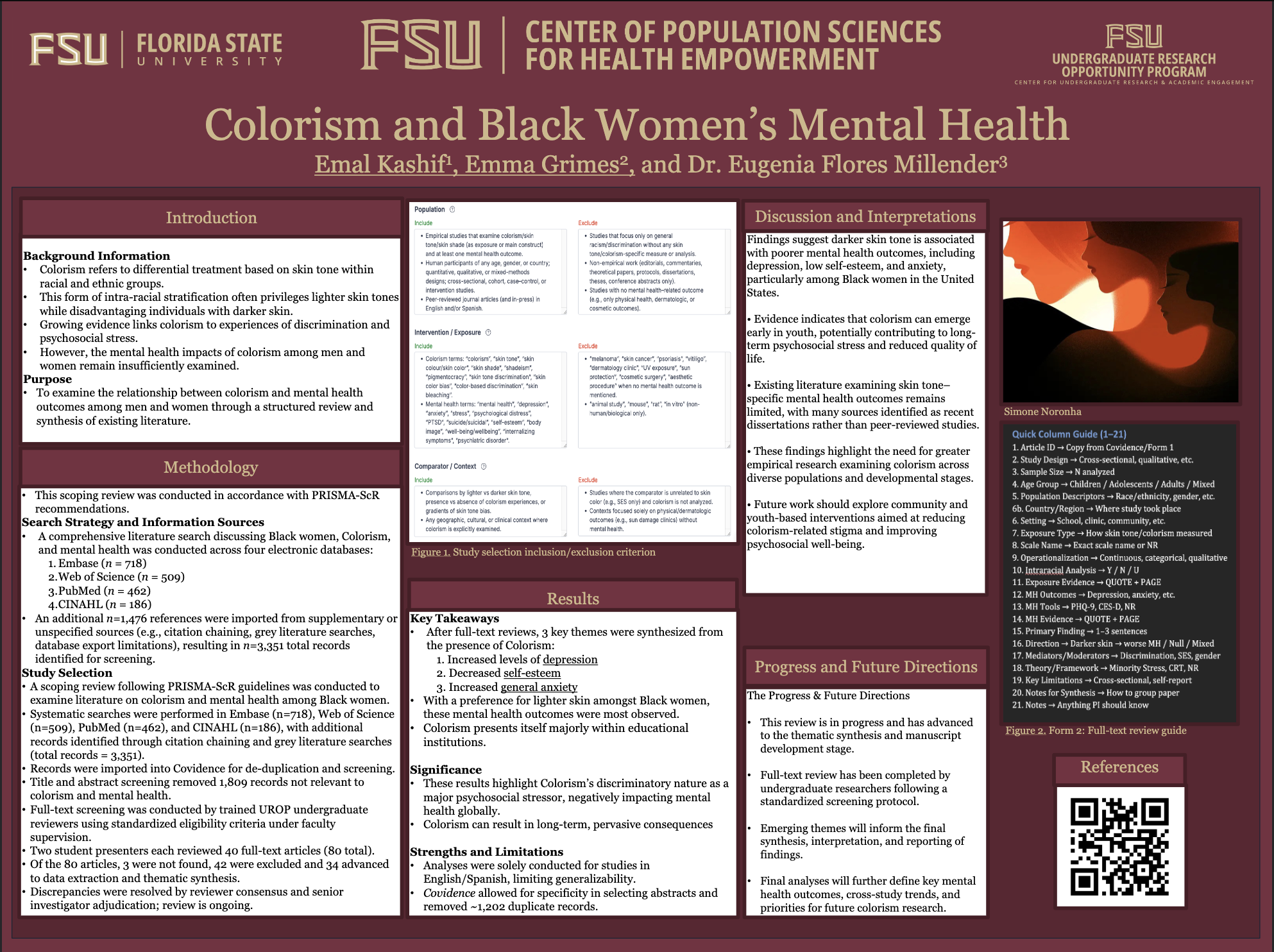
Colorism and Black Women's Mental Health
Authors: Emma Grimes, Dr. Eugenia Flores MillenderStudent Major: International Affairs
Mentor: Dr. Eugenia Flores Millender
Mentor's Department: Nursing Department Mentor's College: College of Nursing Co-Presenters: Emal Kashif
Abstract
Colorism is discrimination based on skin tone. Individuals with darker complexions experience greater negative bias than those with lighter ones. This form of stratification is associated with adverse mental health outcomes among those most affected.
On a team of 6 research assistants, we each screened ~500 abstracts, 2,145 total, for significant data on impacts of Colorism to mental health of primarily African American women, then reviewed 40 full-texts to determine eligibility for the final scoping review.
On the platform Covidence, we screened the abstracts following strict criteria. This included whether a study operationalized skin tones and mental health, like with the Rosenberg Self-Esteem Scale. Studies also had to be empirical and written in English or Spanish. After screening, we reviewed the full-texts with more detailed criteria. An important part of this was checking if there was data linking Colorism with specific skin tones to a mental health outcome; if not, it was no longer eligible to move forward. Additionally, we looked for intraracial analysis.
We found three main effects of Colorism: darker skin was associated with lower self-esteem, higher stress levels, and depression. It affects youth and adults, and often occurs intraracially, between members of the same race, like at predominantly African American schools.
Colorism is prevalent throughout the United States and negatively impacts African Americans with darker skin tones psychologically and socially. Future researchers should implement pilot programs in schools to work towards preemptively combatting Colorism in youth and enable darker-skinned individuals to feel confident in their skin.
Keywords: colorism, mental health, shadism