
Research Symposium
26th annual Undergraduate Research Symposium, April 1, 2026
William Castillo Poster Session 3: 1:45 pm - 2:45 pm / Poster #73

BIO
William Castillo is a student at Florida State University pursuing a dual major in Risk Management & Insurance and Hospitality Management. His academic interests focus on how organizations manage uncertainty, make strategic decisions, and build resilient systems in changing environments.
At FSU, he is involved in the Global Investment Society (GIS), the Association of Latino Professionals for America (ALPFA), and outreach efforts for PorColombia. His background in corporate hospitality shaped his understanding of real-time risk management and team coordination in various environments.
Through the Undergraduate Research Opportunity Program (UROP) and the XS/FS Experimental Economics Lab, William conducts research on decision-making under risk. His work examines how individuals evaluate small probabilities when choosing between uncertain outcomes, using behavioral economics to explain why real-world choices often differ from traditional models and how these insights can improve decision-making in business and policy.
Overweighting of Low-Probabilities in Risky Decision Making
Authors: William Castillo, Dr. Mark IsaacStudent Major: Risk Management Insurance / Hospitality & Tourism Management
Mentor: Dr. Mark Isaac
Mentor's Department: Florida State University Department of Economics Mentor's College: College of Social Science and Public Policy Co-Presenters:
Abstract
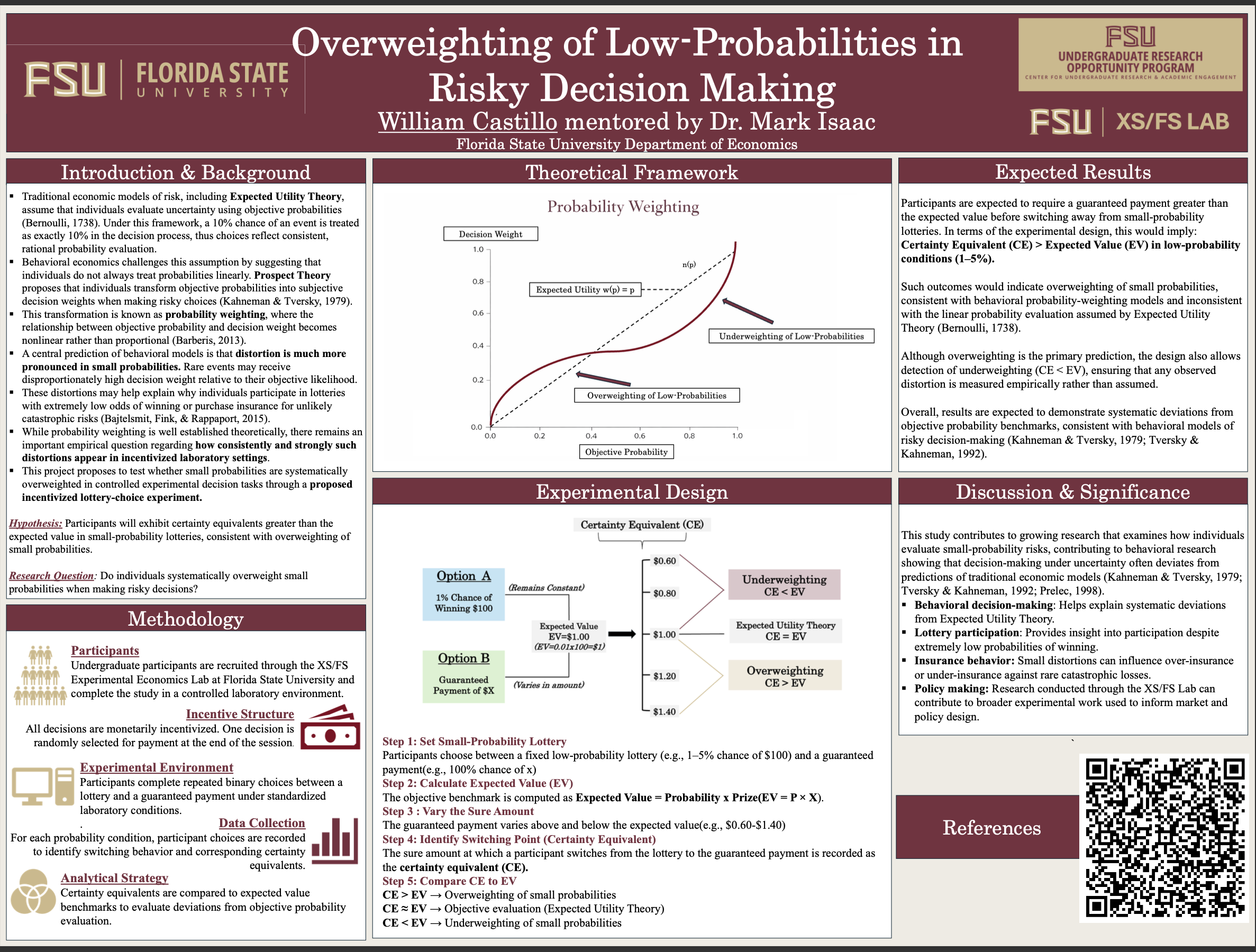
Traditional economic models assume that individuals evaluate probabilities objectively when making decisions under risk. Behavioral research, however, shows that individuals often distort probabilities, particularly when events have very small chances of occurring. This project investigates how individuals evaluate low-probability risks and whether small probabilities are systematically overweighted in decision-making.
The study uses a proposed experimental framework based on risky choice tasks in which participants choose between a lottery and a guaranteed monetary amount. By identifying the certainty equivalent at which participants switch between the two options, the experiment allows decision weights to be inferred and compared to the objective probabilities of the lottery. This approach makes it possible to observe how individuals subjectively perceive small probabilities while the objective outcomes remain constant.
Prior behavioral research suggests that individuals tend to overweight small probabilities, which can lead them to choose low-probability, high-payoff lotteries more frequently than predicted by traditional expected utility models. Observing this pattern in experimental choices would indicate that individuals assign greater decision weight to small probabilities than their objective likelihood warrants. Understanding this bias is important for explaining real-world behaviors such as lottery participation, insurance purchasing, and risk-taking in uncertain environments.
Keywords: Economics, Risk Management, Behavioral Economics, Insurance