
Research Symposium
26th annual Undergraduate Research Symposium, April 1, 2026
Grace Dean Poster Session 1: 9:30 am - 10:30 am / Poster #239
BIO
Grace Dean is a second-year honors student pursuing a Bachelor of Arts in Political Science with a double major in Religion within the College of Social Science and Public Policy. She is also working toward her concentration in public administration alongside the undergraduate certificate in Emergency Management. Grace is deeply involved in both the Florida State and broader Tallahassee community, as she hopes to gain experience in nonprofit management, public interest law, and labor law.
She is an Employment Intern at the International Rescue Committee where she strives to create accessibility in the Tallahassee job market for newly arrived refugees. Grace is proud to have the opportunity to conduct targeted grant research and writing for an environmental nonprofit that provides conservation-based professional development to high school and university students (Conservation Pathways) as a Spring 2026 Sustainability Fellow. At FSU, she serves as the Co-Programming Coordinator for the Pride Student Union as well as a programming intern at Club Downunder. Lastly, she is excited to gain experience on political campaigns and deepen her connection to the Tallahassee community as she begins her position as a volunteer recruitment intern for a local mayoral campaign.
Restoration of Resilience: Religious Congregations' Role in Disaster-Recovery Efforts
Authors: Grace Dean, Dr. David BerlanStudent Major: Political Science and Religion
Mentor: Dr. David Berlan
Mentor's Department: Askew School of Public Administration and Policy Mentor's College: College of Social Sciences and Public Policy Co-Presenters:
Abstract
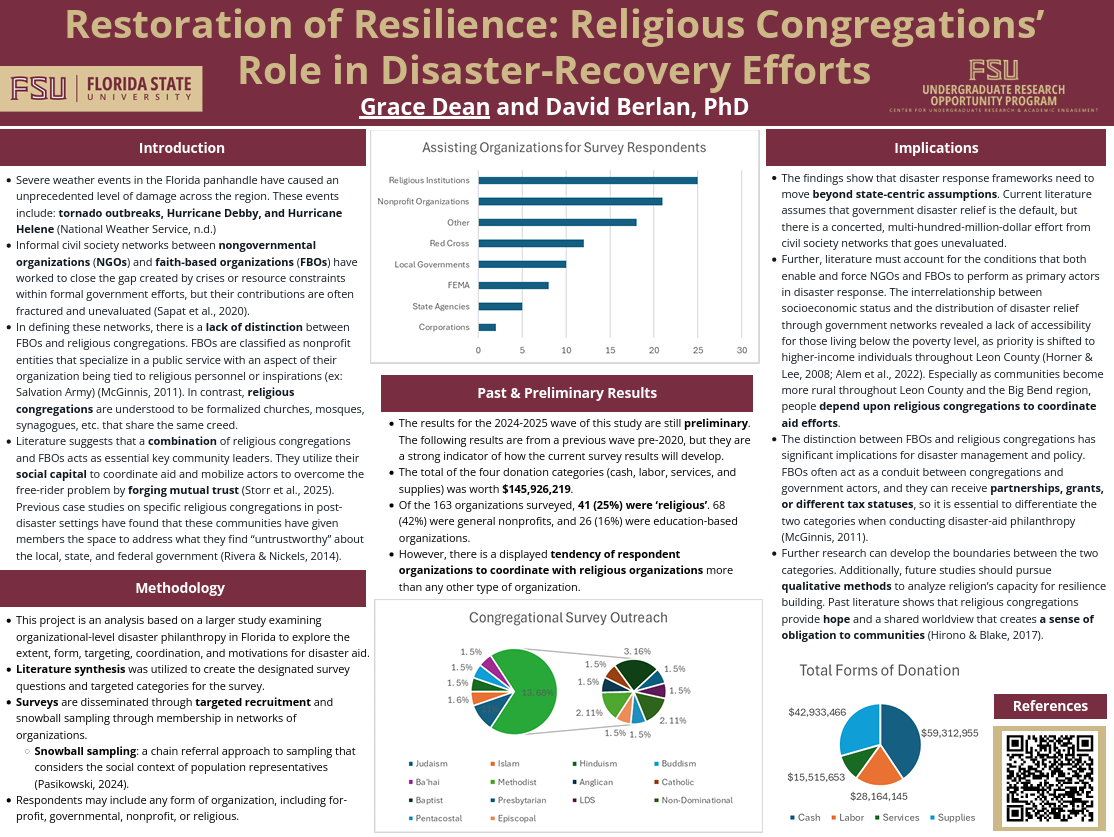
Natural disasters create a fractured response from a wide range of community actors. State and federal disaster-relief programs are often short-term solutions that produce unstable service environments for constituents to navigate (Gajewski et al., 2011). Informal civil society networks, comprising nongovernmental organizations (NGOs), local grassroots or community-based organizations, faith-based organizations (FBOs), and informal neighborhood groups, have contributed essential resilience efforts when formal government efforts are weakened by crises or resource constraints (Sapat et al., 2019). This analysis draws on a larger study examining organizational-level disaster philanthropy in Florida in 2024-2025 to specifically target religious congregations' role in disaster response in Leon County, Florida. Previous literature indicates that FBOs utilize social capital to step into community leadership roles when private or public sector capacity is weak (Roque et al., 2020). However, there has not been a defined distinction between religious congregations and FBOs' functions in disaster relief efforts, despite operational differences. Therefore, through a survey of individuals at religious congregations impacted by or responding to disasters in Leon County throughout 2024-25, this study seeks to understand the extent, form, targeting, coordination, and motivations for disaster philanthropy in this essential part of civil society networks. The findings show that disaster response frameworks need to move beyond state-centric assumptions and account for conditions that enable religious congregations to have more flexibility to act as primary actors in disaster response and recovery to better understand long-term solutions.
Keywords: Nonprofit and NGO Management, Religious Studies, Disaster Relief, Emergency Management