
Research Symposium
26th annual Undergraduate Research Symposium, April 1, 2026
Alana Banton Poster Session 3: 1:45 pm - 2:45 pm / Poster #246

BIO
An undergraduate student pursuing a dual degree in Behavioral Neuroscience and Public Health, with minors in Chemistry and Biomedical Physics, Alana is deeply interested in understanding and addressing global health disparities. As a pre-medical student, her interests center on the inequities that affect populations in less fortunate countries, where access to healthcare, medical resources, and research opportunities is often limited.
Her academic focus explores the brain and its role in behavior, cognition, and disease while also examining the broader social, environmental, and structural factors that shape health outcomes. Through her studies, she has developed a strong foundation in neuroscience, experimental design, and quantitative analysis. Her training in public health further allows her to investigate how systemic and societal conditions influence population health on a global scale. Beyond academics, she is committed to serving underserved communities and advocating for more equitable healthcare systems. Ultimately, she hopes to pursue a career in medicine where she can integrate scientific research with compassionate patient care, working to reduce health disparities and improve outcomes for vulnerable populations worldwide.
Cognitive Skills Model for Predicting Alzheimer's Disease
Authors: Alana Banton, Dorota Kossowska-KuhnStudent Major: Behavioral Neuroscience + Public Health
Mentor: Dorota Kossowska-Kuhn
Mentor's Department: Psychology Mentor's College: Arts and Sciences Co-Presenters: Gianna Diaz and Davion Slocum
Abstract
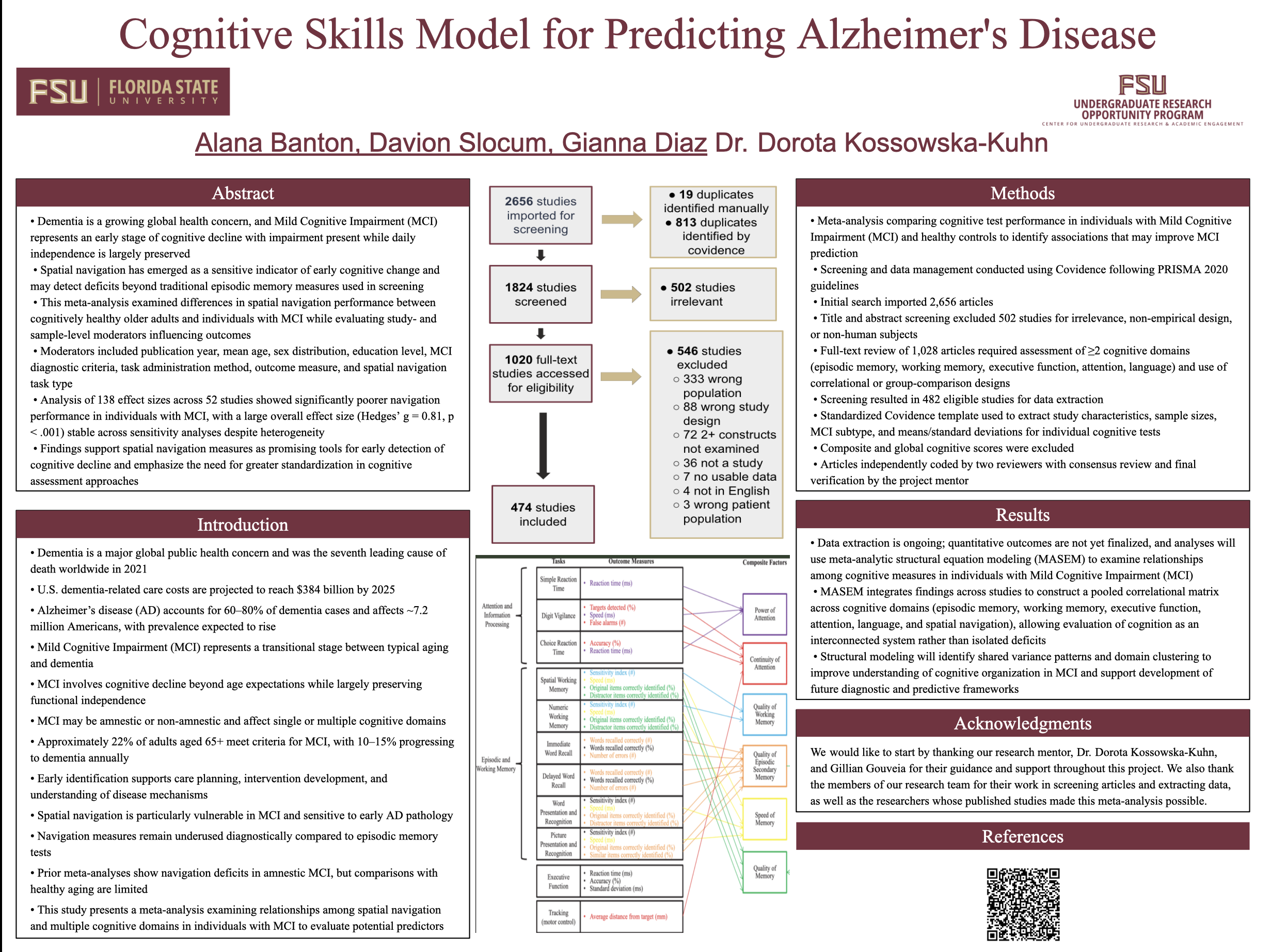
Across 52 studies (138 effect sizes), individuals with Mild Cognitive Impairment (MCI) performed significantly worse on spatial navigation tasks than cognitively healthy older adults, with a large overall effect (Hedges’ g = 0.81, p < .001). While this finding remained consistent across analyses, significant variability between studies suggested that other factors may influence the strength of this relationship. Because MCI is often considered a transitional stage between normal aging and dementia, identifying early indicators of decline is critical. Although episodic memory has traditionally been the focus of early detection, growing evidence suggests spatial navigation deficits may appear earlier and serve as sensitive markers of preclinical cognitive change. This meta-analysis examined spatial navigation performance differences between healthy older adults and individuals with MCI and explored potential moderating factors, including participant demographics, diagnostic criteria, and task characteristics. Moderator analyses showed marginal trends related to the proportion of male participants, the use of matrix-based navigation tasks, and the diagnostic criteria used for MCI, though none reached statistical significance. Overall, the findings support the potential of spatial navigation assessments as tools for early detection of cognitive decline and highlight the need for greater standardization in how these abilities are measured across studies.
Keywords: Alzheimer's Disease, Spatial Navigation, Dementia, Test Validation