
Research Symposium
26th annual Undergraduate Research Symposium, April 1, 2026
Tessa Ngo Poster Session 3: 1:45 pm - 2:45 pm / Poster #143

BIO
Hi! My name is Tessa Ngo, and I’m from Gulf Breeze, Florida. I’m a first-year student pursuing a Bachelor of Science in Psychology on the pre-med track.
Examining Morphological Complexity in 11th Grade English Language Arts Texts Across Genres
Authors: Tessa Ngo, Audrey HendrixStudent Major: Psychology
Mentor: Audrey Hendrix
Mentor's Department: FSU School of Communication Science and Disorders Mentor's College: Florida State University Co-Presenters:
Abstract
Purpose:
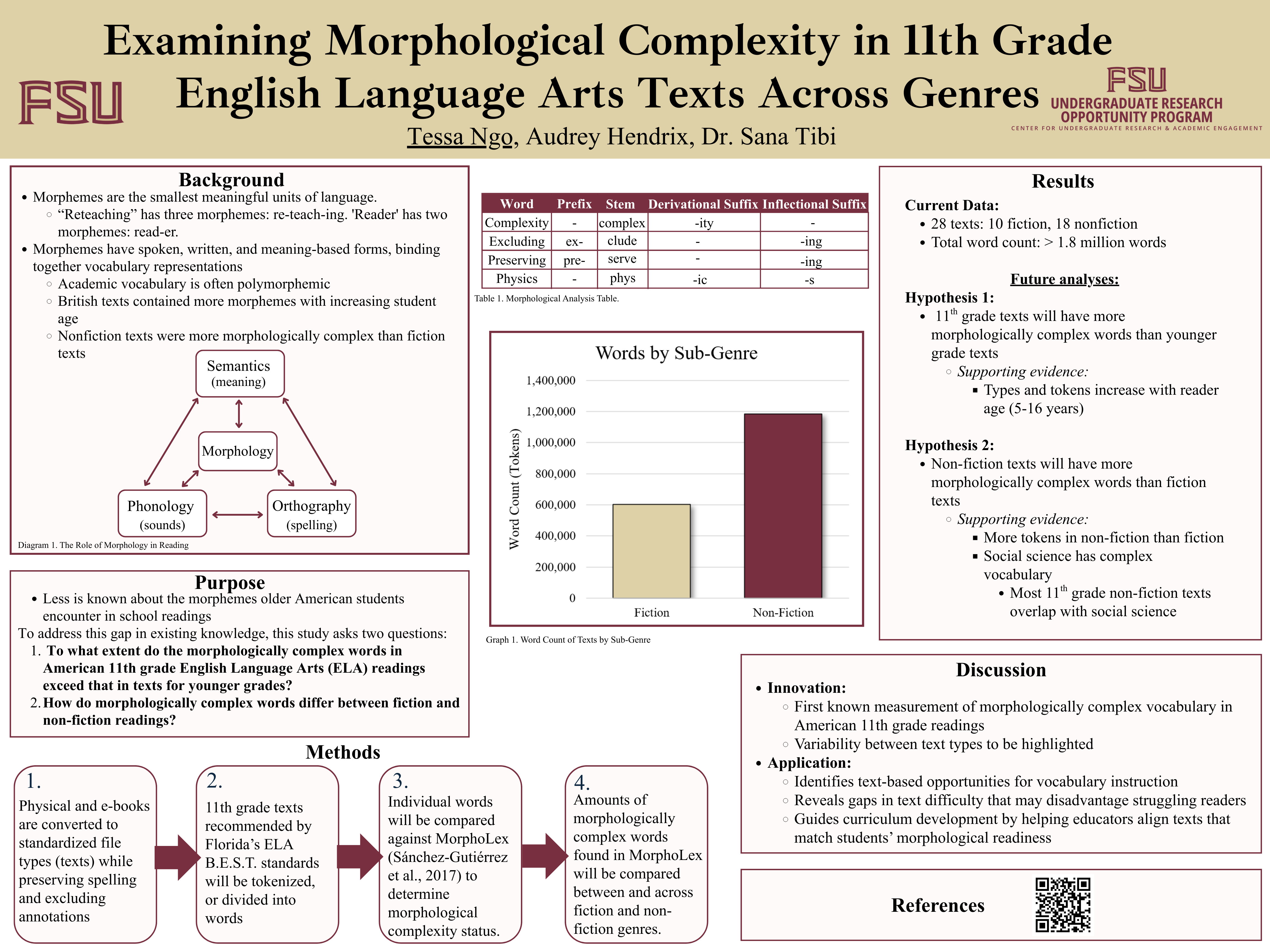
Understanding morphemes, the smallest meaningful units of language (Carlisle, 2003), is essential to understanding complex academic vocabulary encountered in school readings (Nagy & Anderson, 1984) While previous studies (e.g., Dawson et al., 2023) examine both fiction and non-fiction British reading materials for students under 15, less is known about the morphemes encountered by older American teens. This study addresses two research questions: 1. To what extent does the proportion of morphologically complex words in American 11th grade English Language Arts (ELA) readings exceed that in texts for younger grades, reflecting increased morphological demands at the secondary level? 2. How does the proportion of morphologically complex words differ between fiction and non-fiction readings?
Method:
A corpus will be created from 32 eleventh-grade fiction and non-fiction texts recommended by Florida’s ELA B.E.S.T. standards. Words in these texts will be compiled, preserving original spelling and excluding annotations, and then categorized by morphological complexity within and across fiction and non-fiction genres.
Results:
Results are expected to show that Junior-level texts will have a higher amount of morphologically complex words compared to readings of students under 15. Non-fiction texts are expected to have a higher amount of morphologically complex words than fiction texts.
Conclusion:
Results are expected to inform reading instruction by providing detailed information on the amount of morphologically complex vocabulary that older high school students encounter in their ELA readings. Understanding how nonfiction and fiction texts differ in morphological complexity is expected to assist tailored reading instruction by genre.
Keywords: Morphology, Morphological Complexity, Corpus Analysis