
Research Symposium
26th annual Undergraduate Research Symposium, April 1, 2026
Nelson Keakopa Poster Session 4: 3:00 pm - 4:00 pm / Poster #50

BIO
Nelson Keakopa is a sophomore pursuing a Bachelor of Science in Biochemistry at Florida State University. He is involved in undergraduate research studying proteasome assembly and dynamics in yeast under the mentorship of Daniel Betancourt. His work includes techniques such as pulse-chase experiments, plasmid construction, and fluorescence-based imaging to investigate protein localization and complex formation. In addition to his research interests, Nelson is an active musician and performs trumpet in the university’s Jazz Ensemble I. He plans to continue pursuing research in molecular and cellular biology and hopes to attend medical school, potentially following a physician-scientist pathway.
Dissecting the Localization of 26S Proteasome Subunits During De Novo Assembly in living cells
Authors: Nelson Keakopa , Daniel BetancourtStudent Major: Biochemistry
Mentor: Daniel Betancourt
Mentor's Department: Biomedical Sciences Mentor's College: Florida State University Co-Presenters:
Abstract
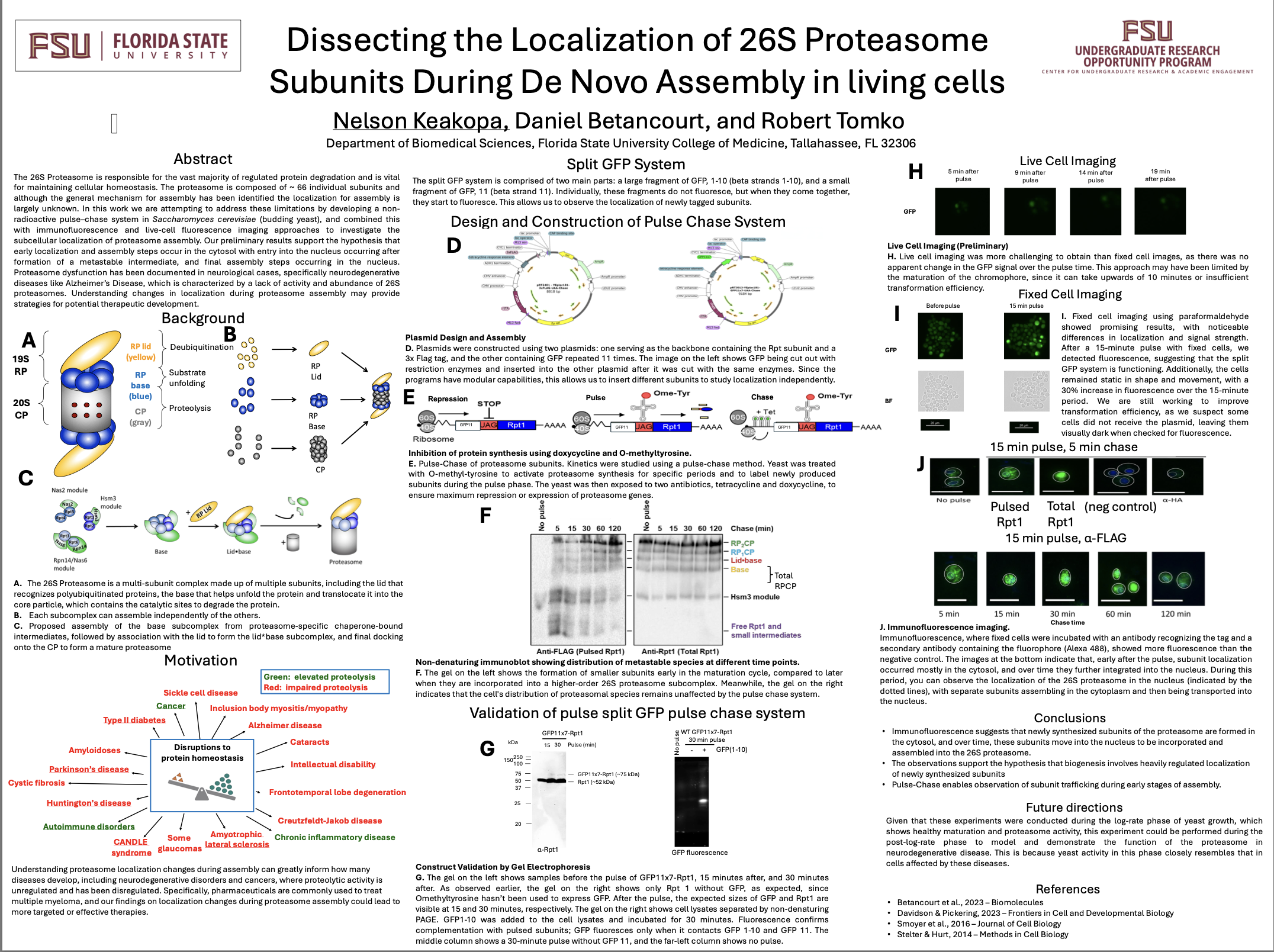
The 26S Proteasome is responsible for the vast majority of regulated protein degradation and is vital for maintaining cellular homeostasis. The proteasome is composed of ~ 66 individual subunits and although the general mechanism for assembly has been identified the localization for assembly is largely unknown. In this work we are attempting to address these limitations by developing a non-radioactive pulse–chase system in Saccharomyces cerevisiae (budding yeast), and combined this with immunofluorescence and live-cell fluorescence imaging approaches to investigate the subcellular localization of proteasome assembly. Our preliminary results support the hypothesis that early localization and assembly steps occur in the cytosol with entry into the nucleus occurring after formation of a metastable intermediate, and final assembly steps occurring in the nucleus. Proteasome dysfunction has been documented in neurological cases, specifically neurodegenerative diseases like Alzheimer’s Disease, which is characterized by a lack of activity and abundance of 26S proteasomes. Understanding changes in localization during proteasome assembly may provide strategies for potential therapeutic development.
Keywords: Molecular-Biology, Localization, proteasome biogenesis