
Research Symposium
26th annual Undergraduate Research Symposium, April 1, 2026
Zoe Miner Poster Session 3: 1:45 pm - 2:45 pm / Poster #271

BIO
Zoe Miner is a first-year Classics student studying Ancient Greek and Latin. For UROP, she works as an editorial and research assistant and plans to pursue graduate study in Classics, with the goal of becoming a professor in the field.
Women and Authority in Early Christianity: Leadership and its Decline
Authors: Zoe Miner, Matthew GoffStudent Major: Classics
Mentor: Matthew Goff
Mentor's Department: Religion Mentor's College: Arts and Sciences Co-Presenters:
Abstract
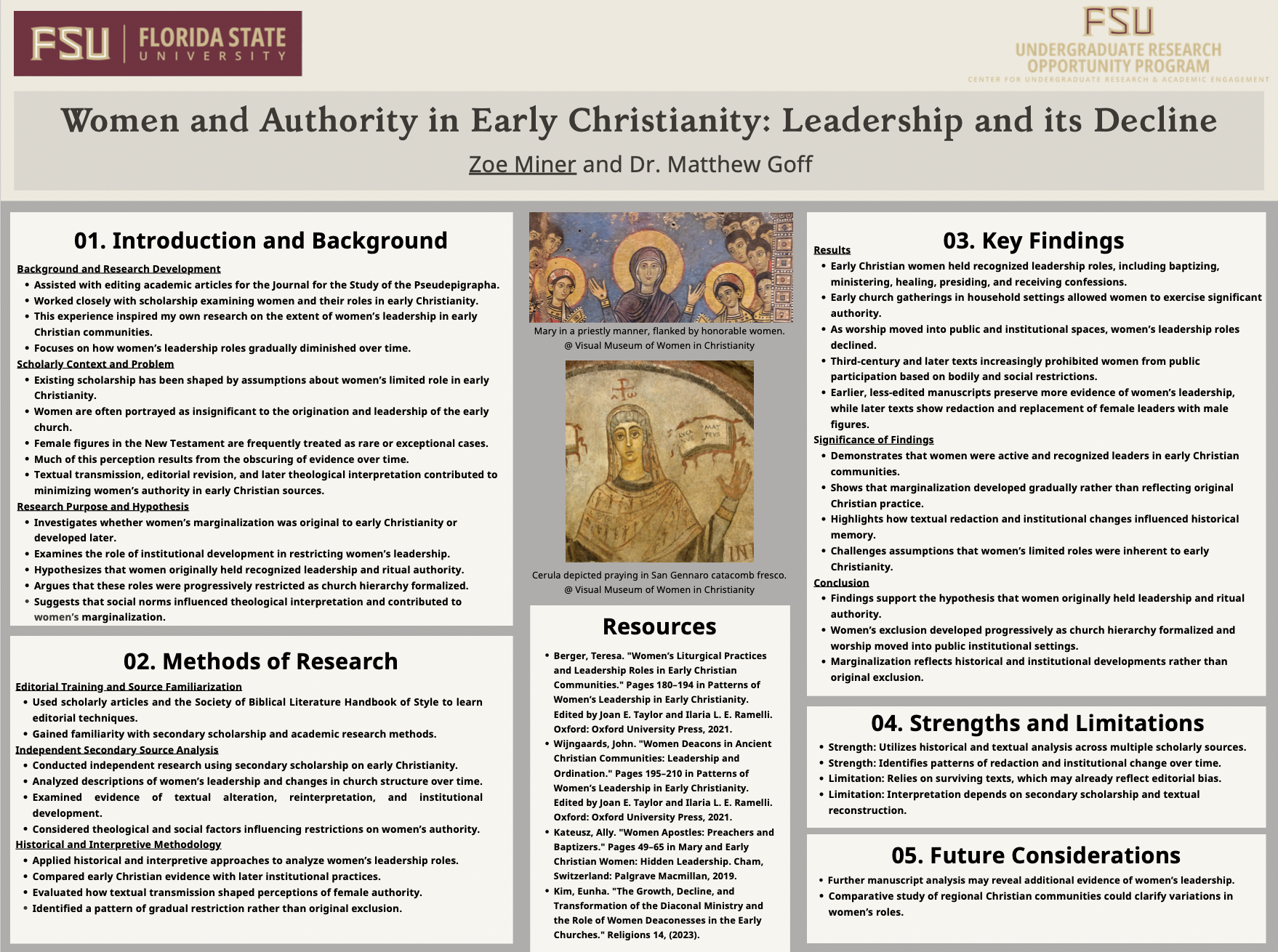
My research explored women leadership roles in the early Christian church and how those roles were diminished as the church became more institutionalized. Investigating this question is important because it challenges long-standing assumptions about women’s roles in Christianity and reveals how societal and institutional developments led to the marginalization of women in and out of the church. This research utilizes a historical and interpretive lens, analyzing various scholarship in order to understand women’s leadership in early Christian communities and evaluating how early evidence of women’s authority in the church was limited and obscured over time. Investigation into the sources showed that in early christian communities, women held strong leadership roles including baptizing, presiding, ministering, healing, and receiving confessions. Additionally, household-focused assemblies allowed for women to be significantly involved in church authority. As worship increasingly shifted into public spaces, leadership roles for women declined. Furthermore, texts from the third century onwards prohibited women from taking part in public worship on account of bodily functions such as menstruation or childbirth. Additionally, the research argues that modern assumptions on the type of leadership roles women had in the early church predominantly come from shortened and censored text. The oldest and least censored text include the most information on female authority and leadership. The study looks at how manuscripts have been redacted by inserting male leaders in place of women who held clear authoritative roles.
Keywords: religion, women, early christianity