
Research Symposium
26th annual Undergraduate Research Symposium, April 1, 2026
Nikolas Kraft Poster Session 4: 3:00 pm - 4:00 pm / Poster #94
BIO
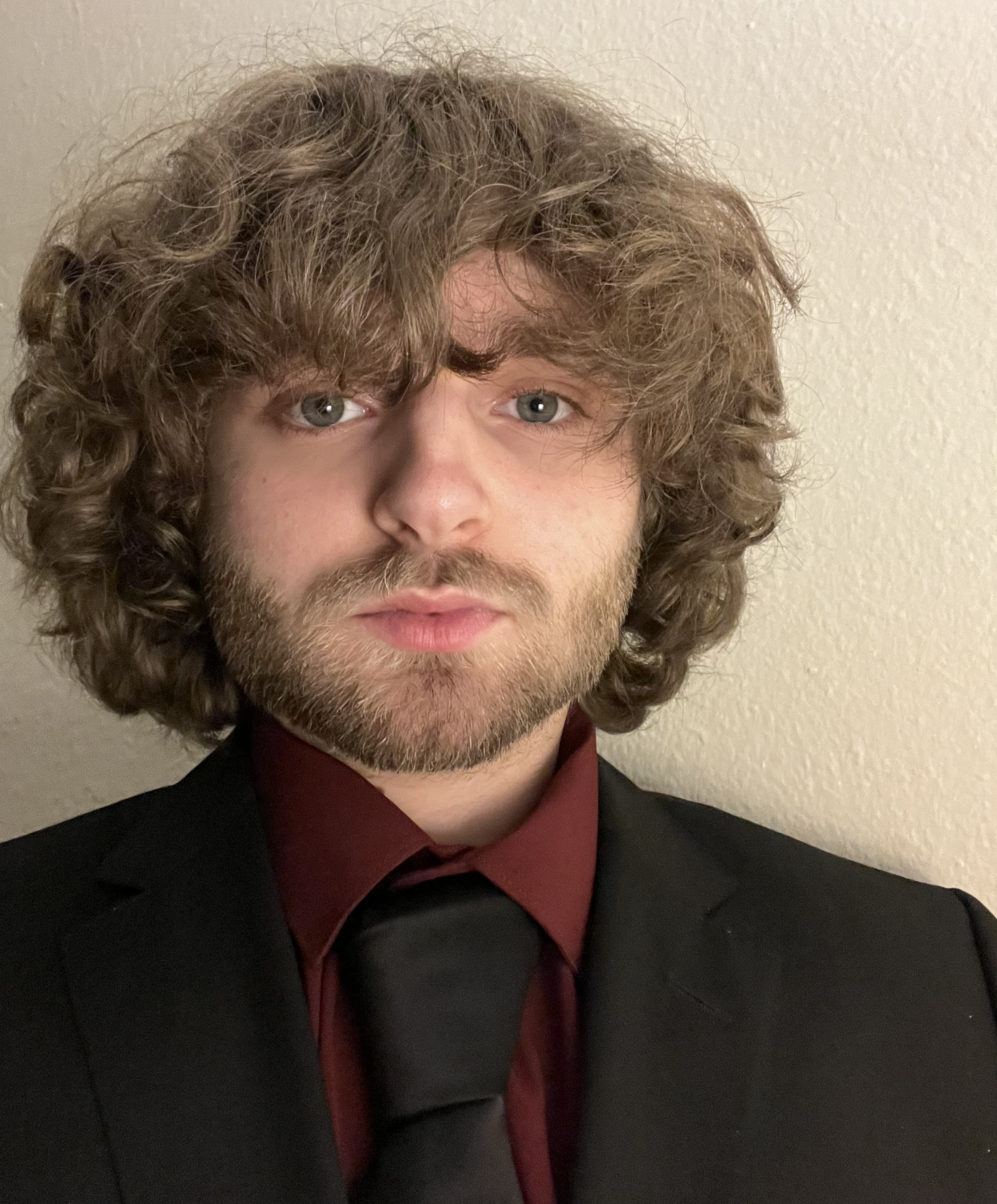
Nikolas Kraft is a second-year, honors, pre-medical sophomore at Florida State University where he is pursuing a Bachelor of Science in Biology along with a minor in chemistry. Additionally, Nikolas is involved in various on-campus organizations and societies such as USSTRIDE, RENEW, Phi Beta Kappa, CELLS, Omicron Delta Kappa, and ACE.
Prior to his work in research, Nikolas obtained his EMT certification through Tallahassee State College. During this time, he accumulated 350 hours in prehospital and hospital emergency care settings. After working as an EMT, Nikolas Kraft became an active volunteer for Big Bend Hospice, where he now provides bedside support and assistance for the staff. In addition to his volunteering position, Nikolas also works as an organic chemistry tutor for ACE at FSU.
Most of his current work has been, and future work will be, involved in biomedical and immunological fields. His most recent project was done under his mentor, Dr. Jingjiao Guan. Under Dr. Guan's mentorship, Nikolas was involved in macrophage cultivation and passaging, microscopy, imaging, and more. His latest project had him synthesize fluorescent particles required to transport amyloids into macrophages.
His future endeavors lie within biomedical research with a particular focus on muscular dystrophy, cardiac conditions, and neurological disorders. He intends to continue his education and research in medical school in hopes of becoming a cardiologist.
Development of Engineered Microparticles for Probing Insulin Balls
Authors: Nikolas Kraft, Jingjiao GuanStudent Major: Biological Sciences
Mentor: Jingjiao Guan
Mentor's Department: Department of Chemical and Biomedical Engineering (CBE) Mentor's College: FAMU-FSU College of Engineering Co-Presenters:
Abstract
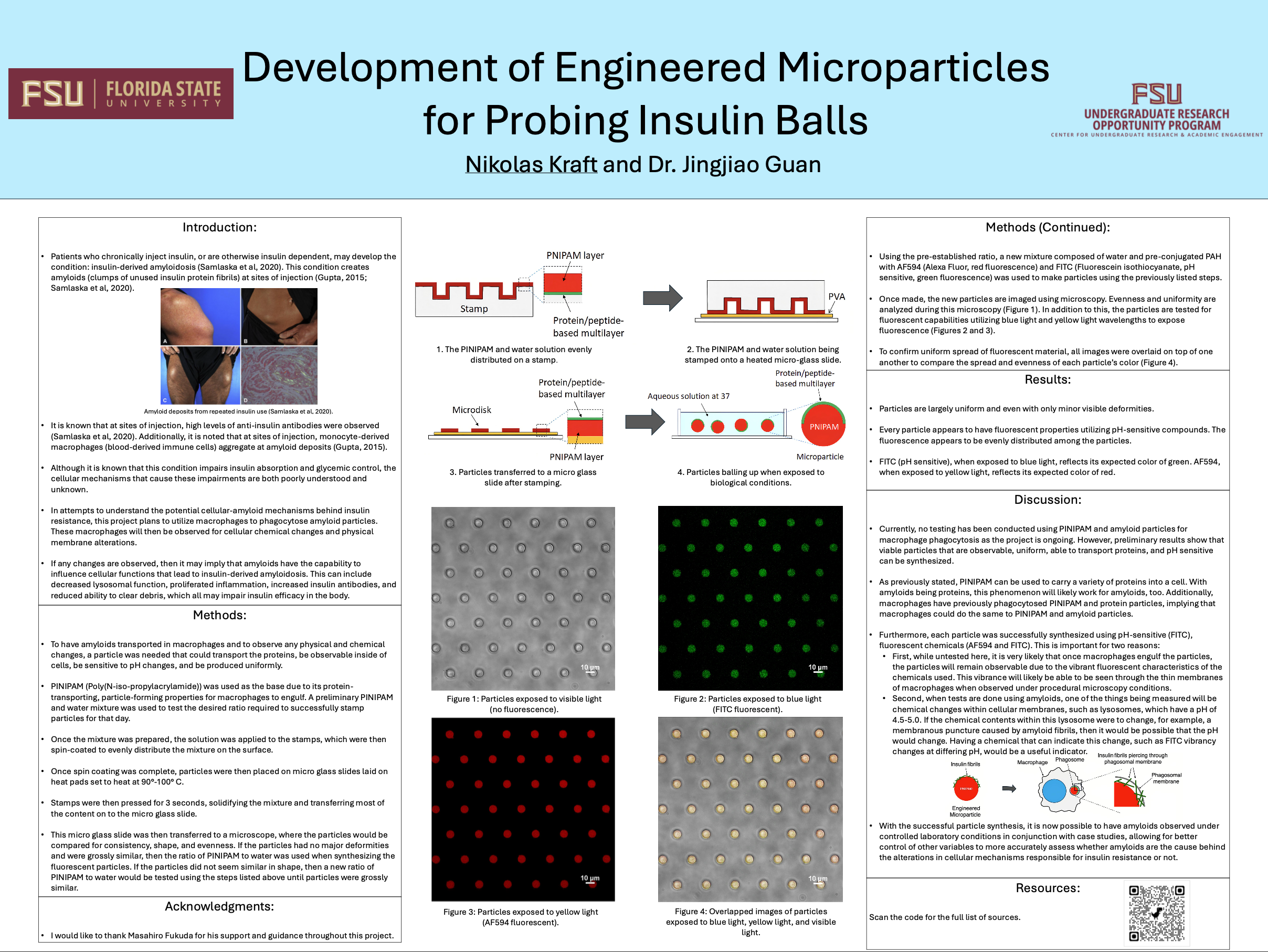
Insulin-derived amyloidosis develops large deposits of amyloid fibrils at sites of injection along with insulin resistance. Due to its rarity, scientists have a poor understanding as to how this happens. This project aims to evaluate how the macrophage-amyloid interactions may lead to insulin derived amyloidosis. Prior to utilizing amyloids, a particle was needed that is uniform, able to transport amyloids, detect changes in cellular environments, and be observable in cells. With these requirements in mind, an experimental fluorescent, circular, pH sensitive particle was produced. To test the fluorescent capabilities of these particles, a microscope with varying visible light wavelengths was used. If the particle emitted expected, different, and vibrant colors when exposed to different wavelengths, it was considered observable. This fluorescent property was achieved using AF594 (Alexa Fluor 594), and pH-sensitive FITC (Fluorescein itsothiocyanate). As for the uniformity, microscopic imaging was utilized to measure the diameters of particles and compare them for consistency in size and shape. Results showed that the method could produce fluorescent, uniform, and pH-sensitive particles to transport amyloids. This is significant because it implies that amyloid-macrophage interactions can be observed under laboratory conditions to detect chemical or physical changes within the cells. This would allow for a more accurate determination of whether the cellular mechanisms behind insulin-derived amyloidosis are caused by amyloids or other factors through artificially controlling variables that may contribute to insulin-derived amyloidosis and insulin resistance.
Keywords: Particles, amyloids, macrophages, fluorescence, microscopy