
Research Symposium
26th annual Undergraduate Research Symposium, April 1, 2026
Elisabeth Zink Poster Session 2: 10:45 am - 11:45 am / Poster #124

BIO
Elisabeth Zink is a senior at Florida State University majoring in Communication Sciences and Disorders. Her honors thesis, Developing a Voice Quality Survey: A Quantitative Review, examines how perceptual training can improve the reliability of voice quality ratings among speech language pathology students. Her research was conducted under the mentorship of Dr. Richard Morris. Elisabeth is especially interested in working with individuals with special needs and supporting communication development. After graduating with a Bachelor of Science in Communication Sciences and Disorders, she plans to pursue a Master’s degree in Speech Language Pathology.
Developing a Voice Quality Survey: A Quantitative Review
Authors: Elisabeth Zink, Dr. Richard MorrisStudent Major: Communication Sciences and Disorders
Mentor: Dr. Richard Morris
Mentor's Department: Communication Sciences and Disorders Mentor's College: Communication Co-Presenters: NA
Abstract
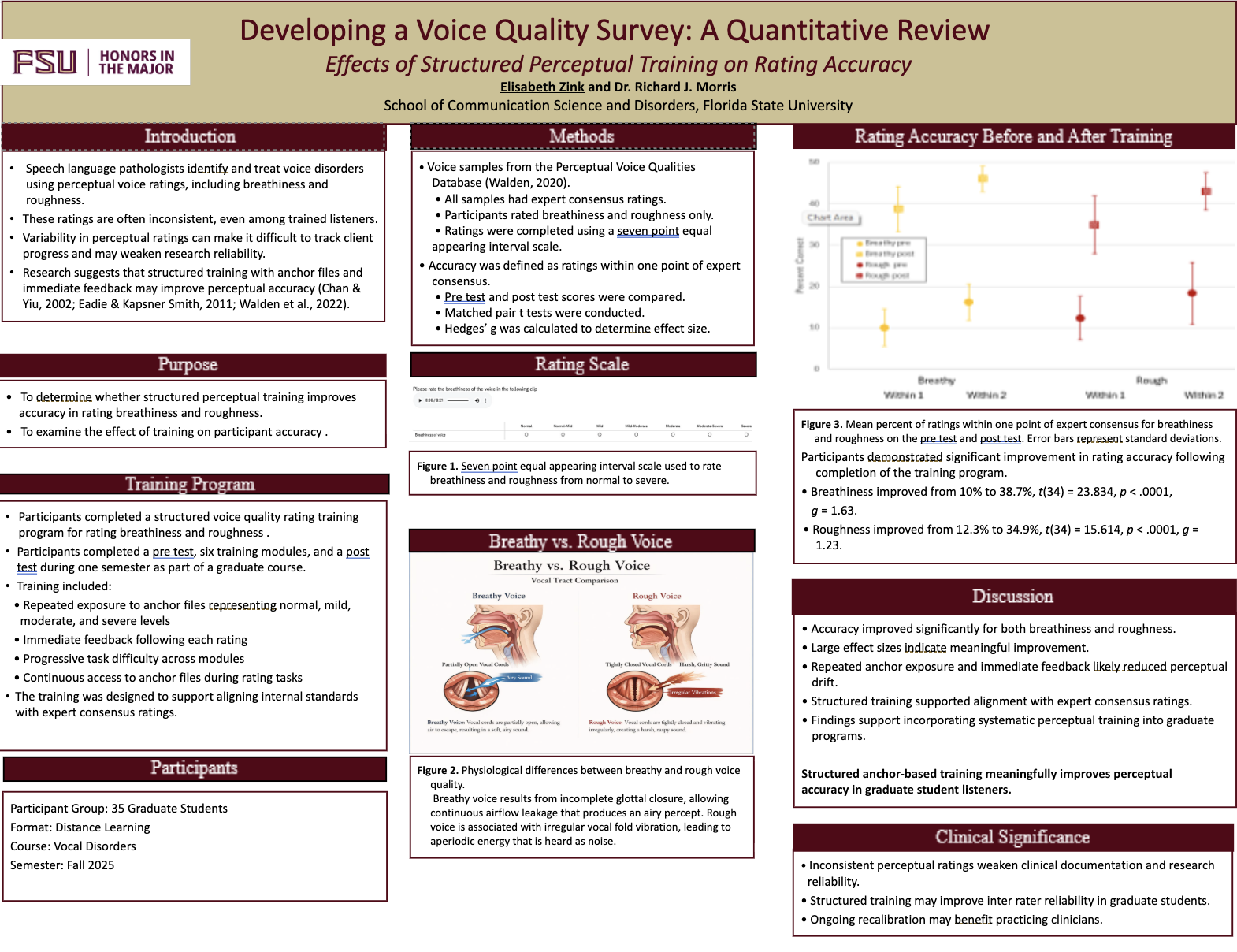
Accurate perceptual evaluation of voice quality is an essential skill for speech language pathology students. However, rating voice qualities such as breathiness and roughness remains difficult, even after clinical and academic training. Variability in ratings can make it harder to track client progress and can weaken research reliability. Previous research suggests that structured training that includes anchor files and immediate feedback may improve perceptual accuracy.
The purpose of this study was to determine whether a structured voice quality rating training program would improve accuracy in rating breathiness and roughness among graduate student listeners. Thirty five second year distance learning graduate students completed a pre test, six training modules, and a post test as part of a required course. The training modules included repeated exposure to anchor files representing normal, mild, moderate, and severe levels of breathiness and roughness. Immediate feedback was provided after each rating. Accuracy was defined as ratings within one point of expert consensus on a seven point scale.
Results showed significant improvements in rating accuracy for both breathiness and roughness from pre test to post test, with large effect sizes. These findings support the use of structured perceptual training in graduate programs to improve consistency in voice quality ratings.
Keywords: Voice, Breathiness and roughness, Listener training , Rating reliability