
Research Symposium
26th annual Undergraduate Research Symposium, April 1, 2026
Bryan Alex Poster Session 1: 9:30 am - 10:30 am / Poster #47

BIO
Bryan Alex is a junior at Florida State University majoring in Behavioral Neuroscience with minors in Chemistry & Child Development and on a track to Md-PhD. His current research is in Virology, specifically on how membrane fusion can increase the efficiency of cancer and gene therapies. Moreover, he is involved in research projects in the Psychology department of FSU and the Environmental Science department of FAMU. Outside of research he is credited with Academic Honors and the Vires Scholarship.
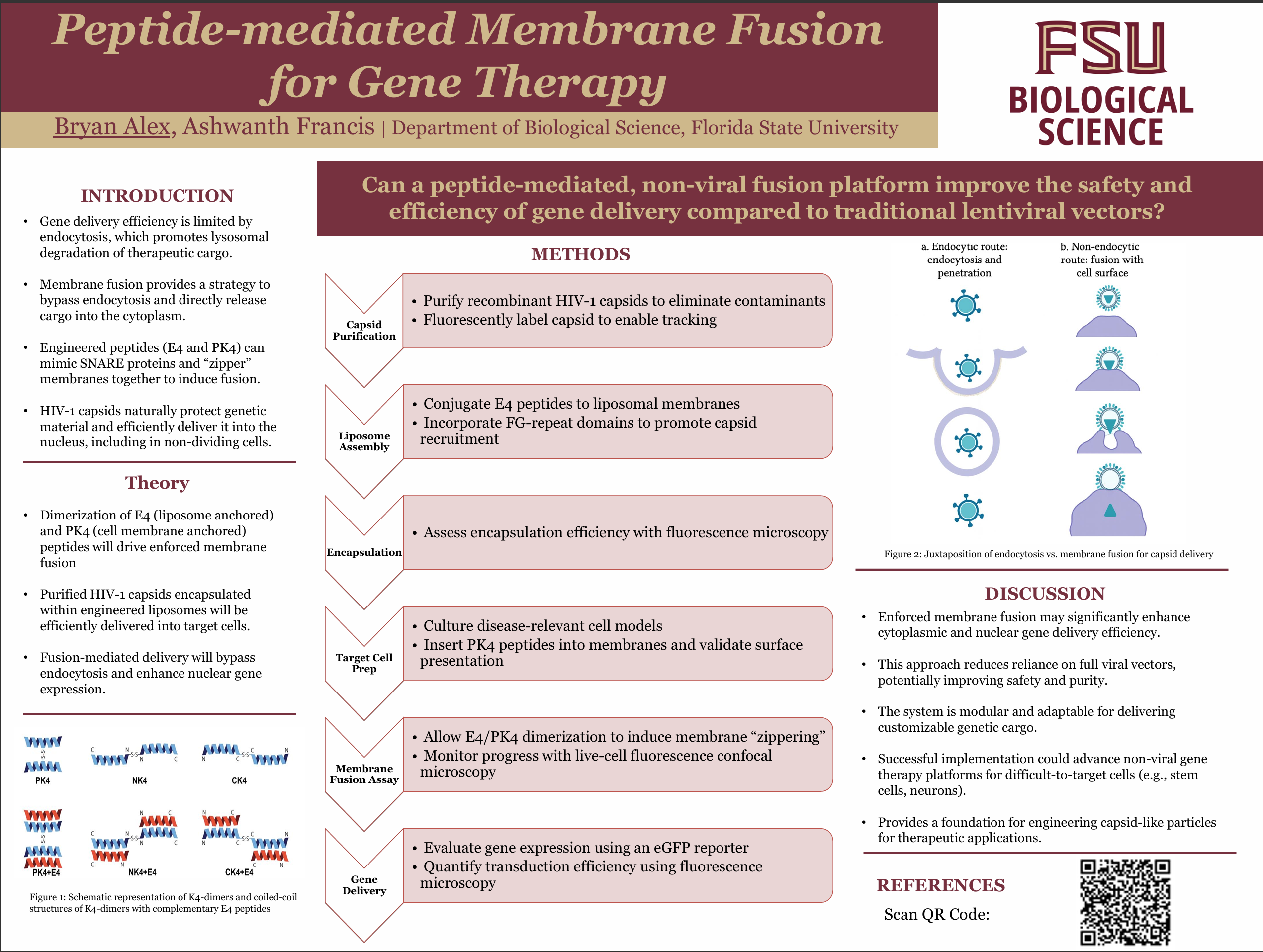
Peptide-Mediated Membrane Fusion for Gene Therapy
Authors: Bryan Alex, Dr. Ashwanth FrancisStudent Major: Behavioral Neuroscience
Mentor: Dr. Ashwanth Francis
Mentor's Department: Virology Mentor's College: College of Arts and Sciences Co-Presenters:
Abstract
Membrane fusion offers a promising strategy to improve gene delivery by bypassing
endocytosis, a pathway that often results in lysosomal degradation and reduced therapeutic
efficiency. This project evaluates an enforced membrane fusion approach to enhance targeted
gene delivery using recombinant peptide dimerization. Building on prior work demonstrating that
engineered peptides (E4 and PK4) can promote membrane fusion between synthetic liposomes
and cellular membranes, we aim to adapt this system to deliver purified HIV-1 capsids into cells.
The HIV capsid naturally protects and transports viral RNA into the nucleus, including in non-
dividing cells such as stem cells and neurons, making it an attractive gene delivery vehicle.
However, traditional lentiviral vectors face limitations including impurities, limited fusogenicity,
and safety concerns. To address these challenges, we propose ultra-purifying HIV capsids and
encapsulating them within de novo assembled liposomes functionalized with E4 peptides.
These peptides are designed to recruit capsids into liposomes and mediate high-affinity
interactions with complementary PK4 peptides anchored to target cell membranes.
Dimerization of E4 and PK4 is expected to mimic SNARE-mediated membrane fusion, driving
liposome–cell membrane fusion and enabling controlled cytoplasmic release of capsid-
contained genetic material. Successful nuclear delivery and gene expression will be evaluated
using an eGFP reporter system and fluorescence-based assays.
If successful, this platform would establish a modular, non-viral strategy for efficient and
targeted gene delivery, enabling the reconstitution of capsid-like particles capable of delivering
customizable genetic cargo for therapeutic applications.
Keywords: Gene, Cancer, HIV-1, Membrane Fusion