
Research Symposium
26th annual Undergraduate Research Symposium, April 1, 2026
Shayna Slatkin Poster Session 1: 9:30 am - 10:30 am / Poster #104

BIO
Shayna Slatkin is a sophomore at Florida State University pursuing a Bachelor of Science in Psychology and a Bachelor of Science in Human Development and Family Sciences. She is involved in undergraduate research through the Undergraduate Research Opportunity Program (UROP), where she works in a family research lab under the mentorship of Dr. Yinan Li. Her research interests focus on family relationships, attachment, and developmental processes that influence emotional and social outcomes across the lifespan.
Through her research experience, Shayna has contributed to projects examining family dynamics and psychological development, gaining experience with qualitative analysis and research methods. She is particularly interested in how early family relationships and social environments shape well-being and interpersonal functioning.
Beyond research, Shayna is passionate about working with children and families and has gained experience through volunteer work and child-focused programs. She plans to pursue graduate training and ultimately earn a doctoral degree in Occupational Therapy, intending to work in pediatric settings. Shayna hopes to combine her background in research and family science to support children’s development and help families navigate challenges that impact health and well-being
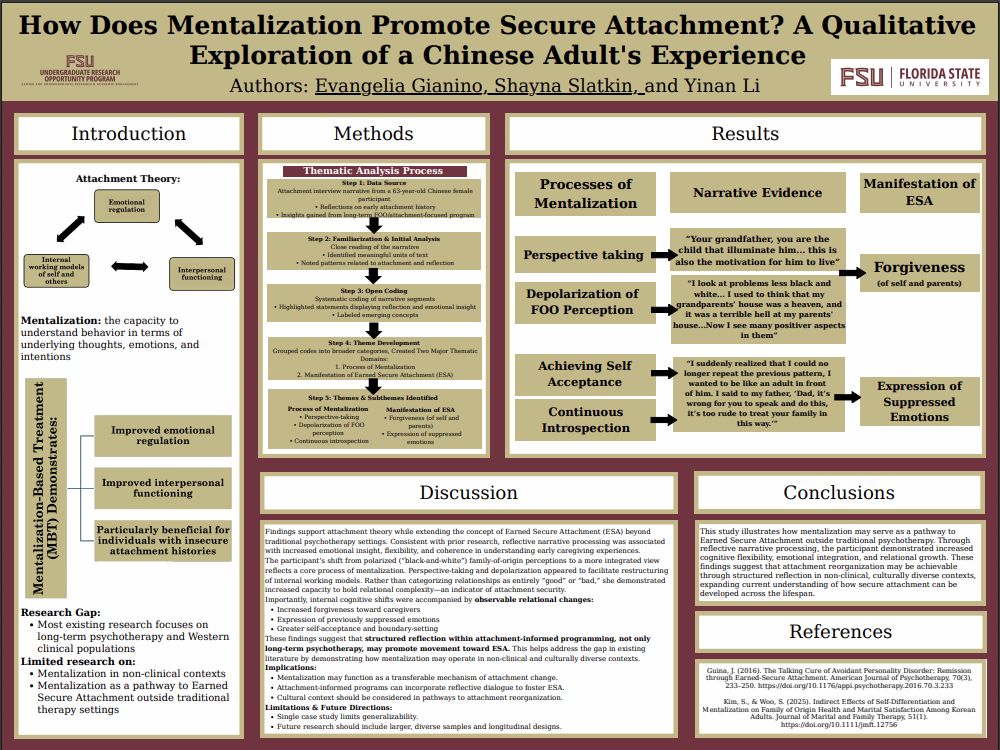
How Does Mentalization Promote Secure Attachment? A Qualitative Exploration of a Chinese Adult's Experience
Authors: Shayna Slatkin, Yinan LiStudent Major: Psychology & Human Development and Family Science
Mentor: Yinan Li
Mentor's Department: Human Development and Family Science Mentor's College: Anne Spencer Daves College of Education, Health, and Human Sciences Co-Presenters: Evangelia Gianino
Abstract
Earned Secure Attachment (ESA) is a newly developed construct that reframes attachment as malleable, challenging the assumption that early insecure attachment patterns remain fixed throughout life. While mentalization, the capacity to understand one’s own and others’ behaviors in terms of underlying thoughts and intentions, has been identified as a key pathway toward ESA, existing research has largely examined this process among adults in long-term psychotherapy within Western, Educated, Industrialized, Rich, and Democratic (WEIRD) populations. Less is known about how mentalization functions in non-clinical settings. The present study aims to broaden current understanding of ESA by exploring how mentalization may operate as an effective pathway within attachment-informed interventions outside traditional therapeutic frameworks. This qualitative study analyzes the attachment narrative of a 63-year-old Chinese woman who participated in a long-term Family of Origin (FOO), attachment-focused program. Her narrative reflects on her early attachment experiences as well as the insights and changes gained through program participation. Using thematic analysis, we examined themes related to the process of mentalization and the manifestation of earned secure attachment. Findings revealed two overarching groups of themes: (1) the development of mentalization and (2) the manifestations reflecting ESA. Subthemes within the mentalization process included increased perspective-taking, reinterpretation of parental behavior, and emotional insight. Manifestations of ESA included forgiveness of self/parents and expression of suppressed emotions. Theoretically, this study enriches the understanding of mentalization as a pathway to ESA through a qualitative, bottom-up perspective. Practically, findings offer insights for designing culturally responsive attachment interventions in non-clinical, non-WEIRD adult populations.
Keywords: Mentalization, Secure Attachment