
Research Symposium
26th annual Undergraduate Research Symposium, April 1, 2026
Kate Khvorostiana Poster Session 2: 10:45 am - 11:45 am / Poster #32

BIO
Kate Khvorostiana is a first-year student on a path to complete a Bachelor of Arts in International Affairs. She is a part of the Class of 2029 cohort of the prestigious Presidential Scholars program, where she has engaged in various advancement and academic discourse opportunities. Outside of the program, Kate is actively involved with on-campus organizations such as the Delta Zeta sorority, the Kappa Alpha Pi Pre-Law Fraternity, FSU Honors, and Seminoles Engaged in Politics. While she is interested in studying global politics and international conflict, she has found a passion for exploring the Eastern European region, as she is originally from Ukraine. Kate's cultural roots have driven her desire to study the current relations and consequently prompted her to co-found a nonprofit organization, "Bridging Borders for Ukraine," which aims to teach war-affected students English. This UROP project builds on Kate's previous involvement in her local Miami-Dade community, where she actively participated in Teen Court proceedings as a student volunteer. Upon completion of her bachelor's degree, Kate plans to attend law school on a path towards a career in international law.
Accessing Florida’s Teen Court Procedures: Leon County
Authors: Kate Khvorostiana, Dr. Alexandra CockerhamStudent Major: International Affairs and Political Science
Mentor: Dr. Alexandra Cockerham
Mentor's Department: Department of Political Science Mentor's College: College of Social Sciences and Public Policy Co-Presenters: Thalia Dorisca and Sophia Antoni
Abstract
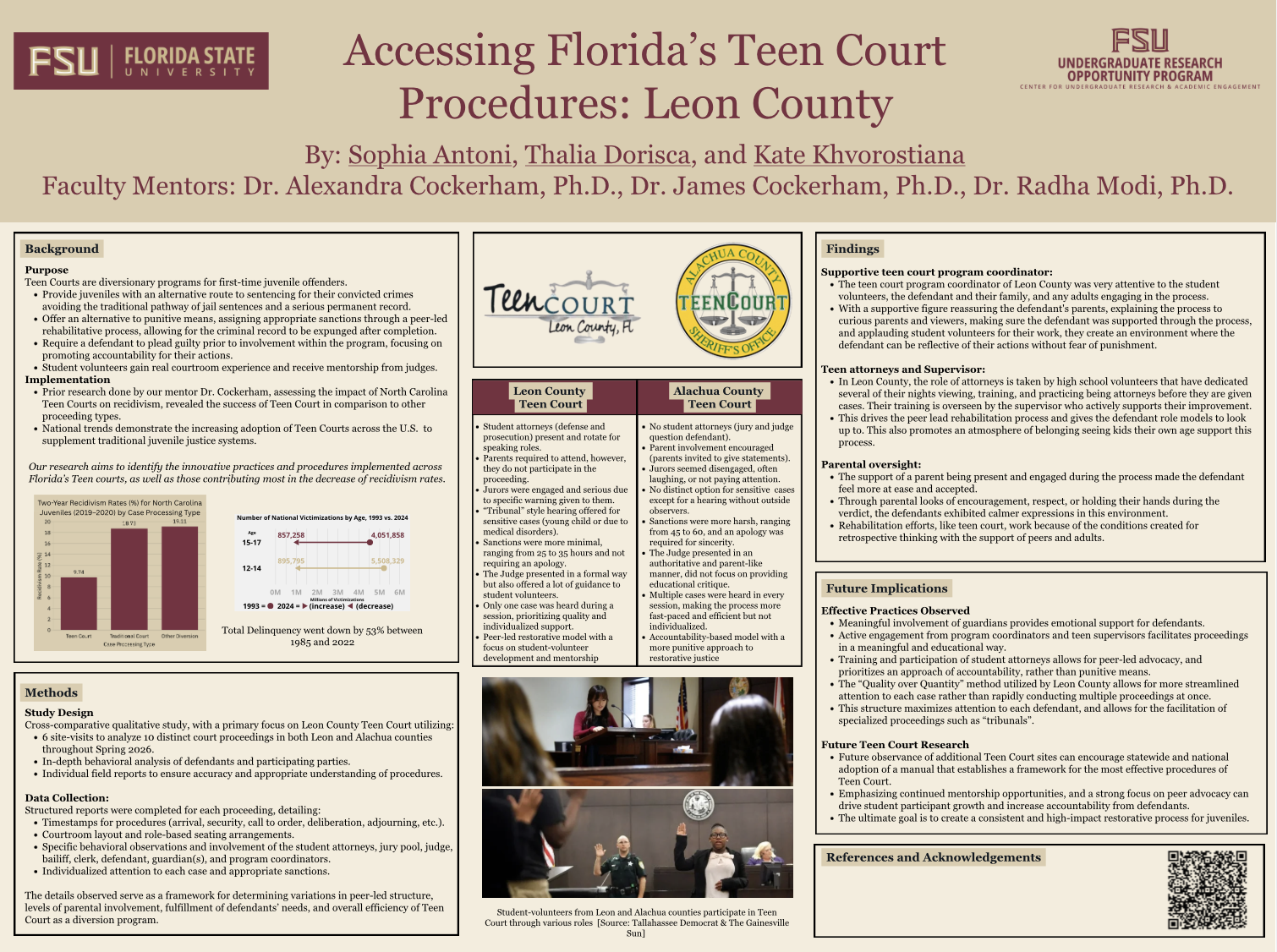
Teen Courts are a diversionary program meant to provide juveniles with an alternative route to that of the traditional justice system, which prioritizes punitive means. The hope is that through a restorative justice approach, including peer involvement to promote accountability and reflection, the juvenile will come to understand the harm they have caused to society, leading to a lower recidivism rate among juveniles. In our research project, we aim to identify the innovative practices and procedures that take place across Teen Courts in Florida and view the mechanisms through which they reduce recidivism. To achieve this, a comparative analysis of Leon County and Alachua County Teen Courts was conducted, focusing on qualitative data gathered through observation reports from various site visits to Teen Court sessions. The observations showed that Leon County employs a “Quality over Quantity” approach to handling Teen Court cases, by taking on one case per session, having teen attorneys who were trained by a Teen Attorney Supervisor, as well as modifying their process to a Tribunal-style teen court session to accommodate sensitive cases. Considering these findings in conjunction with Alachua’s as well as future observations of other Teen Courts in Florida, we seek to pinpoint optimal procedures for Teen Courts nationwide to adopt.
Keywords: Teen Court, Recidivism, Political Science