
Research Symposium
26th annual Undergraduate Research Symposium, April 1, 2026
Santiago Rojas Poster Session 2: 10:45 am - 11:45 am / Poster #136

BIO
Santiago Rojas is a first-year student at Florida State University pursuing a Bachelor of Science in Mechanical Engineering with minors in Business Analytics and Mathematics. He is involved in undergraduate research focused on developing a diver-assist underwater exoskeleton, where he helps design a waterproof wrist-mounted control system using force-sensitive resistors and microcontrollers. His work emphasizes practical mechatronics solutions for underwater environments, and he collaborates with a research team.
Rojas also serves as Project Manager for a team in NASA’s L’SPACE Proposal Writing Evaluation Experience. In this role, he led an eleven-member team that designed a swarm robotics framework for autonomous planetary exploration and servicing missions. The team’s proposal was selected as one of the top concepts in the program and received a $10,000 NASA award.
Outside of research, he is an active member of Theta Tau Professional Engineering Fraternity and the Society of Hispanic Professional Engineers (SHPE). Rojas plans to pursue a career in robotics, aerospace systems, or advanced manufacturing while continuing to contribute to innovative engineering research and development.
Under Water Exoskeleton for Diver Assistance
Authors: Santiago Rojas, Taylor HigginsStudent Major: Mechanical Engineering
Mentor: Taylor Higgins
Mentor's Department: Mechanical Engineering Mentor's College: College of Engineering Co-Presenters:
Abstract
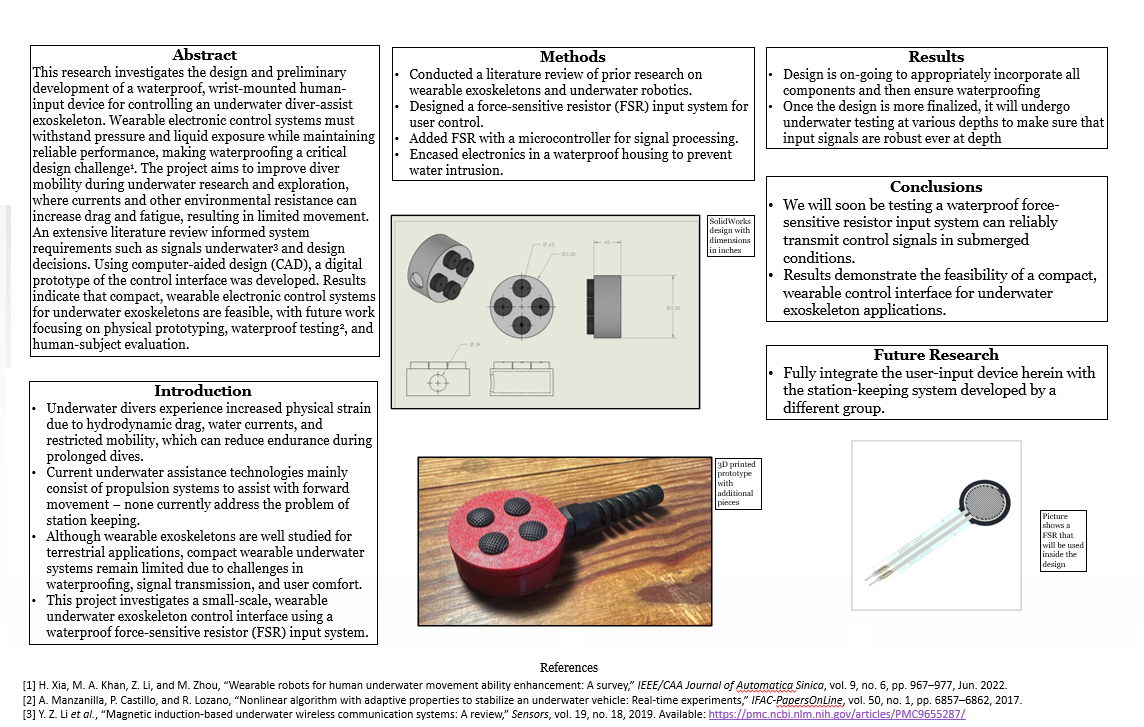
This research investigates the design and preliminary development of a waterproof, wrist-mounted human-input device for controlling an underwater diver-assist exoskeleton. Wearable electronic control systems must withstand pressure and liquid exposure while maintaining reliable performance, making waterproofing a critical design challenge. The project aims to improve diver mobility during underwater research and exploration, where currents and other environmental resistance can increase drag and fatigue, resulting in limited movement. An extensive literature review informed system requirements such as signals underwater and design decisions. Using computer-aided design (CAD), a digital prototype of the control interface was developed. Results indicate that compact, wearable electronic control systems for underwater exoskeletons are feasible, with future work focusing on physical prototyping, waterproof testing, and human-subject evaluation.
Keywords: Mechatronics, Exoskeleton, Underwater.