
Research Symposium
26th annual Undergraduate Research Symposium, April 1, 2026
Aashi Patel Poster Session 3: 1:45 pm - 2:45 pm / Poster #31

BIO
Aashi Patel is a second-year undergraduate student at Florida State University majoring in Biological Science and Psychology, with minors in Chemistry and Child Development, and is on the Pre-Medical track. She is currently a research assistant within the Martin Lab, working under the mentorship of Danielle N. Jones and Colin B. Bowyer, where she works on various projects studying the effect of cognitive tasks on performance using electroencephalography (EEG) data. She wants to use this experience to pursue a career in medicine with a prospective path in neuroscience.
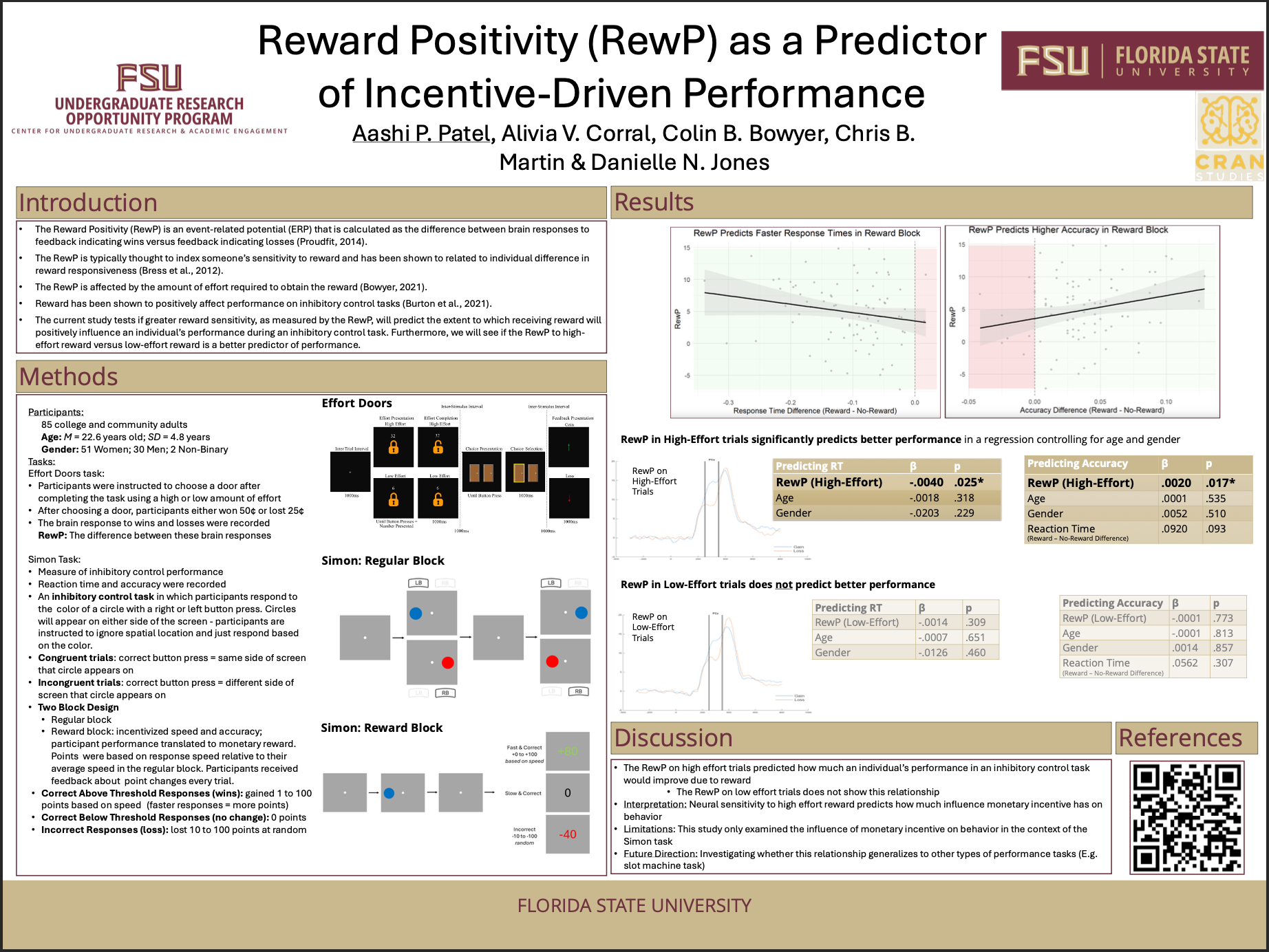
Reward Positivity (RewP) as a Predictor of Incentive-Driven Performance
Authors: Aashi Patel, Danielle JonesStudent Major: Biological Science & Psychology
Mentor: Danielle Jones
Mentor's Department: Psychology Mentor's College: College of Arts and Sciences Co-Presenters:
Abstract
Past work has reliably shown that providing individuals with monetary incentives during inhibitory control tasks leads them to have improved task performance. The Reward Positivity (RewP) is an event-related potential (ERP) that indexes an individual’s sensitivity to reward. We hypothesized that a greater RewP would predict the extent to which receiving reward would improve an individual’s performance during an inhibitory control task. First, 90 student and community participants completed an Effort Doors task while electroencephalography (EEG) data was recorded. The RewP was defined as the difference between their brain response to feedback indicating that they won or lost money. Subsequently, participants completed a two-block Simon task: the first block quantified their baseline speed and the second block provided a monetary incentive for correct responses that were faster than their baseline average speed. The difference between response times in the first and second block was calculated to quantify the effect of reward on performance. A significant positive relationship was found between the RewP response and this difference score, suggesting that individual differences in reward sensitivity, as indexed by RewP, play a role in how strongly incentives modulate task performance.
Keywords: EEG, Reward Positivity, Brain Response