
Research Symposium
26th annual Undergraduate Research Symposium, April 1, 2026
Nicholas Rattigan Poster Session 2: 10:45 am - 11:45 am / Poster #132

BIO
Nicholas is a freshman at FSU currently pursuing a Bachelor's degree in Electrical Engineering. He is from Pittsburgh, PA and is interested in working in the space sector after graduation.
Recrystallization Behavior of Cold Rolled Niobium with Varying Initial Grain Sizes
Authors: Nicholas Rattigan, Dr. Shreyas BalachandranStudent Major: Electrical Engineering
Mentor: Dr. Shreyas Balachandran
Mentor's Department: Department of Materials Science and Engineering Mentor's College: FAMU-FSU College of Engineering Co-Presenters:
Abstract
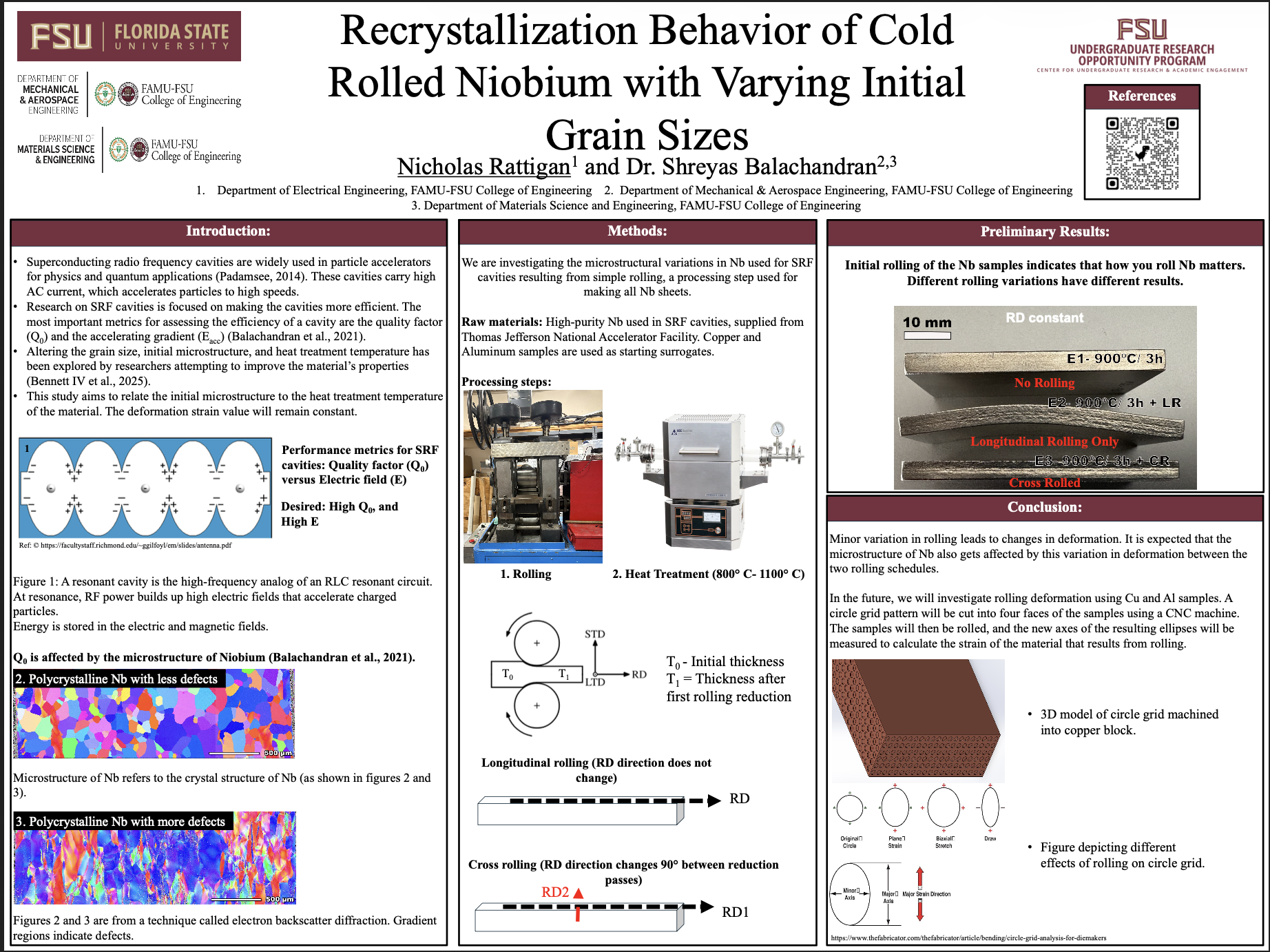
High purity niobium (Nb) is a technologically important material for superconducting radio frequency (SRF) linear accelerators for electrons and ions (Padamsee, 2014). An important metric for efficiency of these linear accelerators is the quality factor (Q0). The higher the quality factor, the better the cryogenic efficiency. Q0 is directly proportional to the residual surface resistance (Rs) of Nb (Posen et al., 2016). Recent work by FSU researchers (Khanal et al., 2024) shows that Rs of Nb is dependent on the microstructure of Nb after final cavity heat treatments. However, the metallurgical variables in the starting material that control the recrystallization are not well known. In high-purity Nb, the metallurgical variable of the starting billet is the initial grain size (Bennett IV et al., 2025).
In this study, we will perform recrystallization/heat treatment studies on cold-rolled starting Nb microstructures, namely: bi-crystal (a few cms), medium grain (1mm), and fine grain (10s of microns). We will assess the impact of the initial microstructure on the final structure after heat treatment. Here we will quantify the heat treatment temperature as a function of initial microstructure at the same deformation strain value. The preliminary work presented here is a progress report on characterizing the rolling deformation that will be performed.
Keywords: Materials, Engineering, Niobium