
Research Symposium
26th annual Undergraduate Research Symposium, April 1, 2026
Luke Napolitano Poster Session 1: 9:30 am - 10:30 am / Poster #81
BIO
Luke Napolitano is a Pre-Finance major at Florida State University, studying in the Honors College under the Presidential Scholars Program. Luke's research mentor is Erik Rawls. Luke wants to go to medical school after graduating college.
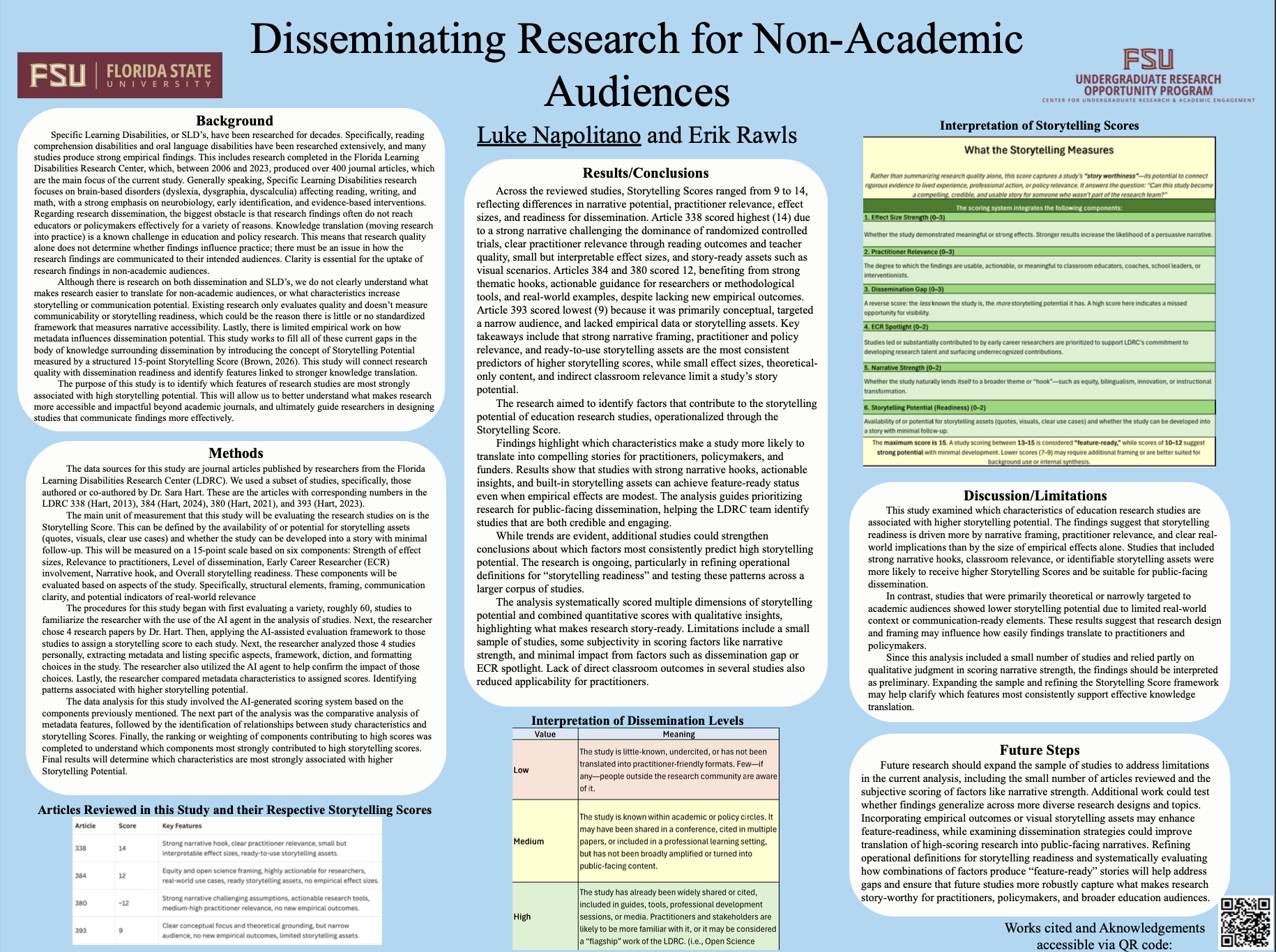
Disseminating Research for Non-Academic Audiences
Authors: Luke Napolitano, Erik RawlsStudent Major: Pre-Finance
Mentor: Erik Rawls
Mentor's Department: Educational Psychology and Learning Systems. Mentor's College: College of Education, Health, and Human Sciences. Co-Presenters:
Abstract
Despite decades of research on specific learning disabilities (SLDs), many important findings never reach the educators and policymakers who could use them most. We do not clearly understand what makes research findings easier to translate for non-academic audiences. This project addresses that gap by examining how certain characteristics of research papers influence a study’s “storytelling potential”. Storytelling potential refers to a study’s ability to connect rigorous evidence to lived experience, professional action, or policy relevance. In focusing on 4 research studies led by Dr. Sara Hart at the Florida Learning Disabilities Research Center, the current process uses an AI-assisted approach to effectively evaluate different characteristics of research related to dissemination and translation. Each study receives a 15-point Storytelling Score based on six components: strength of effect sizes, relevance to practitioners, level of dissemination, involvement of early career researchers (ECRs), narrative hook, and overall storytelling readiness to identify which features are most strongly linked to high storytelling potential. These findings highlight features that improve clarity and real-world impact, helping guide researchers toward stronger knowledge translation and contributing to broader conversations about research. Across the reviewed studies, Storytelling Scores ranged from 9 to 14, with higher scores associated with strong narrative framing, clear practitioner relevance, interpretable effect sizes, and ready-to-use storytelling elements. Studies that were primarily theoretical, narrowly targeted, or lacking empirical outcomes showed lower story potential and dissemination readiness.
Keywords: Dissemination, Specific Learning Disabilities, Storytelling Potential