
Research Symposium
26th annual Undergraduate Research Symposium, April 1, 2026
Mirza Baig Poster Session 2: 10:45 am - 11:45 am / Poster #293

BIO
Mirza Baig is a second-year transfer student at Florida State University pursuing a Bachelor of Science in economics with a minor in mathematics. He has been involved in undergraduate research through the UROP program under the mentorship of Dr. Katie Yewell. Through this experience, he gained exposure to the academic research experience as well as knowledge in the field of economics. Following graduation, Mirza aims to pursue a predoctoral fellowship to further gain exposure to economics-focused research and ultimately matriculate into an economics graduate program.
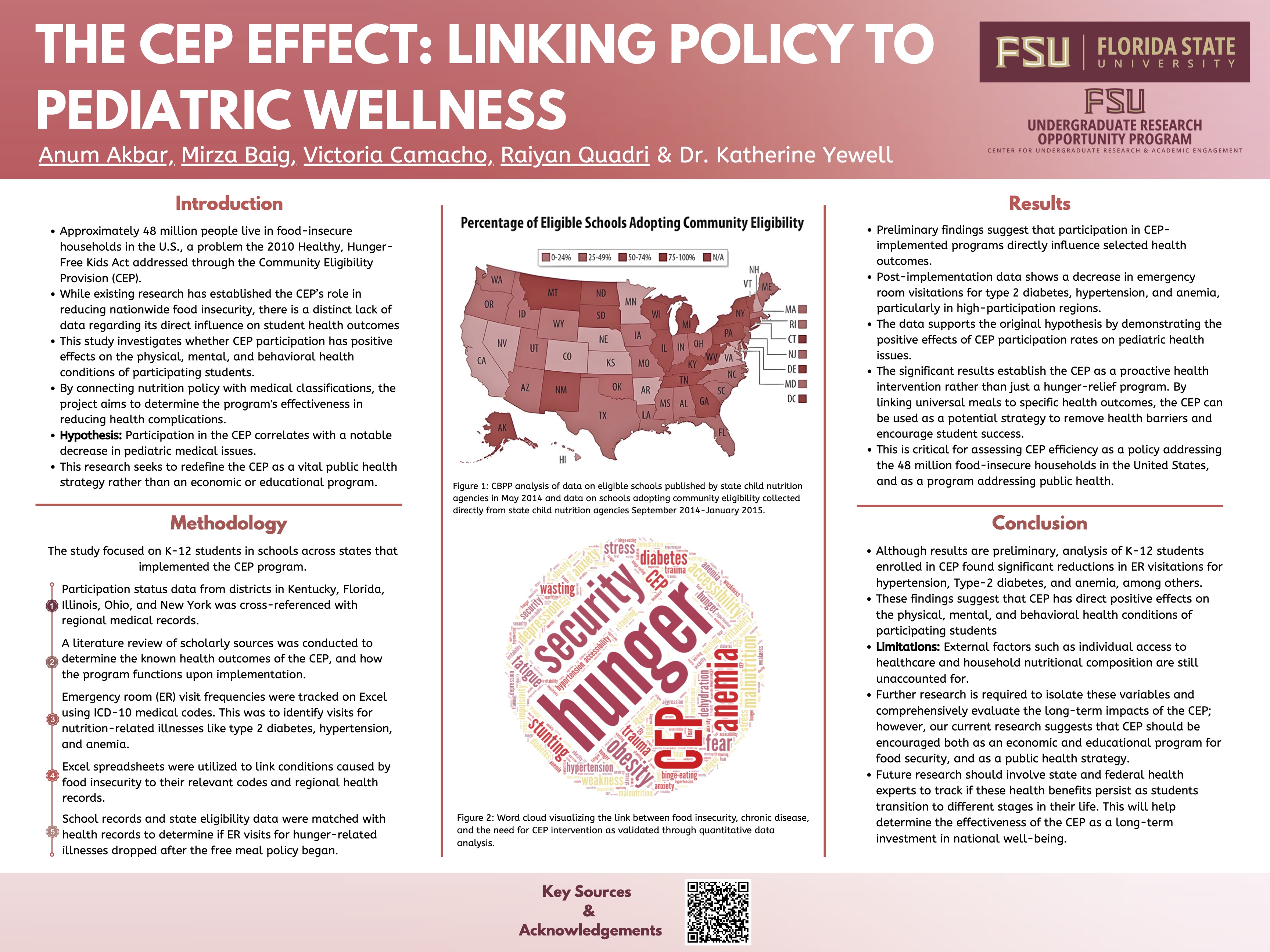
The CEP Effect: Linking Policy to Pediatric Wellness
Authors: Mirza Baig, Dr. Katie YewellStudent Major: Economics
Mentor: Dr. Katie Yewell
Mentor's Department: Department of Economics Mentor's College: College of Social Sciences and Public Policy Co-Presenters: Raiyan Quadri
Abstract
More than 40 million people in the United States experience food insecurity, and a large proportion of those people are school children. To combat this ongoing problem, the government passed the Healthy Hunger-Free Kids Act which helped form the Community Eligibility Provision (CEP), the second-largest food assistance program in the country. The CEP allowed food-insecure children to receive free school meals. While there has been prior research focusing on the impact that the CEP has on food insecurity, there has been virtually no research examining the effect the CEP has on students’ health. Thus, this research project will investigate whether the CEP positively affects students’ health and well-being.
This research project will focus on grade schools (kindergarten through 12th grade) across the country that have implemented CEP. CEP participation will be analyzed at the district level and compared to regional hospital data using ICD-10 codes to evaluate specific diseases such as diabetes, hypertension, and anemia. These codes help identify the purpose and reasoning behind emergency room visitations. The frequency of these hospital ER visits will be used to determine the impact free school meals have on students’ health and well-being. We hypothesise that students who participate in the CEP will demonstrate a lack of hospital ER visits for food-insecurity-related diseases; hence, the CEP will demonstrate an improvement in said students’ health and well-being. After the conclusion of this research project, the findings will demonstrate a working model to scale across the country to combat food insecurity regardless of background.
Keywords: economics; CEP; food insecurity; public policy; pediatric wellness