
Research Symposium
26th annual Undergraduate Research Symposium, April 1, 2026
Brody Mills Poster Session 4: 3:00 pm - 4:00 pm / Poster #252

BIO
Brody Mills is a first-year Benacquisto Scholar and Honors Program student at FSU. He is currently researching under professor Marli Dunietz. He plans to graduate with a dual-degree in Political Science and Economics and either attend law school immediately after graduation, or work in strategic analysis after finishing his undergraduate. His eventual goal is to work in politics.
Political Discussion and Information Transmission under Social Pressure
Authors: Brody Mills, Marli DunietzStudent Major: Political Science
Mentor: Marli Dunietz
Mentor's Department: Political Science Mentor's College: College of Social Science and Public Policy Co-Presenters: Xavier Bauman
Abstract
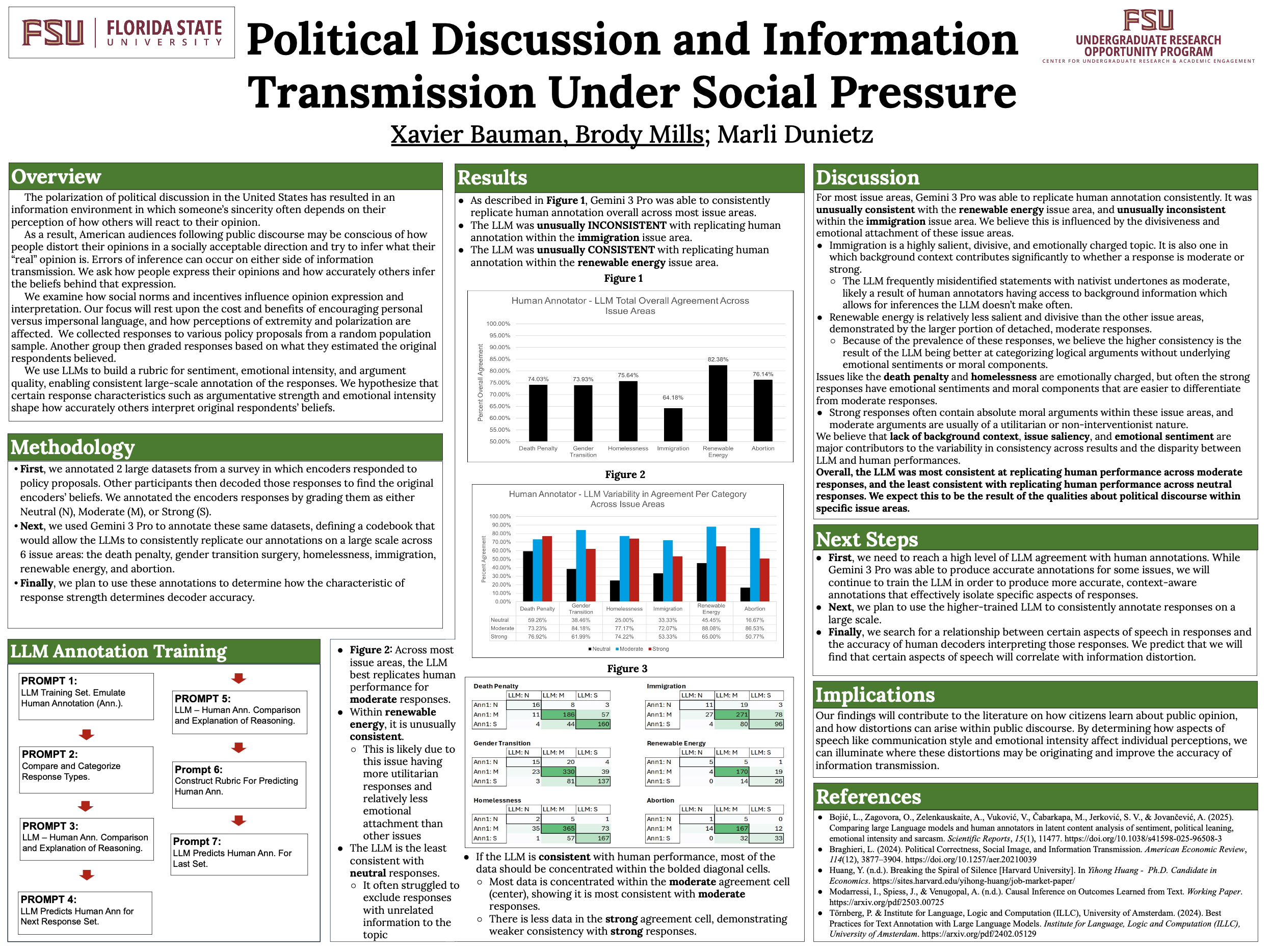
The polarization of political discussion in the United States has resulted in an information environment in which someone’s sincerity often depends on their perception of how others will react to their opinion. At the same time, American audiences following public discourse may be conscious of how people distort their opinions in a socially acceptable direction and try to infer what their “real” opinion is. Errors of inference can occur on either side of information transmission. We ask how people express their opinions and how accurately others infer the beliefs behind that expression.
We examine how social norms and incentives influence opinion expression and interpretation. Our focus will rest upon the costs and benefits of encouraging personal versus impersonal language, and how perceptions of extremity and polarization are affected. We collected responses to various policy proposals from a random population sample. Another group then graded responses based on what they estimated the original respondents believed. We use Large Language Models (LLMs) to build a rubric for sentiment, emotional intensity, and argument quality, enabling consistent large-scale annotation of the responses. We hypothesize that certain response characteristics such as argumentative strength and emotional intensity shape how accurately others interpret original respondents’ beliefs.
Our findings will contribute to the literature on how citizens learn about public opinion, and how distortions can arise within public discourse. By determining how communication style and emotional intensity affects individual perceptions, we can illuminate where these distortions may be originating and improve the accuracy of information transmission.
Keywords: Politics, LLM, Communication, AI, Behavioral Economics