
Research Symposium
26th annual Undergraduate Research Symposium, April 1, 2026
Charalampos Archavlis Poster Session 3: 1:45 pm - 2:45 pm / Poster #79

BIO
Charalampos (Harry) Archavlis is a senior undergraduate student at Florida State University, majoring in criminology while pursuing a minor in psychology. With an Associate of Arts degree in criminal justice, he has broad academic interests beyond his major and minor. He has a strong interest in history, especially European history, because he believes it is crucial to uncover the mysteries of the past. In his first-ever research project, he investigated political violence and repression in early 19th-century Germany during the post-Napoleonic era. He and his group members, along with his mentor Dr. George Williamson, worked on a project about the root causes behind the assassination of conservative playwright August von Kotzebue. This study examines, through archival work, how Kotzebue's assassination was used as a pretext for the crackdown and censorship of political dissident student organizations in universities in the German Confederation. After graduating and obtaining his Bachelor of Science, Harry plans to pursue his Master of Science in criminology, start his career in investigative and law enforcement work, and later become a detective. In the summer of 2026, he will start his internship at the Seminole County Sheriff’s Office to gain experience in his field. His accomplishments include his science fiction book, which he worked on for years before its publication.
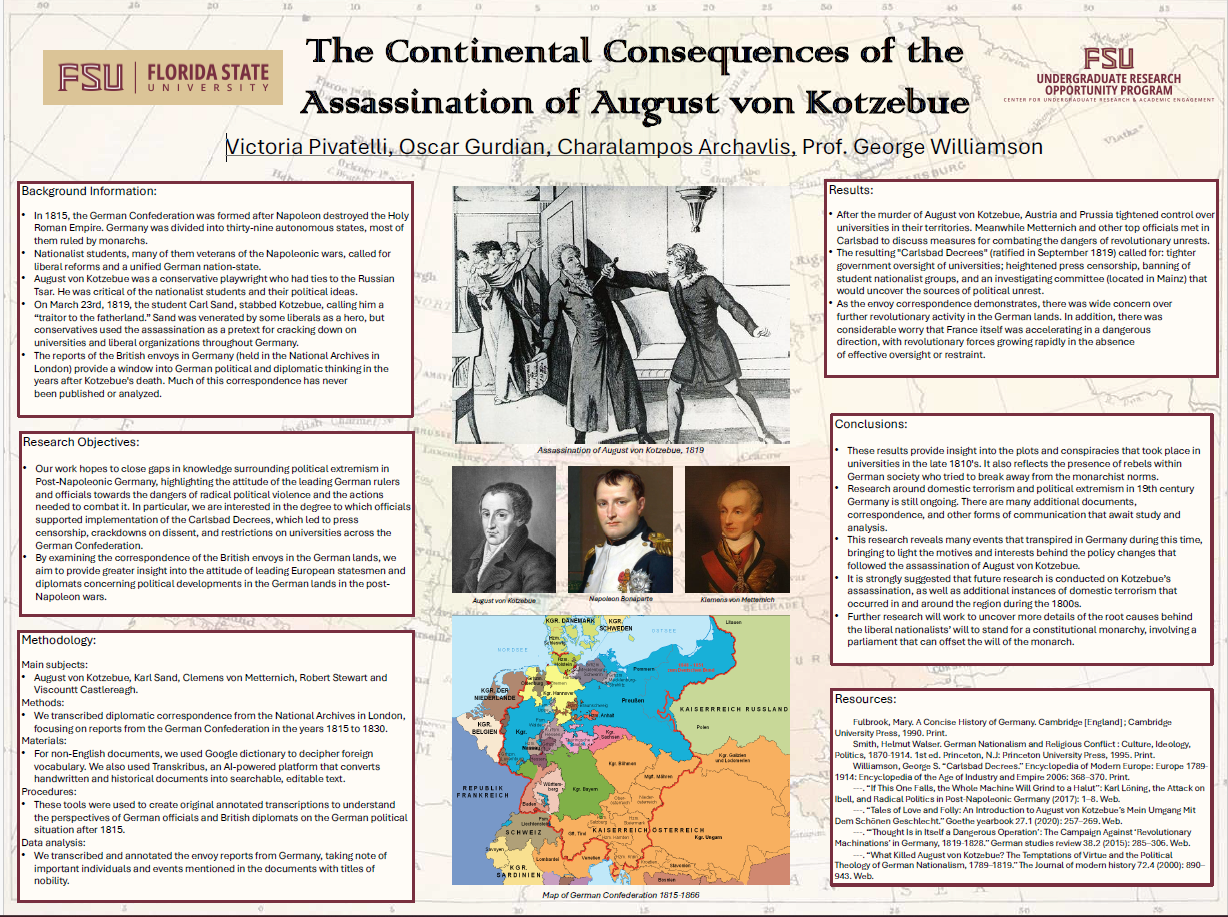
The Continental Consequences of the Assassination of August von Kotzebue
Authors: Charalampos Archavlis, George WilliamsonStudent Major: Criminology
Mentor: George Williamson
Mentor's Department: History Mentor's College: Florida State University Co-Presenters:
Abstract
On March 23, 1819, August von Kotzebue, a German playwright famous across Europe for his conservative commentaries on culture, was assassinated by University of Jena student Karl Sand. This assassination reflected the deep rivalry between conservative royalists and liberal nationalists, where the European ruling class feared a rise in revolutionary anti-monarchist thought after Napoleon’s rampage across Europe. Our research focuses on the extent to which this event was used to justify silencing dissent, censoring the press, and restricting academia across the German Confederation. Our team analyzed, transcribed, annotated, and translated archived materials from English and French diplomatic envoys. To transcribe and translate, we adjusted image exposure and brightness and used Google dictionary to decipher French and English text. The main topic discussed was the tense situations in universities where political fraternity groups hostile to monarchies were organizing. Our research suggests that many German students sought a united German state, which they operated clandestinely in universities to oppose the monarchies. Although authorities believed few students adhered to these radical revolutionary ideas, they still proposed extensive restrictions on universities through the Carlsbad Decrees. The study of government responses to political violence is important to the stability of our political systems, as the potential for the exploitation of chaos threatens the permanent regression of civil liberties.
Keywords: Kotzebue, August, Continental, Germany