
Research Symposium
26th annual Undergraduate Research Symposium, April 1, 2026
Anthony Pham Poster Session 4: 3:00 pm - 4:00 pm / Poster #254

BIO
Anthony Pham is a sophomore seeking a Bachelor of Science in Chemical Engineering. He began working with graduate student and mentor Santiago Lazarte in the fall of 2025, investigating the tribological properties of diamond-like carbons (DLCs). In the future, he is seeking to gain exposure to a variety of engineering disciplines as he progresses through his academic career, and is particularly interested in applications of organic chemistry. After graduating, he intends to transition to industry and manufacturing.
Tribology of Diamond Like Carbon after H2 Exposure
Authors: Anthony Pham, Santiago LazarteStudent Major: Chemical Engineering
Mentor: Santiago Lazarte
Mentor's Department: Materials Science and Engineering Mentor's College: College of Engineering Co-Presenters:
Abstract
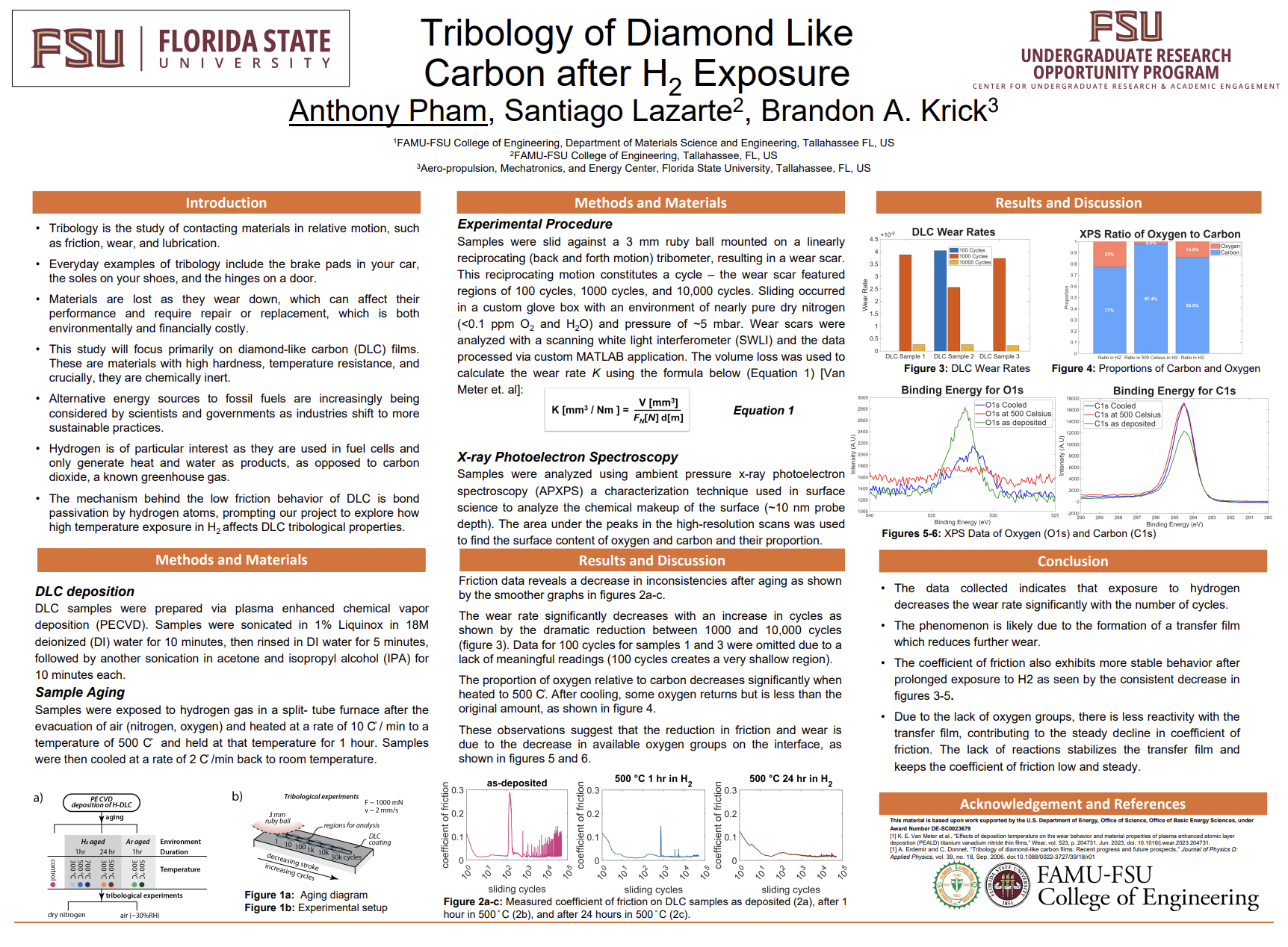
The tribology of diamond-like carbons (DLCs) is a field of study of increasing interest due to their chemical properties consisting of remarkably low coefficient of friction, reduced wear rate, and chemical inertness. These materials therefore wield a significant advantage in manufacturing and aerospace applications. This is occurring at the same time as increasing interest in alternative energy sources, such as hydrogen cells. This study explores how hydrogen interactions with DLC films alter their tribological properties, namely wear rate. Films were prepared via plasma-enhanced chemical vapor deposition (PECVD) and were exposed to pure hydrogen gas in an hydrogen furnace at 1 atmosphere and 500 °C. The samples were then slid against a ruby ball in a linear reciprocating tribometer in a pure nitrogen glove box (~5 mbar) at room temperature, creating a wear scar with regions of 100, 1000, and 10000 cycles. Scanning white light interferometer (SWLI) scans indicated that the wear rate decreased significantly with the increase in cycles, and ambient pressure x-ray photoelectron spectroscopy (AP-XPS) revealed the surface composition of the samples contained decreased proportions of oxygen groups. The decrease in wear rate is likely due to higher stability of the transfer film on the surface and the removal of surface oxygen groups, which may react with the transfer film and increase the friction and wear rates. These findings suggest wear rates and friction of DLC films can be improved by hydrogen aging at high temperatures.
Keywords: Tribology, Friction, Materials, Wear