Research Symposium
26th annual Undergraduate Research Symposium, April 1, 2026
Sarah Padron Poster Session 4: 3:00 pm - 4:00 pm / Poster #216

BIO
Sarah Padron is a second-year student at Florida State University pursuing a Bachelor of Science in Communication Sciences and Disorders, with a minor in Psychology. She has earned a place on the Dean’s List in 2024 and 2025. Sarah works as a Research Assistant in the March Lab through the Undergraduate Research Opportunity Program, where she assists with experimental procedures, data collection, and literature reviews. In addition to research, Sarah has experience tutoring students and volunteering with organizations that support community advocacy and students with disabilities.
Contamination Threat Bias Predicts Left and Right-Wing Authoritarian Support
Authors: Sarah Padron, Dr. David MarchStudent Major: Communication Sciences and Disorders
Mentor: Dr. David March
Mentor's Department: Psychology Mentor's College: Arts and Sciences Co-Presenters: Shae Steenbergh
Abstract
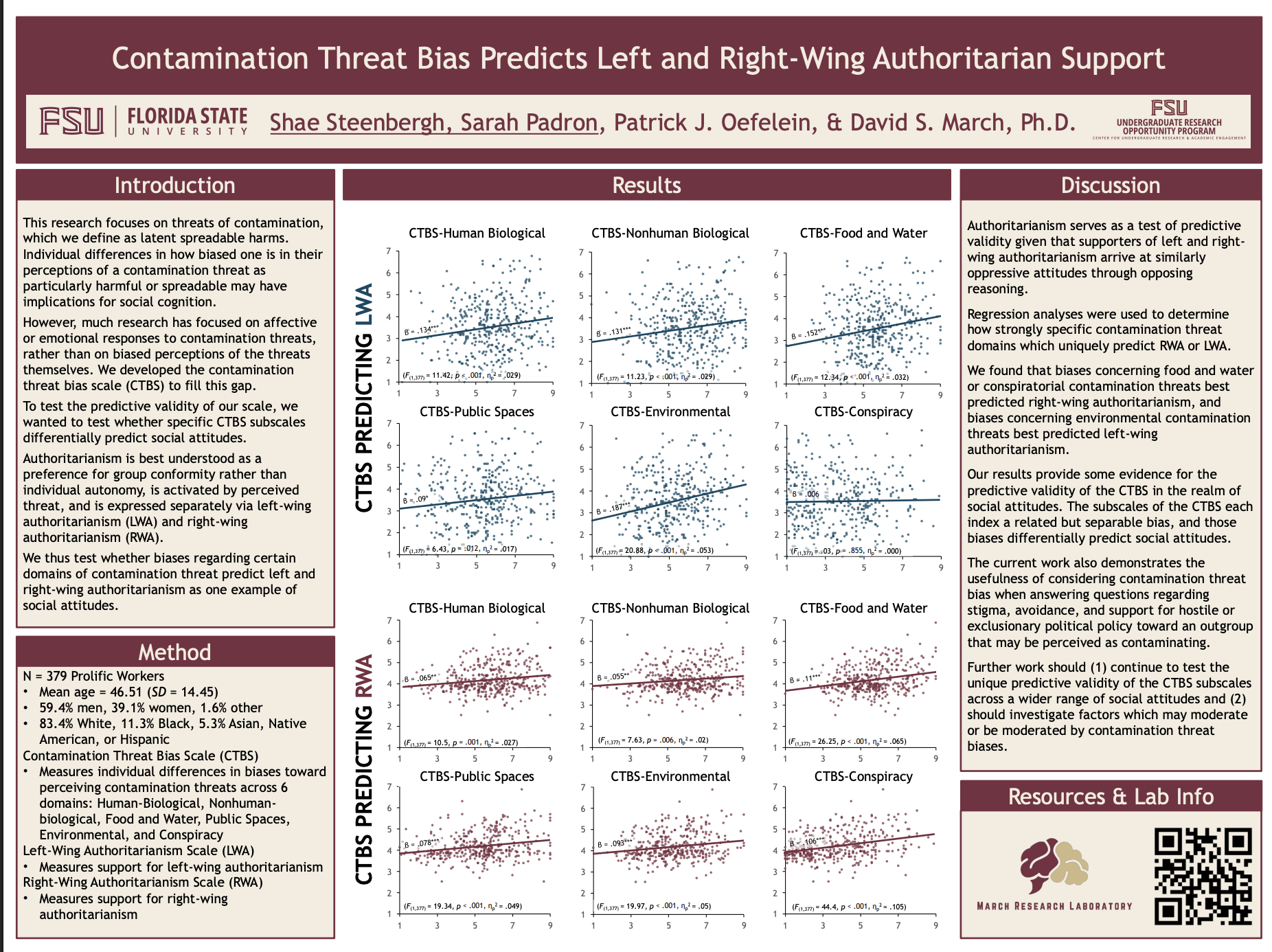
This research focuses on threats of contamination, which we define as latent spreadable harms. Individual differences in how biased one is in their perceptions of a contamination threat as particularly harmful or spreadable may have social cognitive implications. However, much research has focused on sensitivity to disgust, one emotional response to contamination threats, rather than on biased perceptions of the threats themselves. We thus developed the contamination threat bias scale (CTBS) to fill this gap. To test the predictive validity of our scale, we tested whether specific subscales can predict authoritarian support. Authoritarianism is best understood as a motivation for group conformity rather than individual autonomy, is activated by perceived threat, and is expressed separately via left-wing authoritarianism (LWA) and right-wing authoritarianism (RWA). We test whether biases regarding certain domains of contamination threat predict authoritarianism as a measure of social cognitive attitudes. Data were collected online through Prolific from a sample representative of the U.S. population on basic demographics. Participants rated how harmful and spreadable they believed different contamination sources were, including human biological, nonhuman biological, food and water, environmental, and public-space contaminants. These responses were used to predict support for RWA and LWA. We found that when controlling for every other subscale, food and water contaminants most strongly predict RWA, whereas environmental contaminants most strongly predict LWA. The findings show individual biases in contamination threat perception have social cognitive consequences, and thus the CTBS has useful applications in social cognitive research more generally.
Keywords: threat bias, social cognition, individual differences, pathogens, contamination