
Research Symposium
26th annual Undergraduate Research Symposium, April 1, 2026
Charlie Clark Poster Session 1: 9:30 am - 10:30 am / Poster #63

BIO
Charlie Clark is a pre-law sophomore at Florida State University pursuing a Bachelor of Science in Biochemistry. His academic interests focus on the intersection of science and public policy. Charlie is particularly interested in how scientific discoveries can inform legal frameworks and public decision-making. On campus, Charlie is involved in the Honors program, undergraduate mock trial program, and moderates at FSU organization which intersect ethics, science, and research. He aims to apply these experiences to a future career as a patent litigator.
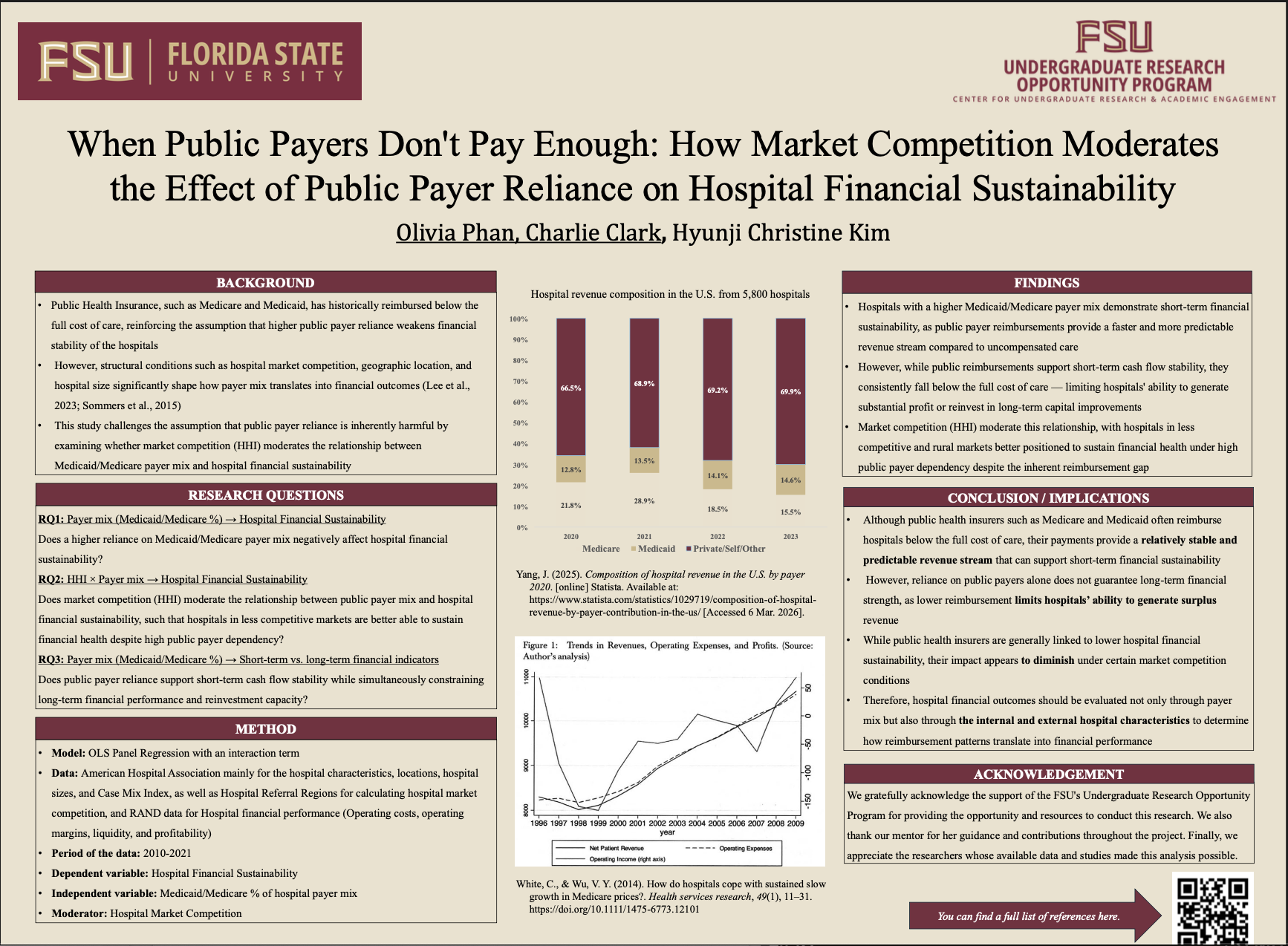
When Public Payers Don't Pay Enough: How Market Competition Moderates the Effect of Public Payer Reliance on Hospital Financial Sustainability
Authors: Charlie Clark, Hyunji Christine KimStudent Major: Biochemistry
Mentor: Hyunji Christine Kim
Mentor's Department: Public Administration Mentor's College: College of Social Sciences and Public Policy Co-Presenters: Olivia Phan
Abstract
This study examines whether hospitals can financially benefit from a greater reliance on public insurance programs, specifically Medicaid and Medicare, by analyzing how the relationship between the proportion of Medicaid/Medicare reimbursement and hospital financial sustainability varies under different structural conditions. The independent variable is the Medicaid/Medicare payer mix, measured as the percentage of total revenue or discharges from these public insurers, and the dependent variable is hospital financial sustainability, captured through metrics such as operating margin, net income, or days cash on hand. Two key contextual moderators are considered: market competition, assessed using the Herfindahl-Hirschman Index (HHI), and geographic location, categorized as urban or rural. The first hypothesis (H1) examines whether a higher Medicaid/Medicare payer mix is positively associated with hospital financial sustainability. Building on this, H2a proposes that this positive association is stronger in markets with lower competition, while H2b suggests the relationship is more favorable for hospitals located in rural areas. By testing these interactions through a moderated regression model, the study challenges the prevailing view that public payer reliance undermines financial health and instead argues that, under the right structural conditions, hospitals can strategically benefit from serving more publicly insured patients—providing important insights for health system leaders and policymakers seeking sustainable and equitable healthcare delivery models.
Keywords: Economics, Healthcare, Medicaid