
Research Symposium
26th annual Undergraduate Research Symposium, April 1, 2026
Rohan Sikka Poster Session 1: 9:30 am - 10:30 am / Poster #275
BIO
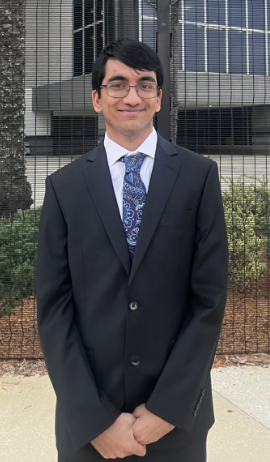
Rohan Sikka is a second-year Psychology major and Sociology minor. While born in St. Louis, Missouri, Rohan spent most of his life in Jacksonville, Florida. He is interested in pursuing a career in either child therapy or school therapy, specializing in services for neurodivergent children. Rohan is currently studying discrimination and religious coping behaviors under his UROP mentor, Jacob Perez. In addition, Rohan is also a member of Florida State University's Psi Chi Psychology Honor Society.
Outside of school, Rohan has served as an officer for Florida State University's chapter of Neurounity Alliance Society for over a year, advocating for the wellbeing of neurodivergent students on campus. He has a deep love for history and film, both of which he attributes to his passion for education. Once he finishes his Bachelor of Science in Psychology, Rohan plans to pursue a Doctorate in Psychology for clinical therapy.
Discrimination Experiences, Coping, and Outcomes of Risk (DECOR)
Authors: Rohan Sikka, Jacob PerezStudent Major: Psychology
Mentor: Jacob Perez
Mentor's Department: Counseling and School Psychology Mentor's College: Psychology Co-Presenters: Ariana Chu
Abstract
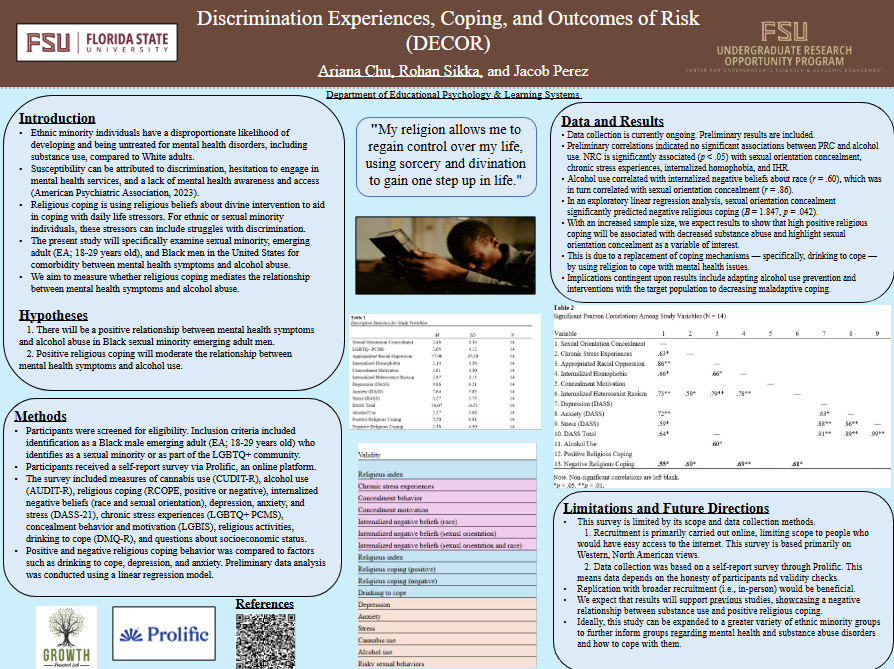
Minority populations are prone to experiences of chronic stress that contribute to mental health symptoms and substance abuse. Positive religious coping (PRC), or the use of spiritual beliefs and practices to foster hope, has shown to protect against chronic stress and merits further investigation among minority groups. Therefore, the aim of this cross-sectional research is to determine the relationships between internalizing mental health symptoms — namely depression, anxiety, stress — and alcohol use and whether these relationships may be moderated by PRC. This is being investigated to inform future research on prevention and intervention for these minority populations. This is relevant to the population of interest, as minority populations tend to have less research targeted at their health disparities. Prolific, an online survey recruitment tool, was used to increase the generalizability of the study. Eligible participants will receive a link to the survey consisting of measures of chronic stress experience, religious activities, religious coping, substance use, and mental health symptoms. Participants include Black emerging adult (18-29) men who identified as a sexual minority. Data collection is ongoing and expected to be completed in March 2026. It is expected that PRC will significantly moderate the effects of depression, anxiety, and stress on alcohol use, such that PRC weakens the associations between internalizing mental health symptoms and alcohol use. Results will inform targets for alcohol use prevention and intervention programs among intersectional groups, like gay and bisexual Black men, who experience conflicting messages about the role of religious coping in their communities.
Keywords: psychology, substance abuse, minority, religion