
Research Symposium
26th annual Undergraduate Research Symposium, April 1, 2026
Ryan Jukes Poster Session 2: 10:45 am - 11:45 am / Poster #72
BIO
Ryan Jukes is a first-year electrical engineering student from Goffstown, New Hampshire. Ryan is passionate about mathematics, physics, coding (C++, Java, and Python), and environmental science. Outside of academics, Ryan enjoys fishing, baseball, and exploring the Tallahassee area. Ryan's future career goals are to attend graduate school and work in industry, developing novel materials and systems that prioritize environmental sustainability in manufacturing.
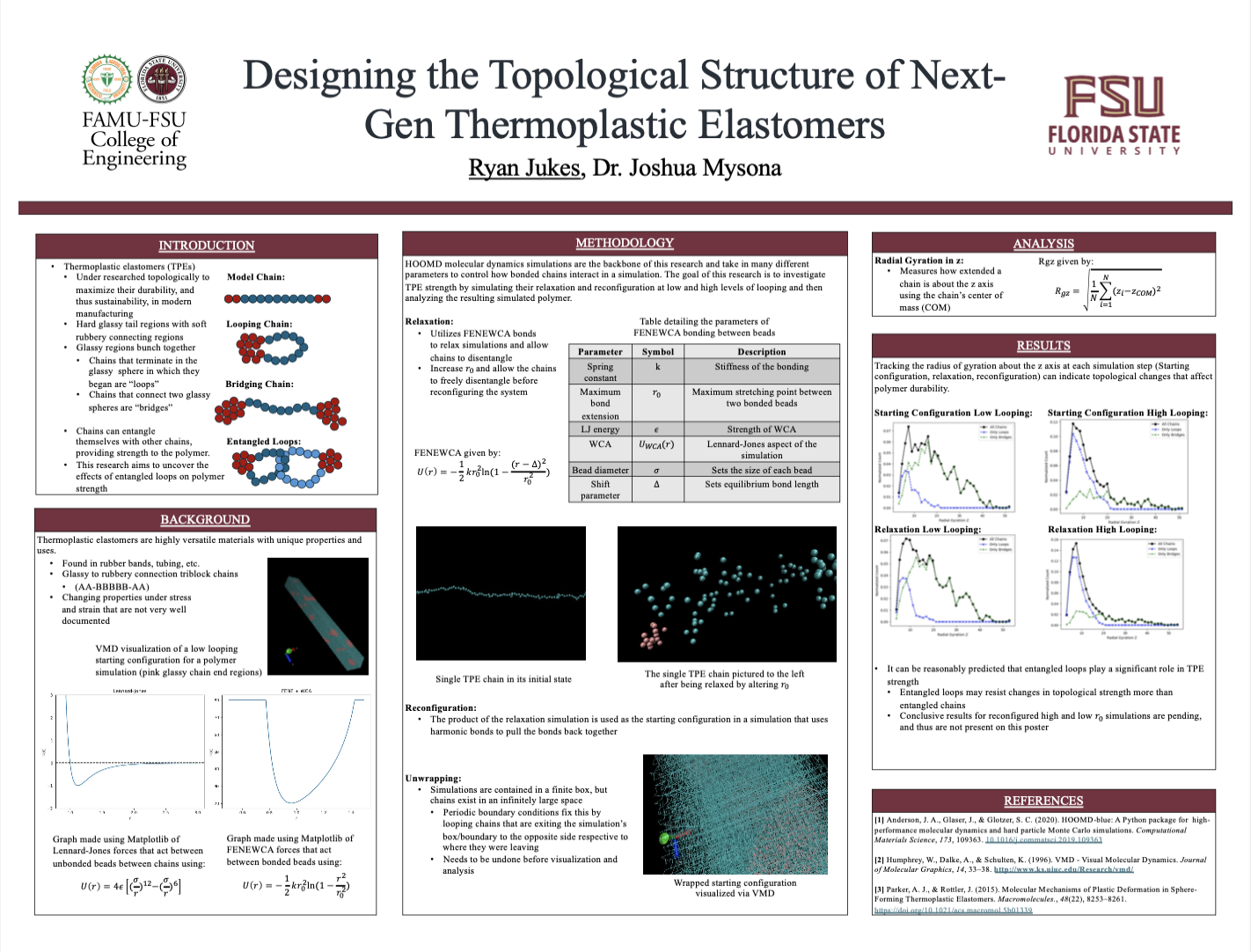
Designing the Topological Structure of Next-Gen Thermoplastic Elastomers
Authors: Ryan Jukes, Dr. Joshua MysonaStudent Major: Electrical Engineering
Mentor: Dr. Joshua Mysona
Mentor's Department: Chemical and Biomedical Engineering Mentor's College: College of Engineering Co-Presenters:
Abstract
Thermoplastic elastomers (TPEs) are used in a number of products due to their combination of both rubber and plastic-like qualities. Given the versatility and utility of TPEs, it is important that the properties of these polymers are studied and optimized for the purpose of increasing their strength and sustainability. TPEs are made up of long monomer (triblock) chains with ends that bunch together and form glassy spheres. Chains that originate at one glassy sphere and terminate at a different glassy sphere are said to "bridge", while chains that terminate in the same sphere from which they originated are said to “loop”. However, the effects of different levels of looping and bridging in TPEs during and after deformation are still somewhat unknown. This research studies the properties of TPEs with molecular dynamics simulations to determine how the extent of bridging and looping alters material durability. Some research suggests that overall polymer strength is dependent upon the fraction of bridges present in simulations. This project suggests that looping plays more of a role in TPE strength than was previously considered through analysis of the radius of gyration of polymer chains, tracking bond and chain lengths, and chain visualization using Visual Molecular Dynamics (VMD) of relaxed and reconfigured molecular simulations containing varied levels of looping. These findings may have implications for the future of TPE production, emphasizing durability and thus sustainability in manufacturing thermoplastic elastomers.
Keywords: Python, Simulation, Polymers, Materials science