
Research Symposium
26th annual Undergraduate Research Symposium, April 1, 2026
Bryce Angus Poster Session 1: 9:30 am - 10:30 am / Poster #205

BIO
Bryce Angus is a second year at Florida State University pursuing a Bachelor of Science in Computer Science with a minor in math. He is originally from Pembroke Pines, Florida. After he graduates Bryce will be pursuing a Master's in Computer Engineering, as a means to to later become a Computer Architect. The Undergraduate Research Opportunity Program (UROP) was his first experience in a research setting, here his project surrounded the extraction of center lines from coherent structures in turbulence fields relevant to Type Ia supernova conditions. Bryce was mentored under Dr. Tomasz Plewa for his UROP project. The goal of the project was to produce a physics-informed automated pipeline for the identification of coherent structure center lines in turbulent flows.
Extracting Coherent Structures in Turbulent Flows
Authors: Bryce Angus, Dr. Tomasz PleawStudent Major: Computer Science
Mentor: Dr. Tomasz Pleaw
Mentor's Department: Scientific Computing Mentor's College: Arts and Sciences Co-Presenters:
Abstract
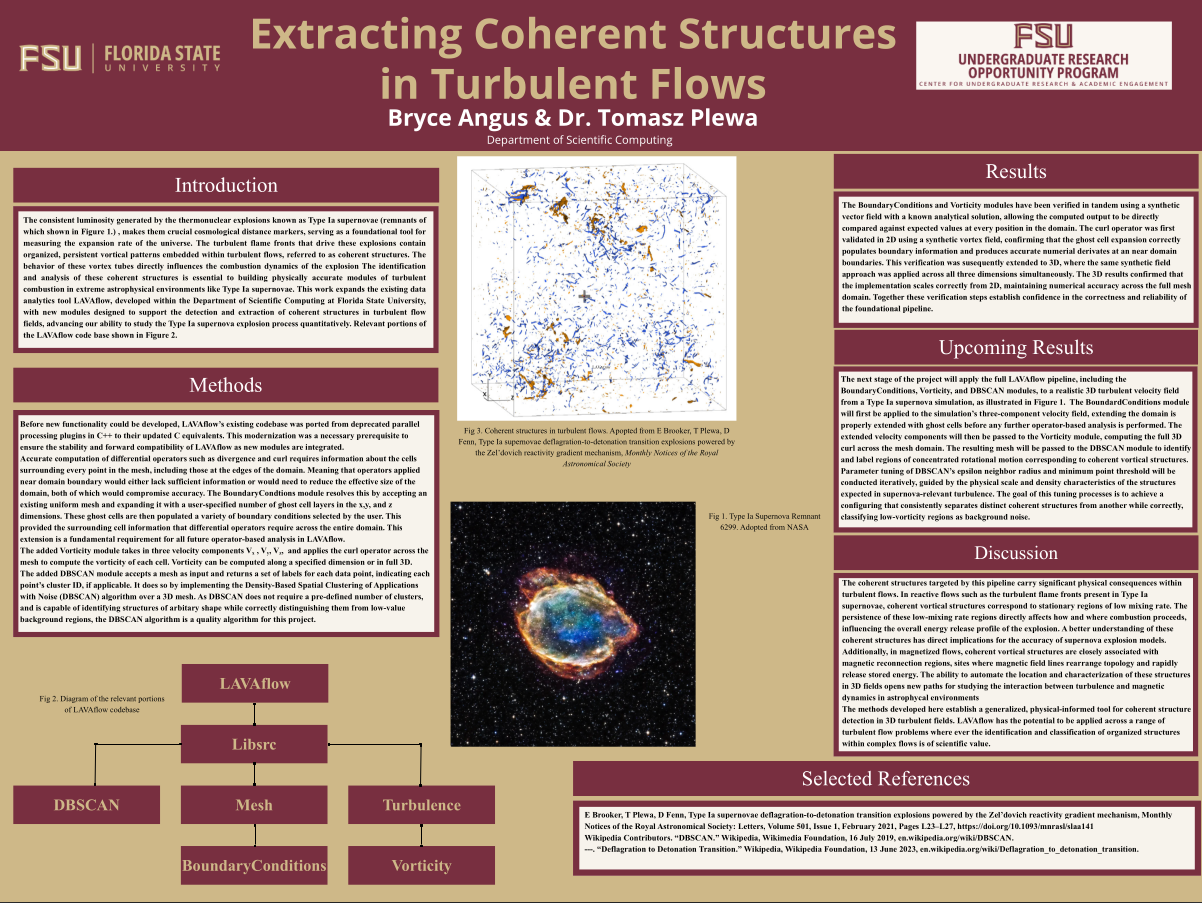
The study of complex turbulent flow fields, fluid motion demonstrating apparent random changes in pressure and flow velocity, is currently limited by a lack of a gold standard automation of the identification and classification of coherent structures within these flow fields, especially with supernovae relevant velocity fields. Using the density-based spatial clustering of applications with noise (DBSCAN) algorithm, this project aims to develop an automated system for extracting clusters of arbitrary shapes, number of structures, and noise points. By incrementally adding optimizations to the DBSCAN algorithm, we hope to see an increase in the speed and accuracy at which structures are identified. Validation is performed by comparing the algorithm’s outputs to known structural features in the test data set. A proper method of identifying coherent structures in supernovae relevant velocity fields, would enhance the field of astrophysics by allowing for the identification of conditions that facilitate the deflagration-to-detonation transition (DDT).
Keywords: Astrophysics, Flow-Fields, Supernovae, Coherent Structures