
Research Symposium
26th annual Undergraduate Research Symposium, April 1, 2026
Aurora Ramirez Poster Session 2: 10:45 am - 11:45 am / Poster #82

BIO
Aurora Ramirez is a sophomore majoring in Cellular and Molecular Neuroscience on the pre-medical track, and is passionate about health related sciences. In her time at FSU, she has participated in the FSU Pre-Health Living-Learning Community, Neuroscience Undergraduate Student Association, completed a certification in medical assisting through Health Science Consulting, and is currently participating in UROP and the Honors Program. She is exploring opportunities in the Tallahassee area that allow her to deepen her understanding in the healthcare field and prepare her for the next steps in her academic journey.
Community, Peer, and Gender Factors Associated With Kratom Knowledge and Use Among Adolescents
Authors: Aurora Ramirez, Qinglan Feng Ph.D.Student Major: Cellular and Molecular Neuroscience
Mentor: Qinglan Feng Ph.D.
Mentor's Department: Florida Center of Prevention Research Mentor's College: College of Social Work Co-Presenters:
Abstract
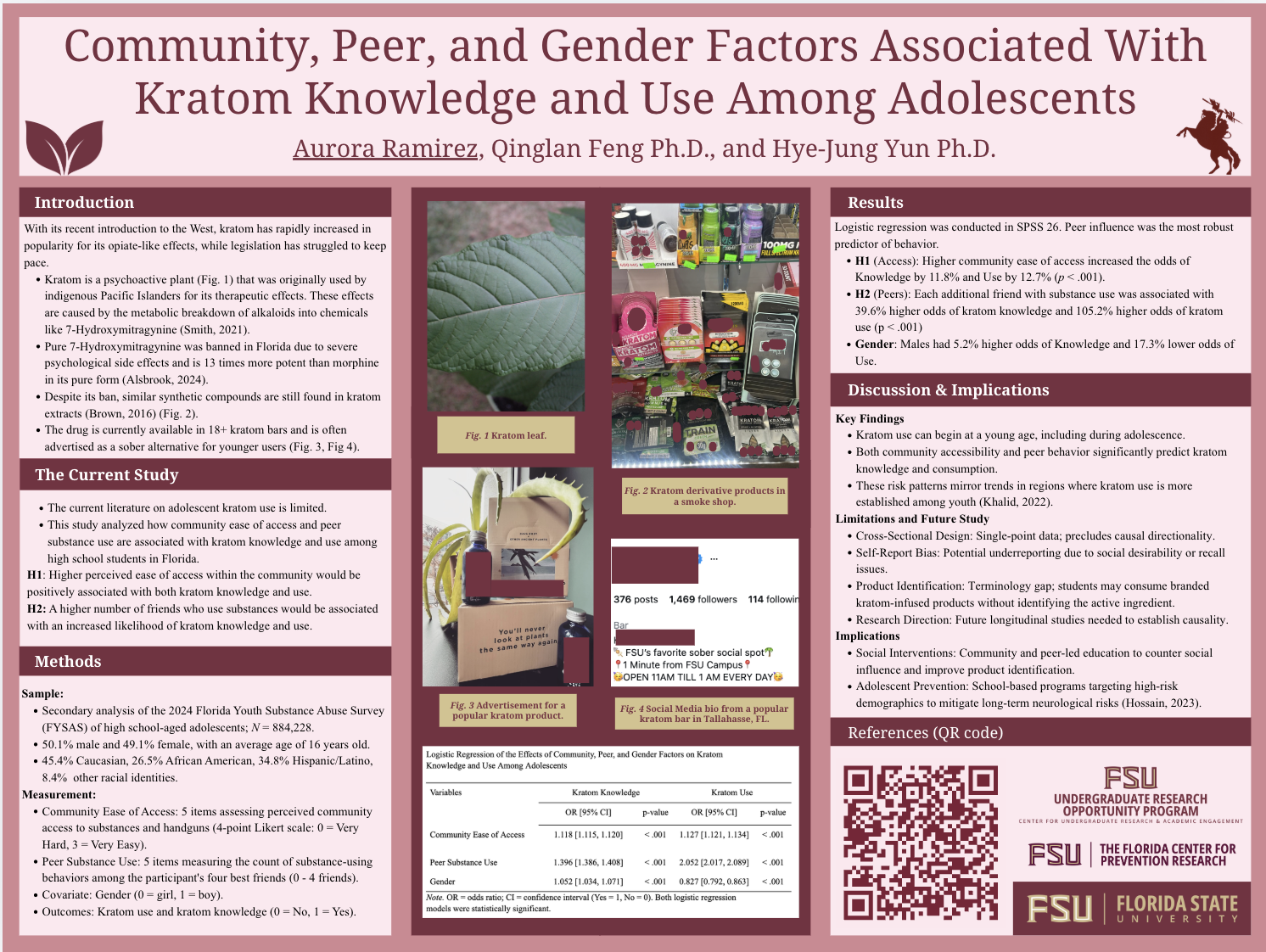
This study sought to identify the associations between community ease of access, peer substance use, and kratom knowledge and use among high school students in Florida. Although kratom and its derived products are a relatively recent introduction to the United States, its popularity has increased rapidly due to its opioid-like effects, and public health policies have been unable to keep up. Current marketing portrays kratom as an alcohol alternative, particularly appealing to individuals under the age of 21, and there is limited public knowledge on its risks. Understanding the patterns of attitudes around kratom among minors is critical for informing prevention and education efforts. The data used in this study was pulled from the Florida Youth Substance Abuse Survey for high schoolers in 2024. Preliminary analyses and logistic regression were conducted in statistics software.The research was significant in that males were found to have used kratom more, despite females being more likely to know of the drug. We found that peer drug use and community ease of access were positively correlated with kratom use and knowledge, with peer substance use having the most significant associations . These findings demonstrate that a subset of adolescents is actively using kratom, and identifying kratom use in adolescents as an important field is the first step in protecting those affected. This highlights the need for further research on the effects of kratom, the need for educating the public on the drug, and the impact of misleading or predatory marketing practices.
Keywords: kratom, opiates, adolescents, drug use