
Research Symposium
26th annual Undergraduate Research Symposium, April 1, 2026
Natalie Richard Poster Session 3: 1:45 pm - 2:45 pm / Poster #237

BIO
Natalie Richard is a first-year undergraduate student at Florida State University pursuing a Bachelor of Science in Psychology with a minor in Political Science. Through these areas of academia, she is working to build a strong foundation understanding human behavior, psychological processes, and political systems that shape today's societies. After completing her undergraduate degree, she plans to attend law school. With this legal training, Natalie aims to build a career in humanitarian law, advocating for human rights to support communities impacted by conflict and injustice.
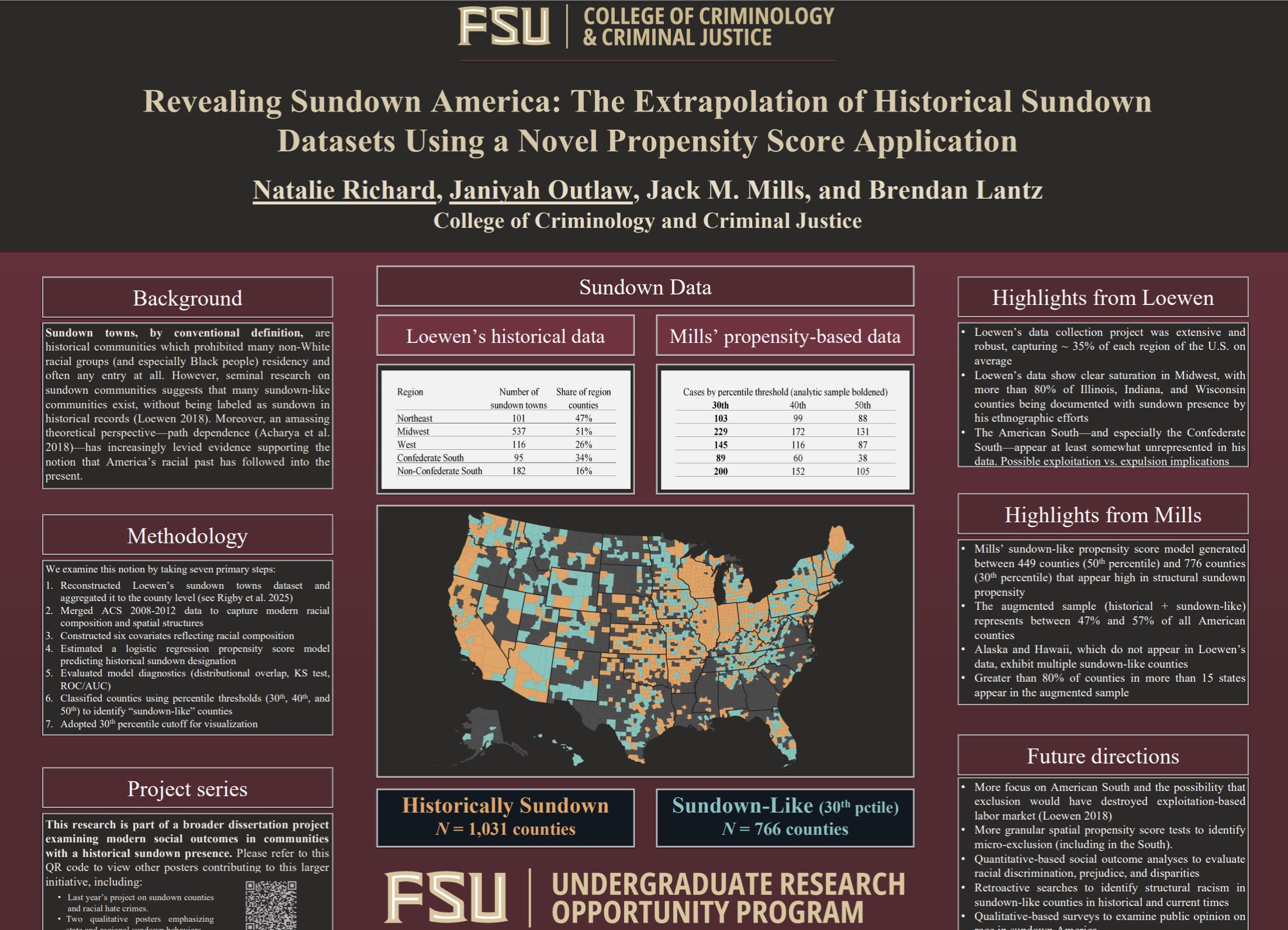
Revealing Sundown America: The Extrapolation of Historical Sundown Datasets Using a Novel Propensity Score Application
Authors: Natalie Richard, Jack MillsStudent Major: Psychology
Mentor: Jack Mills
Mentor's Department: Criminology and Criminal Justice Mentor's College: College of Criminology and Criminal Justice Co-Presenters: Janiyah Outlaw
Abstract
Sundown towns were historical American communities that intentionally prohibited non-White populations, particularly Black residents, from living within or entering community boundaries. While existing research has largely examined sundown towns as a historical phenomenon, there is merit in understanding these places as evolving community practices that persist today. In this project, we present a descriptive overview of Sundown America at the county level to examine the spatial distribution of racially exclusive communities across the United States. We present descriptive statistics and spatial illustrations of county-level sundown restrictions in a two-part analysis. First, we draw on a historical sundown dataset, which offers an incomplete illustration of sundown geographies. Second, we extend this dataset by identifying counties similar to historically documented sundown counties using novel propensity score analyses. Taken together, this project demonstrates the need for stronger empirical attention toward racialized boundaries in the United States and underscores the importance of contextualizing Sundown America as a contemporary phenomenon. Empirically, we draw on a historical dataset identifying 1,051 counties with documented sundown practices, while acknowledging that this record is incomplete. To address this, we augment the data using propensity score analyses based on racial boundary characteristics measured at the tract-within-county level. Applying median percentile thresholds, we identify an additional 449 counties resembling historically documented sundown counties, yielding an augmented sample of 1,500 counties. By combining historical documentation with probabilistic identification, this analysis offers a more comprehensive spatial account of racially exclusionary community practices and highlights the persistence of racialized boundaries across U.S. counties today.
Keywords: Sundown, Racism, History