
Research Symposium
26th annual Undergraduate Research Symposium, April 1, 2026
Aysia Hudson Poster Session 3: 1:45 pm - 2:45 pm / Poster #199

BIO
Aysia Hudson is a junior at Florida State University pursuing a Bachelor of Science in Cell and Molecular Neuroscience. Originally from San Diego, California, she is interested in gaining research experience that will support her long-term goal of working in the medical field.
Aysia is currently involved in undergraduate research through the Undergraduate Research Opportunity Program (UROP) at Florida State University. She works under the mentorship of Richard Wagner, Dorota Kossowska-Kuhn, and Fotena Zirps on a project focused on developmental dyslexia. The research involves conducting systematic literature reviews and meta-analysis to identify trends and predictors related to dyslexia. This project represents her first formal research experience beyond previous shadowing opportunities and has helped her develop skills in academic research, critical analysis, and scientific communication.
After graduating, Aysia plans to attend medical school and pursue a career as a neurosurgeon. She hopes to combine her background in neuroscience and research experience to better understand neurological conditions and contribute to advancements in patient care.
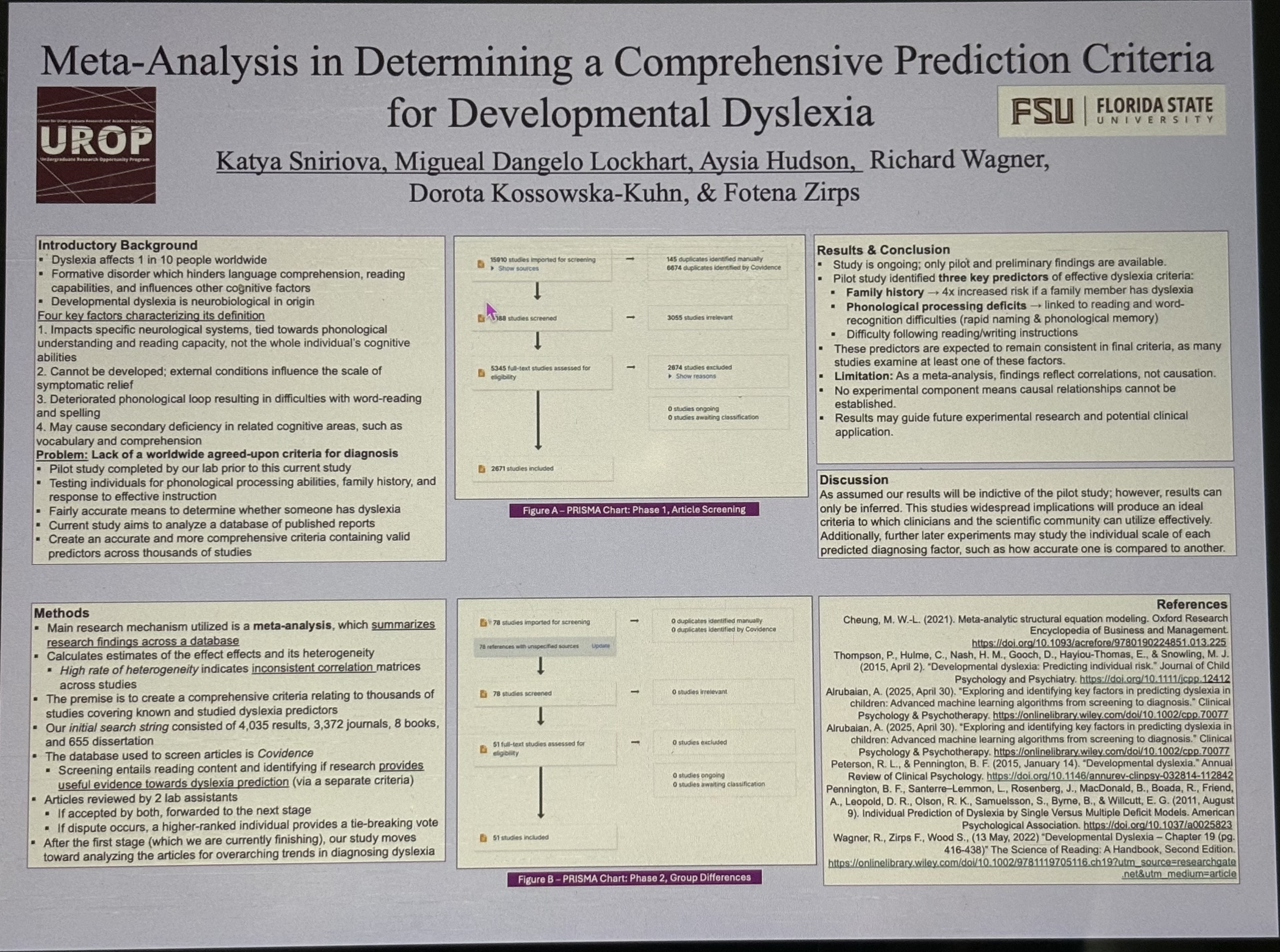
Meta-Analysis in Determining a Comprehensive Prediction Criteria for Developmental Dyslexia
Authors: Aysia Hudson, Dr. Richard WagnerStudent Major: Cell and Molecular Neuroscience
Mentor: Dr. Richard Wagner
Mentor's Department: Psychology Mentor's College: Department of Psychology Co-Presenters: Katya Sniriova, Migueal Dangelo Lockhart
Abstract
Dyslexia affects individuals worldwide, impacting their capabilities to read fluently and hindering literary understanding. Developmental dyslexia is the primary form of this disorder, stemming from a combination of genetic and environmental features that display the severity of symptomatic portrayal. There are various criteria that reflect the possible causes of developmental dyslexia. However, no single analysis is effective in prediction. Our study seeks to analyze trends in overarching causes of dyslexia to create a comprehensive prediction model through a meta-analysis study.
To resolve conflicting definitions of dyslexia and contradicting criteria for the causes a examination of relevant publications is comprised through literary review.
The study functions through the technological applications Covidence, eliminating irrelevant articles to create a finite multifactor dyslexia prediction model. These articles are eliminated based on an established external criterion, created within the lab, and outlines the preferred metrics and topics to be included.
The study remains ongoing, screening hundreds of articles weekly in pursuit of a comprehensive source list. The expectation amongst papers alludes to the expansion of predictors of development dyslexia. While not fully developed some of the overarching factors include educational upbringing, phonetic exposure, reading programs, and others. Additionally, genetic predisposition holds its own imposition for development dyslexia.
These preliminary results suggest that many individuals should seek out early screening for dyslexia with caregivers following the guise of the typical causes and predictors. Whilst an agreement has not been made regarding the criteria for dyslexia, this study produces relevant results that aims to bridge that gap.
Keywords: Meta-Analysis for Developmental Dyslexia