
Research Symposium
26th annual Undergraduate Research Symposium, April 1, 2026
Moira Shoffstall Poster Session 2: 10:45 am - 11:45 am / Poster #162

BIO
Moira Shoffstall is in her Junior year and is seeking a Bachelor's Degree in Art History. Her primary focus is on Islamic Art in the Iberian Peninsula, a subject she has been studying since 2022. While in the Undergraduate Research Opportunity Program, she was mentored by Dr. Ben Dodds from the Department of History. Her poster is part of his ongoing project, "In the Footsteps of Bandits: An Alternative History of Spain." While not strictly in her major or area of academic interest, this has been a passion project of hers since last Fall.
Moira currently holds an Associate of Arts degree from Tallahassee State University, where she graduated in Fall 2024. She is planning on graduating in Spring 2027 with an Honors in the Major under Dr. Erika Loic from the Department of Art History before continuing on and going into a Master's Program studying Islamic Art. She hopes to become a professor and do further research on her interests.
Don Juan de Serrallonga: An Analysis Through the Lens of a Biographical Poem
Authors: Moira Shoffstall, Ben DoddsStudent Major: Art History
Mentor: Ben Dodds
Mentor's Department: Department of History Mentor's College: Florida State University Co-Presenters:
Abstract
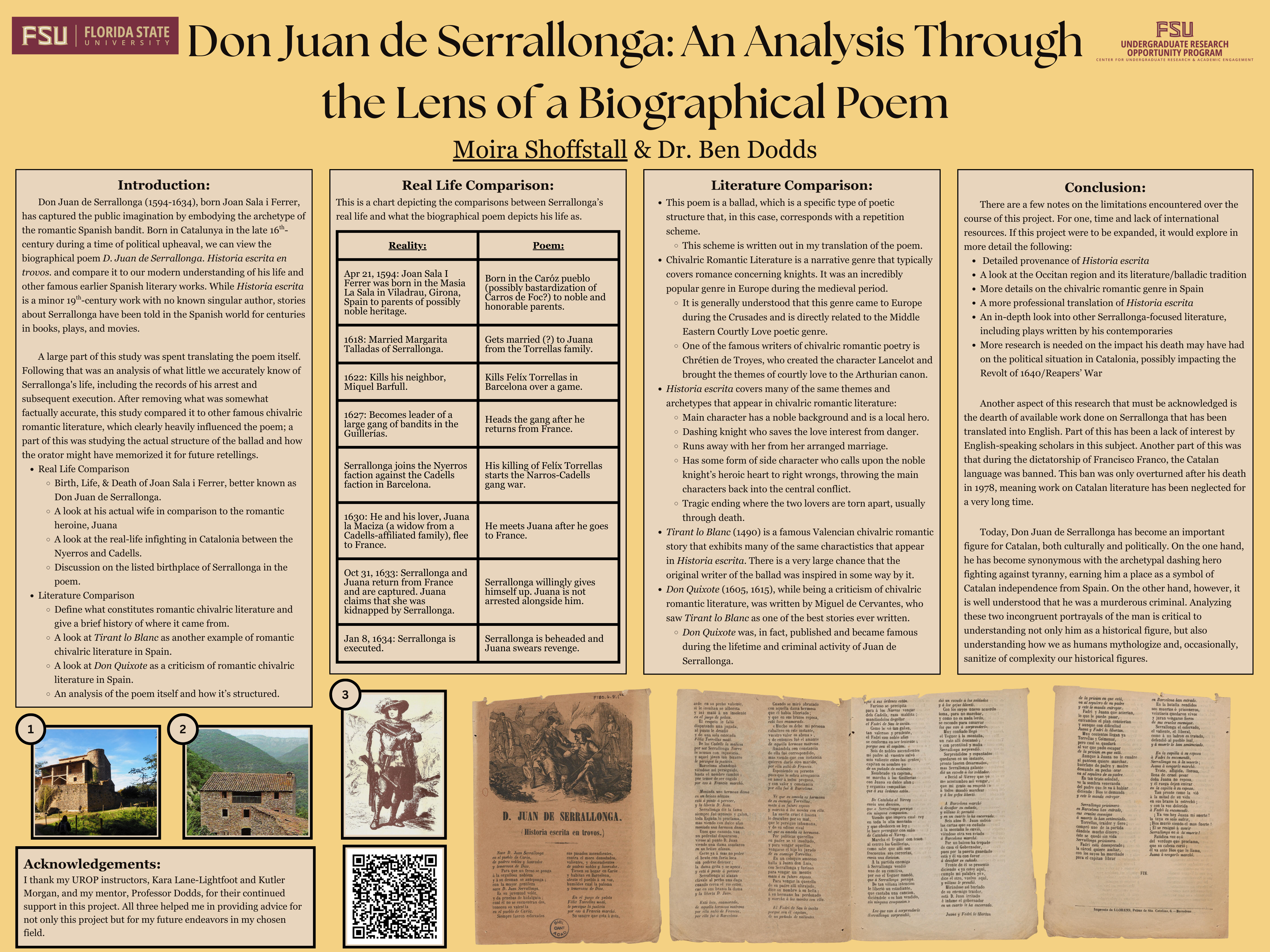
Don Juan de Serrallonga (1594–1634), born Joan Sala i Ferrer, has captured the public imagination by embodying the archetype of the romantic Spanish bandit. Born in Catalunya in the late 16th century during a time of political upheaval, we can view the biographical poem D. Juan de Serrallonga. Historia escrita en trovos. and compare it to our modern understanding of his life and other famous earlier Spanish literary works, such as Tirant lo Blanc and Don Quixote. While Historia escrita is a minor 19th century work with no concretely known singular author, stories about Serrallonga have been carried on in the Spanish world for centuries in books, plays, and – more recently – movies. A large part of this study was spent translating the poem itself. Following that, I studied what little we accurately know of Serrallonga’s life, including the records of his arrest and subsequent execution. After I removed what I saw that was somewhat factually accurate, I compared it to other famous romantic chivalric literature, which clearly heavily influenced the poem; a part of this was studying the actual structure of the ballad and how the orator might have memorized it for future retellings. By viewing this biographical poem, we can study not only how bandolers operated in the period just prior to The Catalan Revolt of 1640, but also how these figures have become such an integral part of the Catalonian zeitgeist, leading to, in the case of Serrallonga, becoming a symbol of Catalonian pride and independence.
Keywords: History, Catalan, Spain, Translation, Literature, Poetry