
Research Symposium
26th annual Undergraduate Research Symposium, April 1, 2026
Calvin Nguyen Poster Session 2: 10:45 am - 11:45 am / Poster #284
BIO
Calvin Nguyen is an undergraduate student at Florida State University pursuing a Bachelor of Science in Electrical Engineering. Previously, he was a Lead Researcher investigating glucose-driven bioenergetics in yeast , where he analyzed wet lab data concerning anaerobic respiration and CO2 production. He also led a calculus-based research project on temperature optimization for frosting application. Beyond the lab, Calvin applies his technical skills as an Electrical Subsystem Member for the Society of Automotive Engineers, assisting in the design and wiring of a Baja car. He serves as the Brotherhood Chair and Sergeant of Arms for Lambda Phi Epsilon International Fraternity, Inc. and is a member of the Society of Asian Scientists and Engineers. Looking ahead, Calvin aims to leverage his interests in power generation systems, AI/ML optimization, and systems engineering to pursue a career in the tech industry, targeting roles at major technology companies or within the space exploration sector.
Modeling of Spacecraft Power Systems: Thermal and Electrical Optimization for Space Exploration
Authors: Calvin Nguyen, Ryan GosseStudent Major: Electrical Engineering
Mentor: Ryan Gosse
Mentor's Department: Mechanical Engineering Mentor's College: FAMU-FSU College of Engineering Co-Presenters:
Abstract
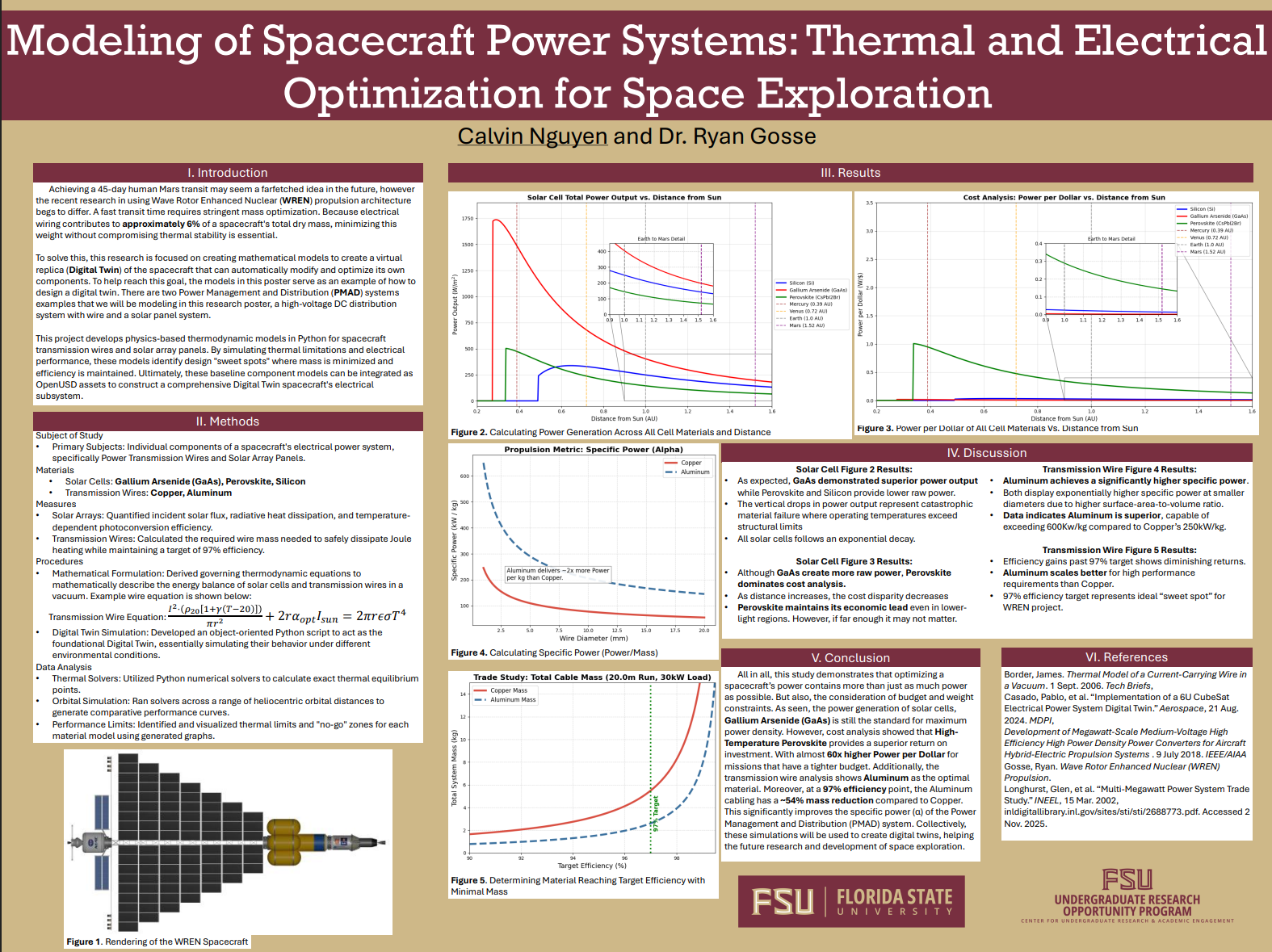
Achieving a 45-day human Mars transit may seem a farfetched idea in the future, however
the recent research in using Wave Rotor Enhanced Nuclear (WREN) propulsion architecture
begs to differ. A fast transit time requires stringent mass optimization. Because electrical
wiring contributes to approximately 6% of a spacecraft's total dry mass, minimizing this
weight without compromising thermal stability is essential.
To solve this, this research is focused on creating mathematical models to create a virtual
replica (Digital Twin) of the spacecraft that can automatically modify and optimize its own
components. To help reach this goal, the models in this poster serve as an example of how to
design a digital twin. There are two Power Management and Distribution (PMAD) systems
examples that we will be modeling in this research poster, a high-voltage DC distribution
system with wire and a solar panel system.
This project develops physics-based thermodynamic models in Python for spacecraft
transmission wires and solar array panels. By simulating thermal limitations and electrical
performance, these models identify design "sweet spots" where mass is minimized and
efficiency is maintained. Ultimately, these baseline component models can be integrated as
OpenUSD assets to construct a comprehensive Digital Twin spacecraft's electrical
subsystem.
Keywords: Space, Energy, Engineering, Electrical, Solar