
Research Symposium
26th annual Undergraduate Research Symposium, April 1, 2026
Benjamin Bernsteen Poster Session 3: 1:45 pm - 2:45 pm / Poster #5
BIO
I am a student at Florida State University with a strong interest in electrical engineering, applied research, and hands-on problem solving. I am originally from Guadalajara, Mexico, and having lived in different places throughout my life has helped me become adaptable, curious, and comfortable working with people from many backgrounds. Those experiences have shaped the way I approach both academics and research, pushing me to stay open-minded and look at problems from multiple perspectives. My research interests include electronics, instrumentation, imaging systems, signal processing, and the ways electrical engineering connects with real-world experimental work. I am especially interested in projects that combine theory with practical testing, whether through sensors, circuits, data acquisition, or computational analysis. I enjoy learning how technical systems work at a deeper level and applying that understanding to improve performance, accuracy, and design. What draws me most to research is the opportunity to contribute to meaningful work while continuing to build technical skills through direct experience. In the future, I hope to build a career in engineering that allows me to work on advanced technologies with real impact. I am particularly interested in areas where electrical engineering overlaps with innovation in aerospace, robotics, imaging, and complex systems. My long-term goal is to contribute to challenging projects, grow through research and mentorship, and become an engineer who can combine technical ability with creativity and collaboration. Through UROP, I hope to strengthen my research background and gain experience that will prepare me for graduate study and future engineering opportunities.
SAFS: High-Speed Density-Gradient Imaging
Authors: Benjamin Bernsteen, Dr. Alexandre BergerStudent Major: Electrical Engineering
Mentor: Dr. Alexandre Berger
Mentor's Department: 218000 Mentor's College: FAMU-FSU Colledge of Engineering Co-Presenters:
Abstract
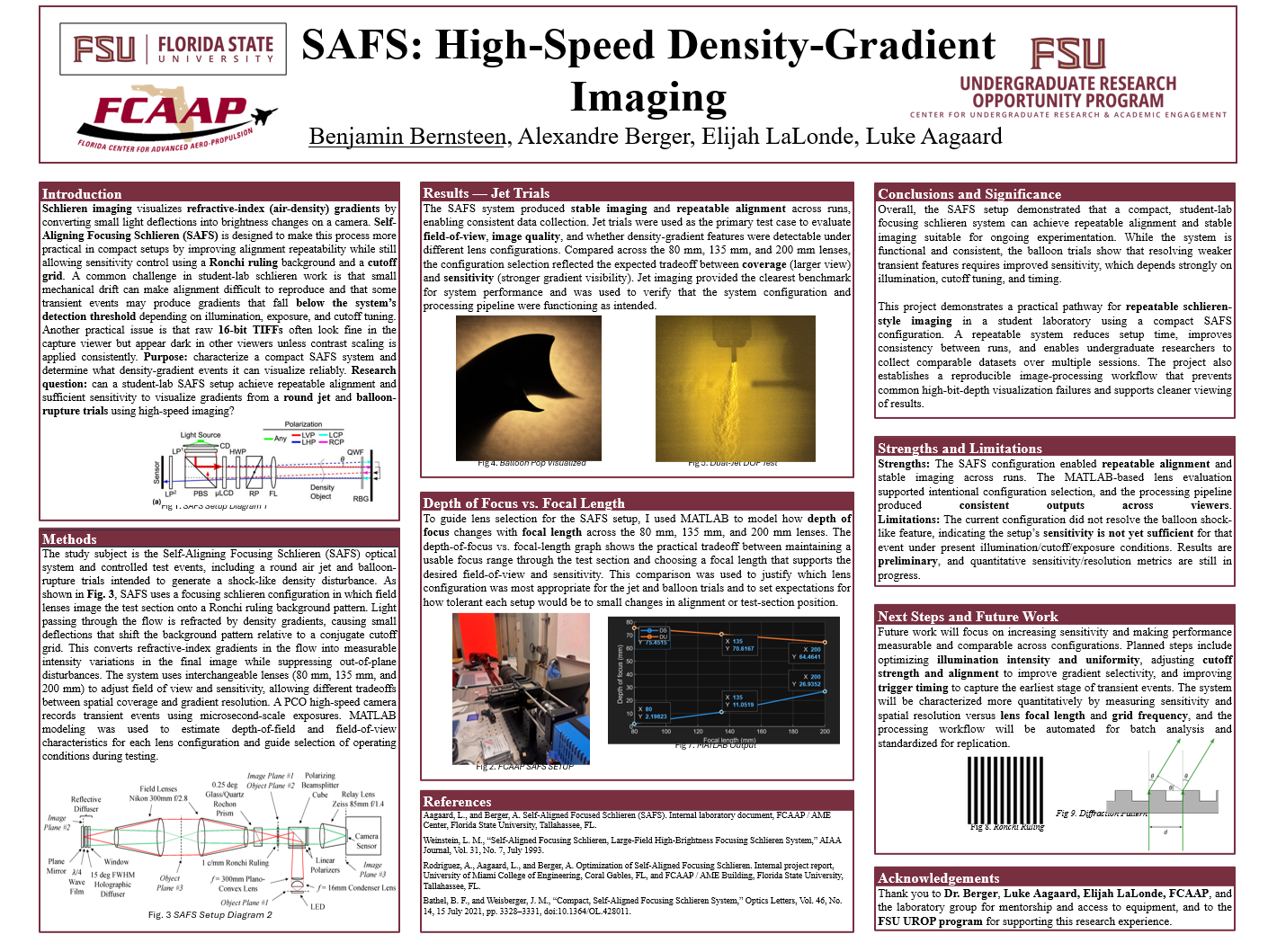
Schlieren photography is an imaging technique used to visualize refractive gradients in airflow. In this UROP project, we worked with a Self-Aligning Focusing Schlieren (SAFS) system in the FCAAP laboratory. Unlike traditional schlieren, SAFS is a focusing schlieren method, meaning it emphasizes gradients in a selected plane and suppresses out-of-plane content. This is especially useful for free-jet experiments because it can filter out undesirable background features such as tunnel-wall boundary layers or other out-of-plane disturbances that would otherwise make the image less usable. Using MATLAB and qualitative analysis, we examined several SAFS configurations with different lenses (80, 135, and 200 mm) and modeled their behavior in terms of focal length, field of view, and depth of field to optimize the balance between image sensitivity and field of view. We also used a MATLAB script to process the image output by converting the captured schlieren images into consistently scaled and labeled files, allowing clearer comparison across the different lens configurations. To further test the system’s sensitivity, we popped 12-inch black latex balloons in an attempt to capture a controlled shock. Throughout testing, the SAFS system produced consistently strong imaging performance, supporting its value as an experimental tool. However, the system did not detect a clear shock front during the balloon tests, which suggests that the density gradient was below the sensitivity threshold of the system. Overall, this project helped establish a foundation for future calibration and sensitivity optimization of the SAFS system.
Keywords: Aerospace, Engineering, Analysis