
Research Symposium
26th annual Undergraduate Research Symposium, April 1, 2026
Alivia Corral Poster Session 2: 10:45 am - 11:45 am / Poster #42
BIO
Alivia Corral is a 2nd year Psychology and Studio Art double major, minoring in Statistics. She conducts research under the Martin Lab with Danielle Jones as her mentor. She also works as a peer educator in the mental health advocacy program RENEW and plans to get a graduate degree in Counseling or Clinical Psychology.
“Oh No, Too Slow” the CRN as an Index of Performance Monitoring in Individuals with Alcohol Problems
Authors: Alivia Corral, Danielle JonesStudent Major: Psychology and Studio Art
Mentor: Danielle Jones
Mentor's Department: Psychology Department Mentor's College: Florida State University Co-Presenters:
Abstract
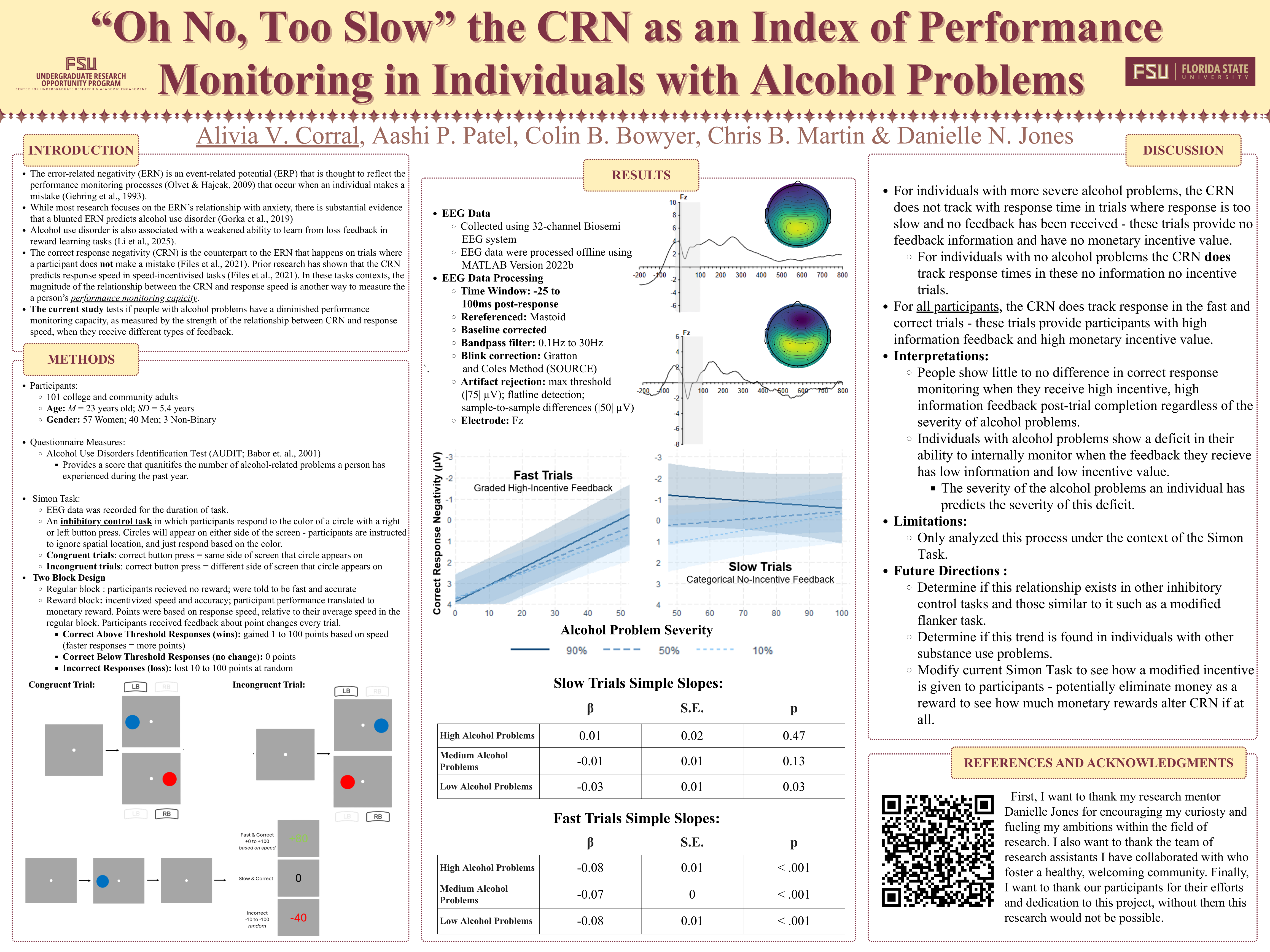
Correct Response Negativity (CRN) is an event related potential (ERP) that reflects an individual's “performance-monitoring process”, past data shows that CRN indexes response speed when fast responses are incentivized (Files et al., 2021), indicating that individuals are learning an implicit boundary regarding speed and accuracy. Current literature suggests that alcohol use disorder (AUD) is associated with problems in learning (Gorka et al., 2019). Our study aims to determine if people with alcohol problems show impaired performance-monitoring in a task with new implicit response-time boundaries. In the experiment participants fill out questions about alcohol use as a part of a larger questionnaire. They then perform a series of tasks during the EEG, this research focuses on the data obtained during the SIMON task. This task is broken into two sections, during the latter half the task boundaries are changed and external rewards are associated with performance. After data collection a three way interaction is performed revealing a correlation between individuals with alcohol problems and slower acquisition of new boundaries. As problems increased larger deficits in correct response monitoring were evident. The data shows impaired or delayed ability in individuals to error monitor and learn task boundaries once altered. The results of this study can be used to better predict and understand the downstream effects associated with alcohol problems.
Keywords: CRN Performance EEG Alcohol Problems