
Research Symposium
26th annual Undergraduate Research Symposium, April 1, 2026
Andrew Zhang Poster Session 1: 9:30 am - 10:30 am / Poster #59

BIO
Andrew is an Exercise Physiology second year hailing from Stillwater, Oklahoma. He is an aspiring physician hoping to provide high-quality and compassionate emergency care to rural populations. He is particularly interested in furthering the current scientific body in the realms of cardiac dysfunction treatment and traumatic wound treatment.
Nocturnal Blood Pressure Dipping Patterns In Young Adults With Preclinical Obesity
Authors: Andrew Zhang, Christin DomeierStudent Major: Exercise Physiology
Mentor: Christin Domeier
Mentor's Department: Department of Health, Nutrition, and Food Science Mentor's College: College of Education, Health, and Human Sciences Co-Presenters:
Abstract
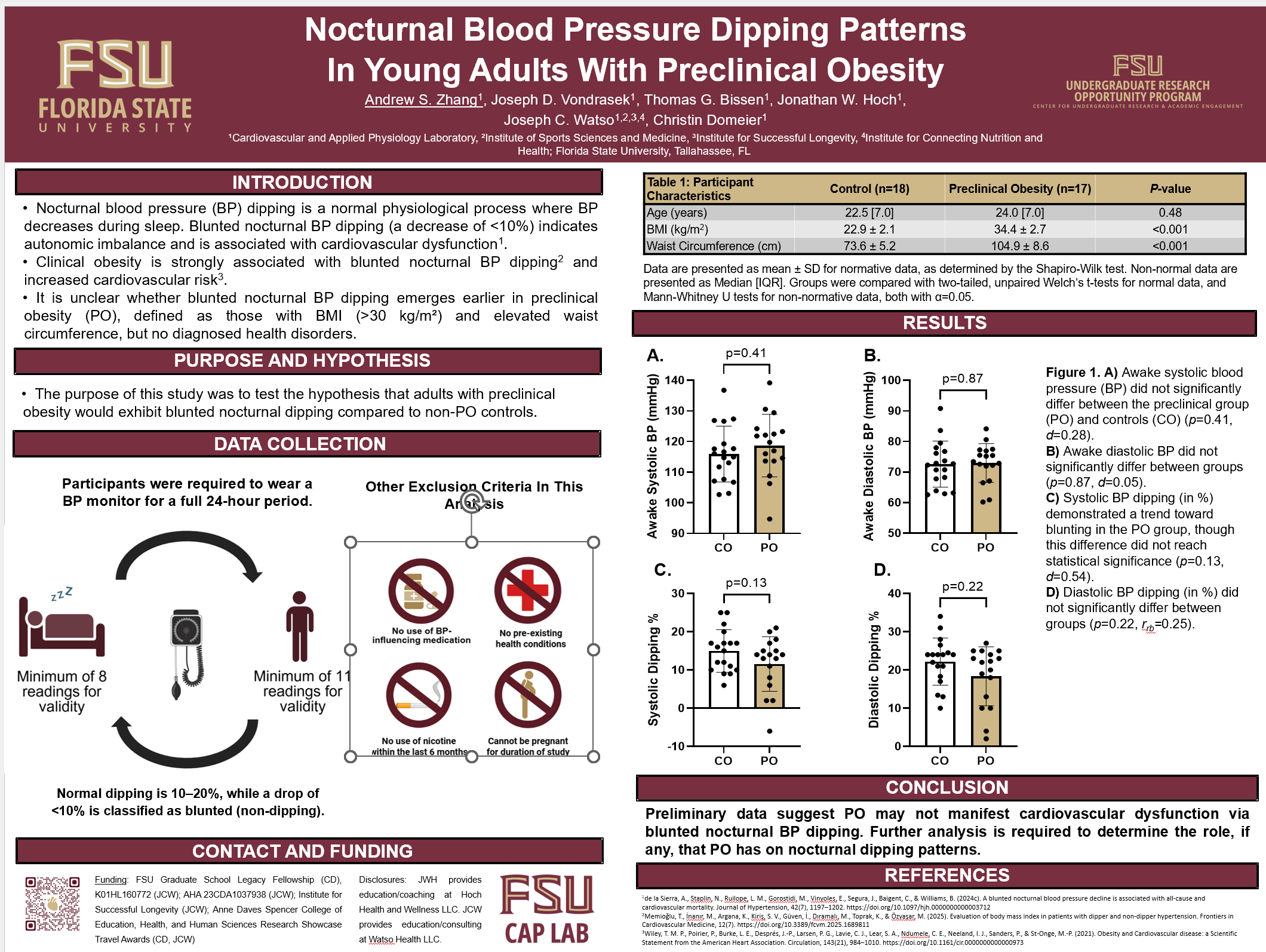
As global obesity rates rise, identifying early physiological precursors is crucial for proactive interventions. Clinical obesity is linked to blunted nocturnal blood pressure (BP) dipping (<10%), which is prognostic for greater all-cause and cardiovascular mortality. However, it remains unclear whether these patterns emerge in preclinical obesity (PO), defined as body mass index (BMI) 30-40 kg/m2 and elevated waist circumference, without chronic health conditions. We hypothesized that adults with PO have blunted nocturnal BP dipping.
We compared 24-hour ambulatory BP data between individuals with PO (n=17, 8 females, age: 24[7] years, BMI: 34±3 kg/m2, Waist: 105±9 cm) and without obesity (control; n=18, 7 females, age: 23[7.0] years, BMI: 23±2 kg/m2, Waist: 74±5 cm). Groups were compared using Welch’s t-tests (mean±SD; Cohen's d (d)) or Mann-Whitney U test (median[IQR]; rank biserial correlation (rbc)) based on normality.
Awake systolic BP (PO: 119±10 vs. control: 116±9 mmHg, p=0.41, d=0.28) and diastolic BP (PO: 73±6 vs. control: 72±7 mmHg, p=0.87, d=0.05) did not differ. However, PO exhibited significantly higher nocturnal systolic BP (PO: 105[11] vs. control: 99[7] mmHg, p=0.03, rbc=0.43) but not diastolic BP (PO: 59[8] vs. control: 55[7] mmHg, p=0.10, rbc=0.33). Systolic (PO: 12±7 vs. control: 15±6%; p=0.12; d=0.54) and diastolic BP dipping (PO: 22[11] vs. Lean: 24[5]%; p=0.22; rbc=0.25) were numerically, but not statistically, lower among participants with PO.
Data suggest PO may manifest with nonoptimal cardiovascular function via elevated nocturnal systolic BP, despite no differences in daytime BP readings. Larger groups are needed to understand whether PO is associated with altered dipping.
Keywords: Physiology, Cardiovascular, Exercise, Obesity