
Research Symposium
26th annual Undergraduate Research Symposium, April 1, 2026
Galatea Vodovozov Poster Session 3: 1:45 pm - 2:45 pm / Poster #299

BIO
Galatea Vodovozov is a junior Biochemistry major at FSU from Queens, New York City. Since Spring 2025, she has conducted research in the lab of Dr. Qian Yin at the Institute of Molecular Biophysics, studying adaptor protein complexes involved in vesicular trafficking. She also interns at Biotools Inc. and tutors Organic Chemistry and Calculus at the Academic Center for Excellence. After graduation, she plans to pursue a Doctor of Philosophy in Protein Biochemistry.
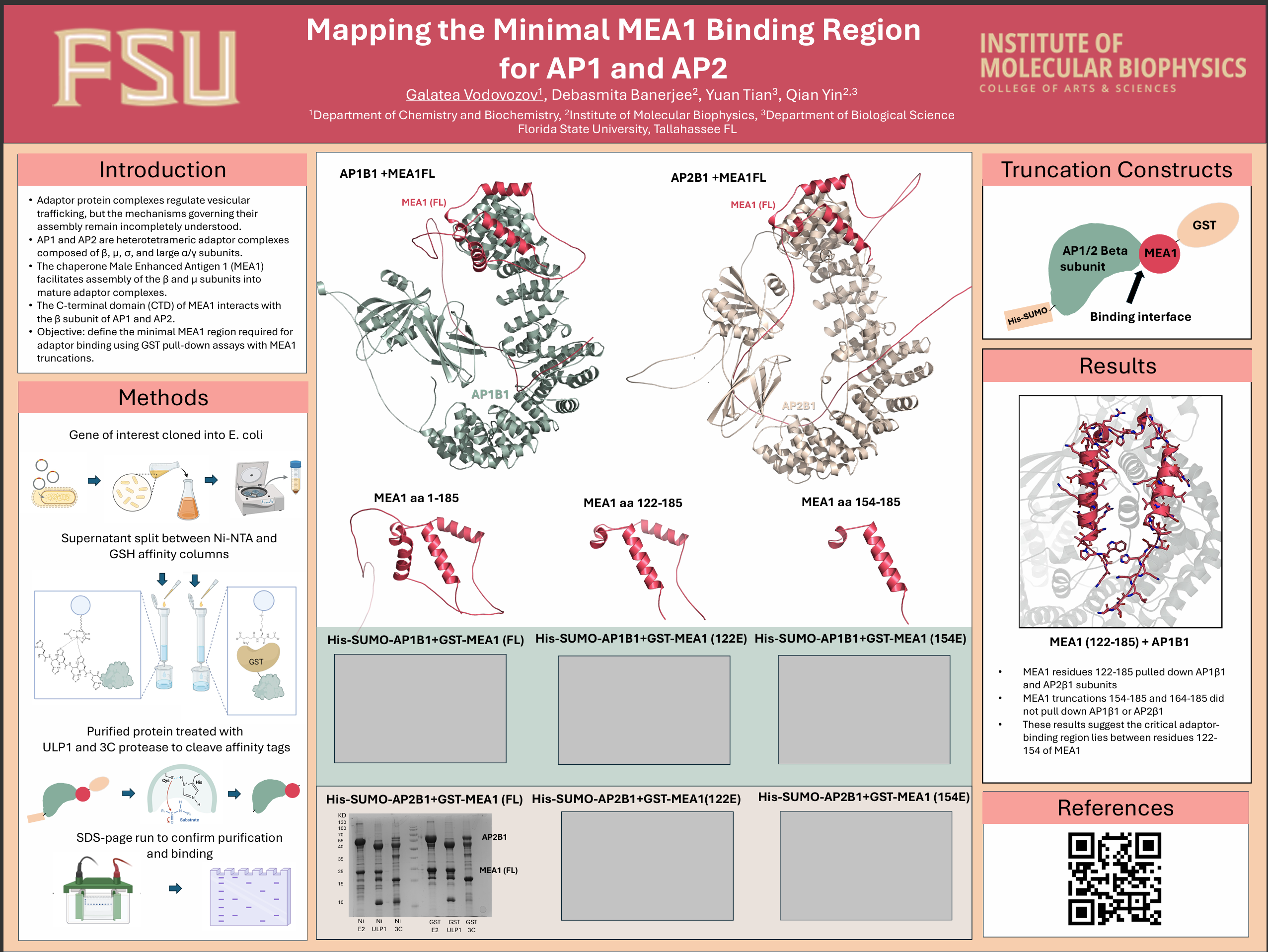
Mapping the Minimal MEA1 Binding region for AP1 and AP2
Authors: Galatea Vodovozov, Qian YinStudent Major: Biochemistry
Mentor: Qian Yin
Mentor's Department: Biological Science Mentor's College: Arts and Sciences Co-Presenters:
Abstract
Adaptor protein complexes are essential for vesicular trafficking, yet the mechanisms governing their assembly and stability remain incompletely understood. The chaperone protein Male Enhanced Antigen 1 (MEA1) is known to interact with β and μ subunits of adaptor protein complexes 1 and 2 (AP1 and AP2). The C-terminal region of MEA1 interacts with the β subunit, facilitating the assembly of mature heterotetrameric adaptor complexes. Previous studies demonstrated that MEA1 residues 122-185 retain binding to AP1β and AP2β. In order to further refine the minimal binding region, GST-tagged MEA1 truncations spanning residues 164-185 and from 154-185 were generated and co-expressed with His-SUMO-tagged AP1β and AP2β in E.Coli BL21 (DE3) RIPL using a T7 expression system. Following cell lysis and centrifugation, the supernatant was divided between GSH and Ni-NTA affinity columns to assess co-purification and confirm independent protein expression in absence of interaction. GST pulldown assays showed that MEA1 residues 122–185 co-purify with both AP1β1 and AP2β1 subunits, whereas truncations containing residues 154–185 or 164–185 did not retain detectable binding. These results indicate that the critical adaptor-binding region lies between residues 122 and 154 of MEA1.
Keywords: Biochemistry Structural-Biology Biophysics Protein