
Research Symposium
26th annual Undergraduate Research Symposium, April 1, 2026
Alex Burnside Poster Session 2: 10:45 am - 11:45 am / Poster #4

BIO
Alex is a sophomore pursuing a Bachelor of Science in Electrical Engineering with a minor in Computer Science. His academic interests include machine learning applications in cyber-physical systems, power system monitoring, and smart infrastructure. Alex is an undergraduate research assistant in the Cyber-Physical Machine Learning Lab at the Center for Advanced Power Systems. His research focuses on applying machine learning methods to detect and localize cyberattacks in smart energy systems. He has worked on projects involving anomaly localization in electric vehicle charging stations and attack detection in UAV networks. Through this work, he applies and evaluates both shallow and deep learning models to analyze system behavior using real-world data. Alex is also interested in technologies that support the transition to renewable energy and the modernization of power systems. His broader interests include the integration of hardware and software systems to improve the reliability of modern infrastructure.
Machine Learning-Based Detection of Cyberattacks Against UAVs
Authors: Alex Burnside, Abdulrahman TakiddinStudent Major: Electrical Engineering
Mentor: Abdulrahman Takiddin
Mentor's Department: Electrical & Computer Engineering Mentor's College: FAMU-FSU College of Engineering Co-Presenters:
Abstract
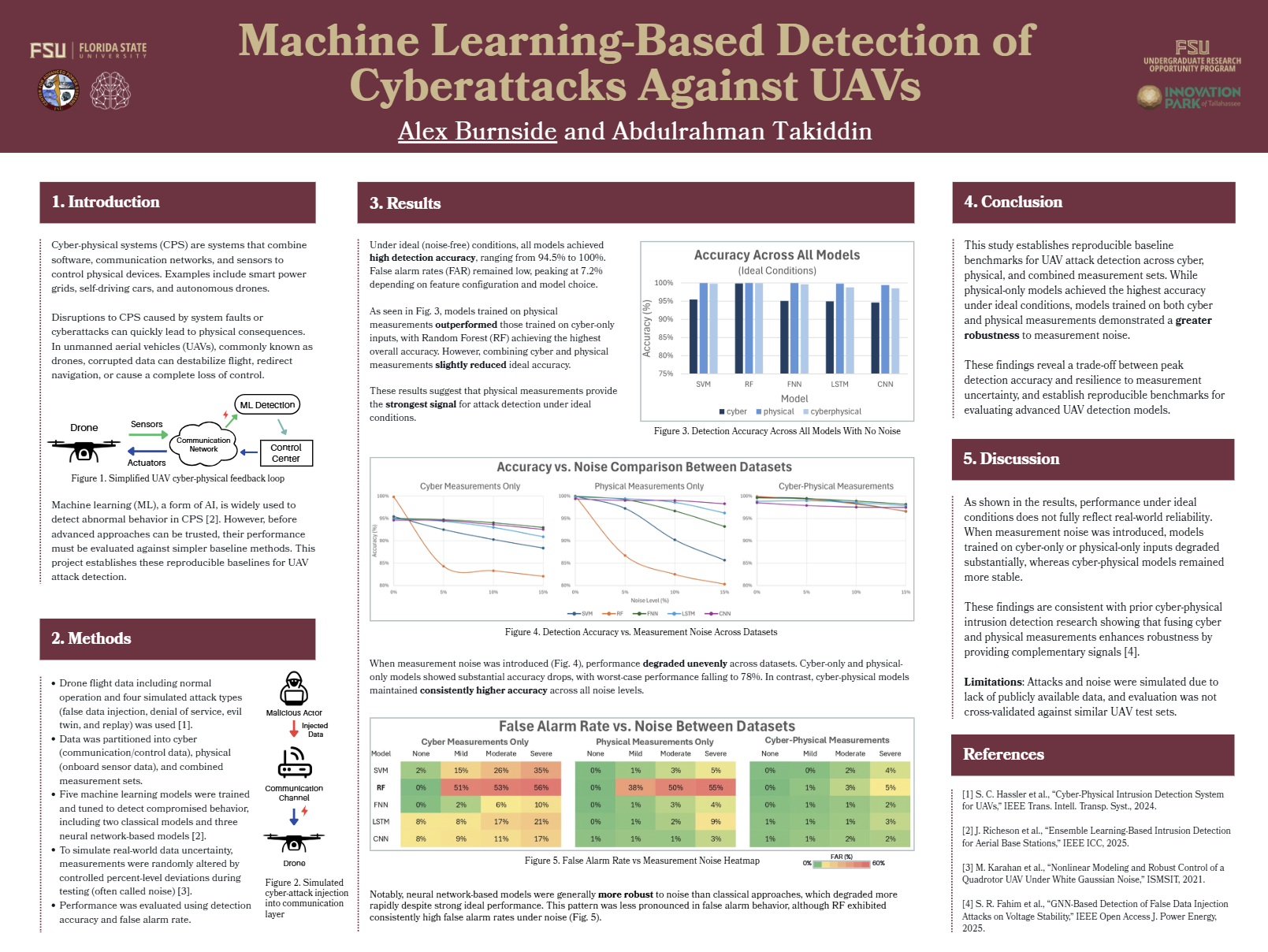
Unmanned aerial vehicles (UAVs), commonly known as drones, are now widely used for package delivery, infrastructure inspection, and emergency response. However, their reliance on network communication and onboard sensors for safe operation makes them vulnerable to both cyberattacks and physical disruptions. An estimated 40% of commercial UAV platforms contain at least one cyber-related vulnerability, highlighting the need for automated detection systems. This project evaluates the effectiveness of machine learning models for detecting compromised UAV behavior. Drone flight measurements containing normal operation and four simulated attack types, including false data injection, denial of service, evil twin, and replay attacks, were analyzed. The data was organized into three categories: cyber data from communication and control signals, physical data from onboard sensors, and a combined cyber-physical set. Five machine learning models, consisting of two classical and three neural network-based approaches, were trained and evaluated using detection accuracy and false alarm rate (FAR). Under ideal testing conditions, models trained on physical data performed best, achieving an average detection accuracy of 99.8% with FAR peaking at 0.7%. To better reflect real-world measurement uncertainty, controlled deviations from expected values, known as noise, were introduced during testing. As noise increased, performance declined unevenly across datasets; models trained on combined cyber-physical data maintained high performance, while single-measurement models degraded more rapidly. In summary, these findings establish reproducible baselines for UAV detection systems and highlight trade-offs between model performance and reliability.
Keywords: Machine Learning, Cyber-Physical Systems, Cybersecurity, Drones, Attack Detection