
Research Symposium
26th annual Undergraduate Research Symposium, April 1, 2026
Luke Isham Poster Session 2: 10:45 am - 11:45 am / Poster #230

BIO
Motivated Biological Sciences major at Florida State University with a strong foundation in math, science, and chemistry, expected to graduate in May 2027. Experienced in laboratory settings, currently working as a research lab assistant. Hands-on background in animal rehabilitation, environmental education, and community outreach, complemented by work experience in customer service and lifeguarding and as a licensed emergency medical technician. Multiple academic honors and dedicated to pursuing opportunities in scientific research and the medical field, while bringing strong interpersonal, organizational, and problem-solving skills to every role.
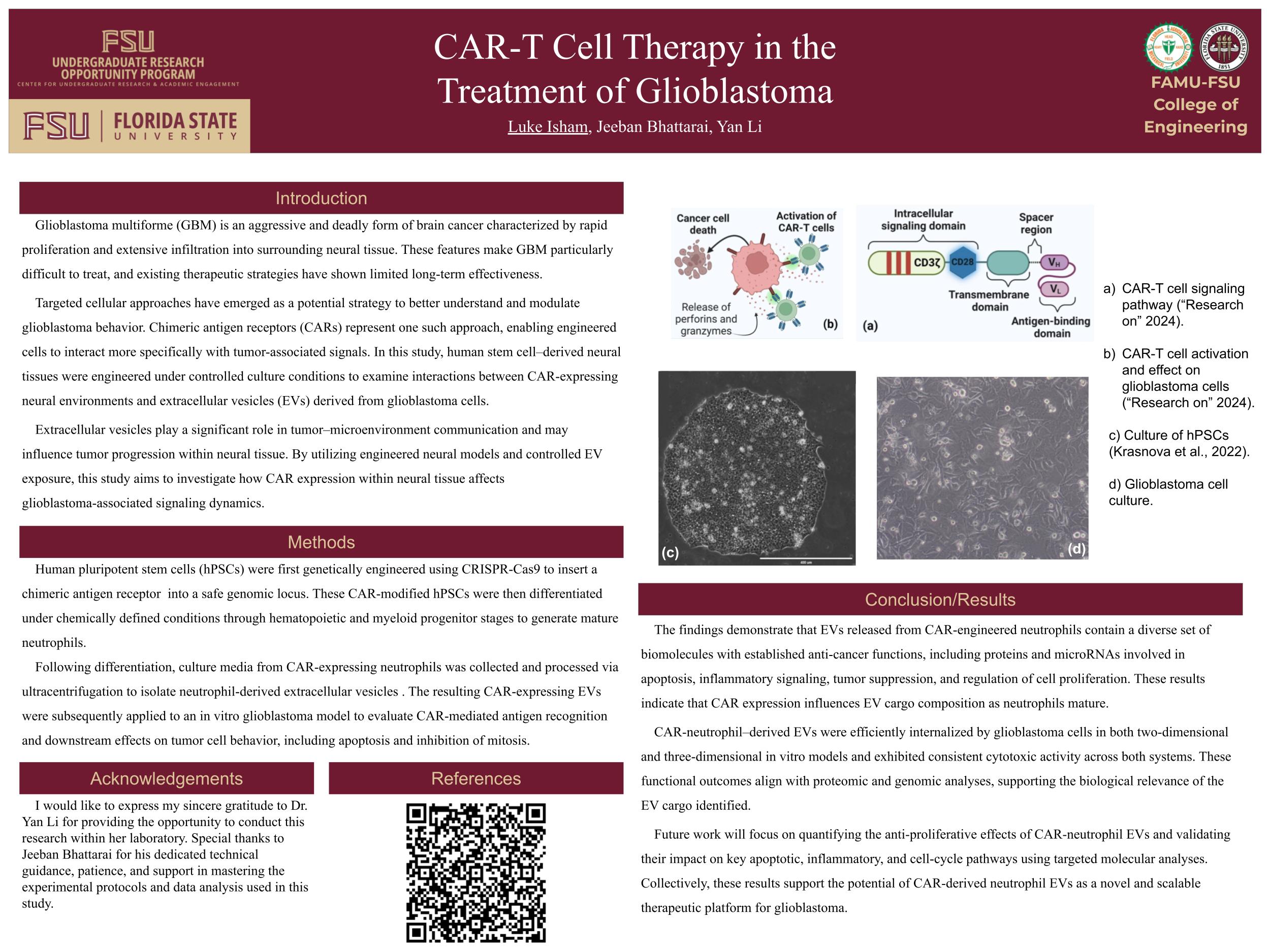
CAR-T Cell Therapy in the Treatment of Glioblastoma
Authors: Luke Isham, Jeeban BhattaraiStudent Major: Pre-Biological Science
Mentor: Jeeban Bhattarai
Mentor's Department: Biomedical Engineering Mentor's College: FAMU-FSU College of Engineering Co-Presenters:
Abstract
Glioblastoma is an aggressive and deadly form of brain cancer that remains difficult to treat due to its rapid proliferation and infiltration of surrounding neural tissue. Despite extensive research, most experimental treatments have demonstrated limited long-term success. Evidence suggests that the progression of glioblastoma may be slowed through targeted cellular interventions. One potential strategy is to use chimeric antigen receptors (CARs) in neural cells to inhibit tumor spread. Extracellular vesicles (EVs) released by glioblastoma cells were isolated and introduced into engineered neural tissue models. Two sets of neural tissue were generated from human stem cells using fibroblast growth factor-2 (FGF-2). One group received an additional growth factor to induce increased CAR expression. A controlled culture framework allowed EVs to be collected separately, ensuring complete neural maturation before exposure. Neural tissues were cultured for 45 days in nutrient-rich conditions prior to treatment. Following exposure to glioblastoma-derived EVs, neural tissues with elevated CAR expression exhibited a slower rate of tumor spread compared to controls. The findings suggest that CAR expression may help limit glioblastoma progression. Further research is necessary to optimize CAR design, improve therapeutic efficacy, and evaluate minimally invasive delivery methods for future clinical application.
Keywords: Glioblastoma, Chimeric Antigen Receptors, Cancer Research