
Research Symposium
26th annual Undergraduate Research Symposium, April 1, 2026
Maia Merkel-Leavitt Poster Session 4: 3:00 pm - 4:00 pm / Poster #276

BIO
Maia Merkel-Leavitt is a Pre-Law student pursuing dual degrees in Political Science and Psychology. Her on-and off-campus involvements include competitive team member of FSU Mock Trial, Outreach Leadership and Moderator in Political Discourse Club, Undergraduate Research Opportunity Program.
Analyzing Trends in U.S. Hate Crime Legislation
Authors: Maia Merkel-Leavitt, Matthew Vanden BoschStudent Major: Political Science, Psychology
Mentor: Matthew Vanden Bosch
Mentor's Department: College of Criminology and Criminal Justice Mentor's College: College of Criminology and Criminal Justice Co-Presenters: Eva Morris
Abstract
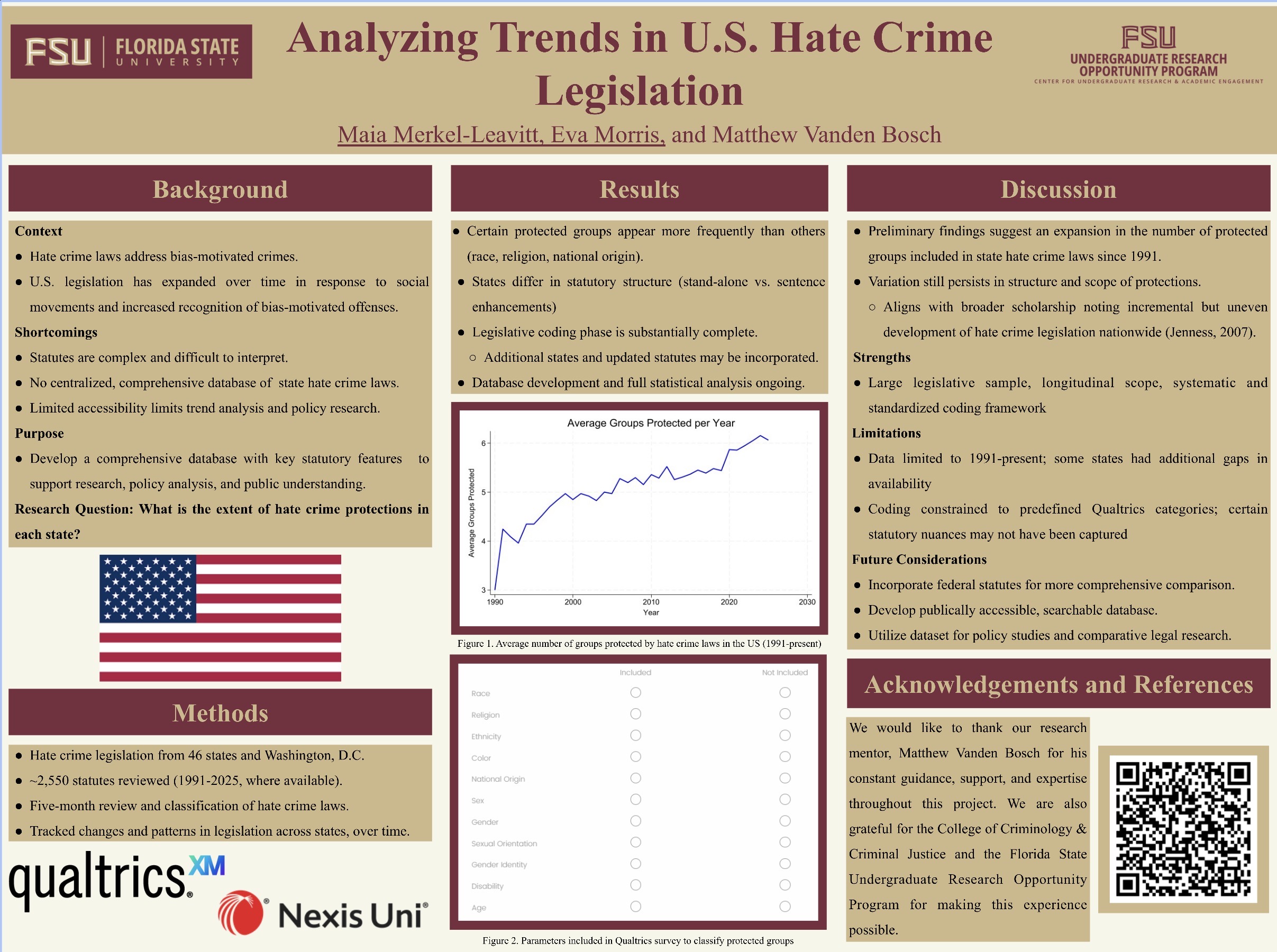
This research examines the extent of hate crime protections across the United States. Because hate crime legislation is primarily determined at the state level, protections vary significantly across jurisdictions. To better understand these differences, this project asks: “What is the extent of hate crime protections in each state?” The study aims to improve accessibility and understanding of hate crime legislation by developing a comprehensive database of state statutes for which legislative data were available. Over a five-month period, approximately 2,550 pieces of legislation from 46 states and the District of Columbia were identified using LexisNexis and systematically reviewed. Available statutory data generally spanned 1991–2025. Each statute was coded using a structured Qualtrics survey instrument that captured key variables, including state, legislative identifier, year of enactment, protected groups, crime severity and punishment, sentence enhancements, and relevant statutory language. This categorical coding framework allowed legislation to be compared across states and tracked over time. Findings indicate substantial variation in both the structure and scope of state hate crime laws. Some states rely primarily on sentence-enhancement provisions, while others establish stand-alone offenses. The number and types of protected groups also vary widely across jurisdictions. The resulting dataset provides a foundation for a publicly accessible database that can support legal research, policy analysis, and public understanding of hate crime legislation. Future work will expand the dataset, incorporate additional statutes, and update the database as laws evolve.
Keywords: Hate crime, law, criminology, database