
Research Symposium
26th annual Undergraduate Research Symposium, April 1, 2026
Samantha Eckert Poster Session 3: 1:45 pm - 2:45 pm / Poster #6

BIO
Samantha is a first-year student at Florida State University studying biochemistry, with a planned double major in public health. She intends to work in the medical field with a particular interest in studying as a pharmacologist, physician, or physician's assistant. She is excited to explore these potential careers through research opportunities and job shadowing in addition to coursework.
Measuring enzyme catalysis with integration of lipid additives
Authors: Samantha Eckert, Steven LenhertStudent Major: Biochemistry
Mentor: Steven Lenhert
Mentor's Department: Biological Science Mentor's College: Arts and Sciences Co-Presenters: Evan Lorenz, John McAlvin, Jackie Moss, Tyler Albanese
Abstract
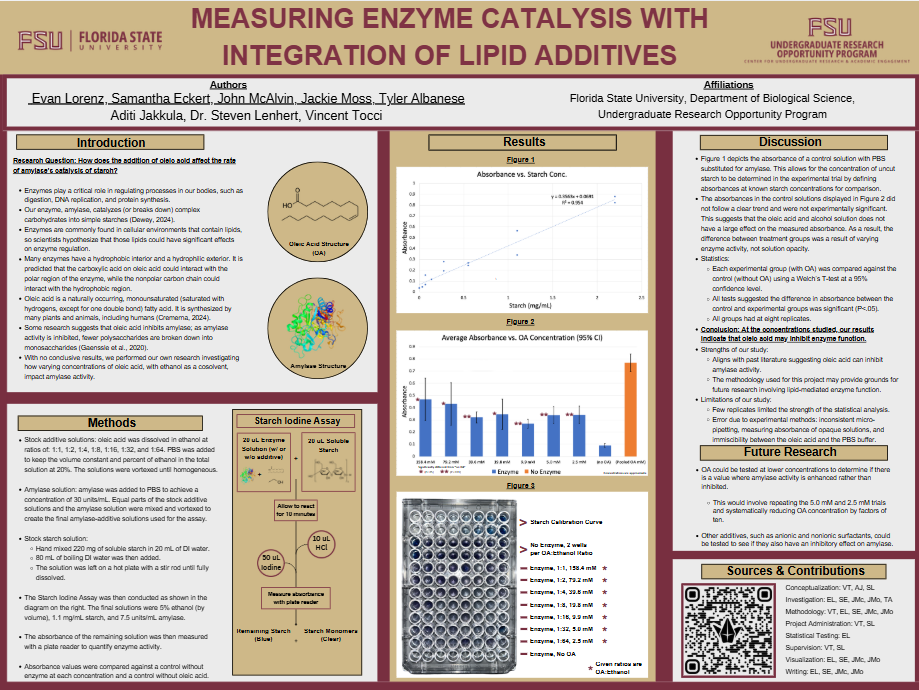
Lipids have been typically associated with the inhibition of enzyme function, but recent findings point towards their potential in increased catalysis rates. Enzymes are protein catalysts that speed up chemical reactions and play a critical role in regulating processes in our bodies, such as digestion. It is important to better understand enzyme activity, specifically how different conditions and chemicals affect them. Our research question aims to analyze the effect that oleic acid, a lipid, has on enzyme activity, specifically the activity of amylase. A preliminary literature review was conducted to determine ideal conditions and methods of amylase reactivity. Enzyme function was then tested by comparing various concentrations of oleic acid to the control group without an additive. Ethanol was used as a cosolvent with the oleic acid. Light absorbance of the sample was then measured with a plate reader to obtain quantitative data. When enzyme was added, there was an observed trend that as the ratio of oleic acid decreased, enzyme activity increased. Specifically between the 1:64 ratio of oleic acid:alcohol, there is a large difference between the absorbance values. Our research was limited by a small sample size and experimental error, such as inconsistent micro-pipetting, measuring opaque solutions in the plate reader, and immiscibility of solutions. Further research would include more trials with smaller concentrations of oleic acid which would work to minimize some of these concerns. This may introduce an unexpected increase in amylase activity, instead of the respective decrease exhibited in this research.
Keywords: Enzyme, Catalysis, Lipid